 Tech Volt Lab Automation | PLC | SCADA | Electrical | Electronics

Related Articles

A Torque Calculator helps engineers, electricians, machine designers, maintenance technicians, automation professionals, and students calculate the turning force produced by a motor, shaft, gearbox, lever, pulley, or rotating drum. Depending on the selected method, torque can be calculated from force and radius or from mechanical power and rotational speed. Torque is one of the most important values in rotating machinery. A motor may have enough power for a process but still fail to start the load if its available starting torque is too low. Excessive torque can damage shafts, couplings, keys, bearings, gearboxes, belts, and driven equipment.
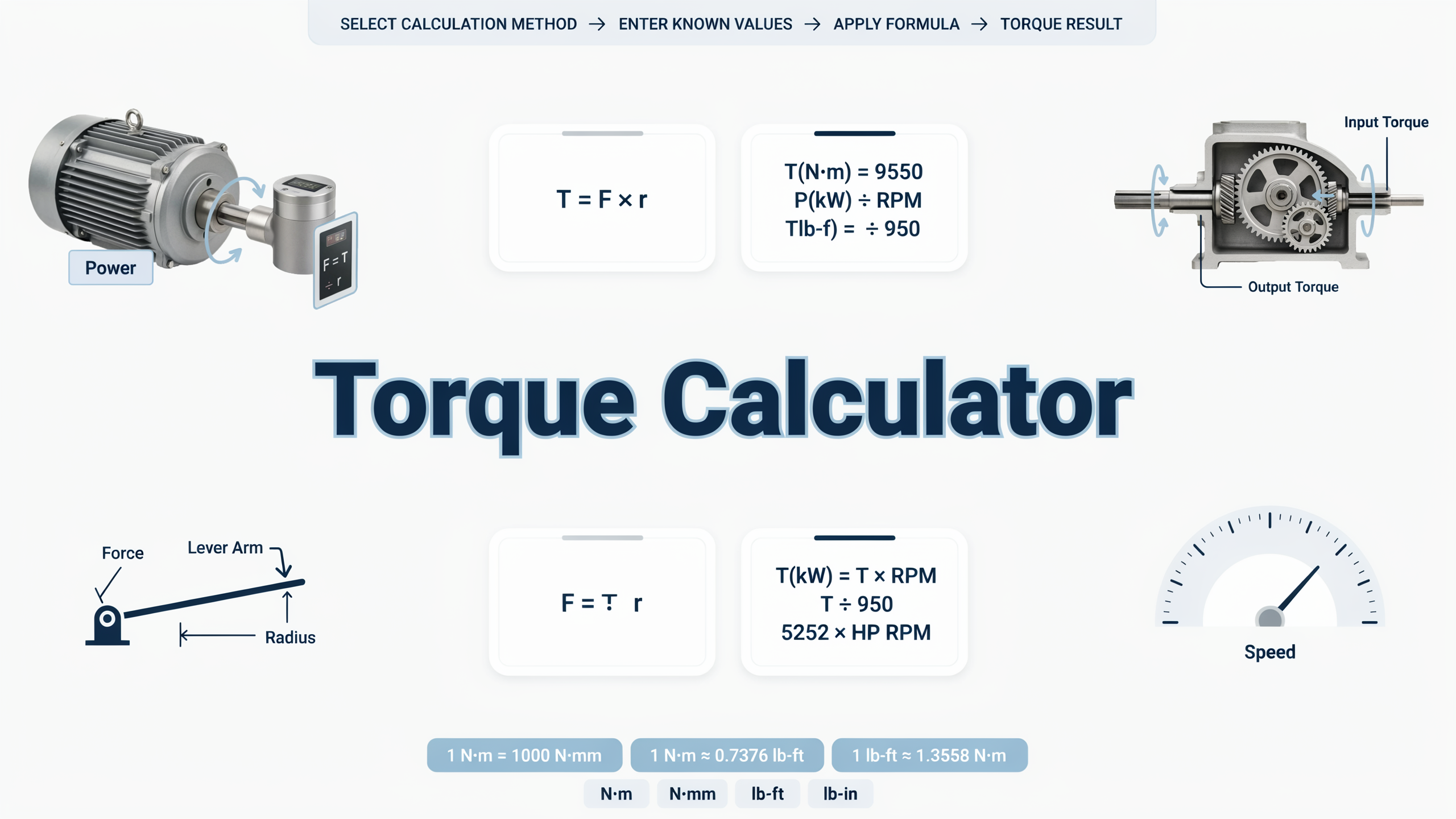
This guide explains the main torque formulas, units, motor and gearbox calculations, practical examples, and common selection mistakes. The calculated result should be compared with the equipment manufacturer’s torque-speed data, service factor, duty cycle, acceleration requirement, and actual operating conditions.
What Is a Torque Calculator?
A Torque Calculator is an engineering tool used to determine the rotational effect of a force around an axis. In the SI system, torque is normally expressed in newton metres (N·m). Other commonly encountered units include pound-feet (lb-ft), pound-inches (lb-in), kilogram-force metres (kgf·m), and newton centimetres (N·cm).
For a lever or shaft, torque depends on the applied force, the distance from the axis, and the angle at which the force is applied. For a rotating motor, torque can be calculated from mechanical output power and shaft speed. At a fixed power, available torque increases as rotational speed decreases.
A torque calculation is useful when selecting motors, gearboxes, couplings, brakes, shafts, pulleys, sprockets, conveyors, mixers, winding systems, and lifting mechanisms. However, normal running torque is only one part of the design; starting torque, breakaway torque, acceleration torque, shock loading, and emergency stopping must also be considered.
How Does a Torque Calculator Work?
The calculator applies a formula based on the information entered by the user. If force and lever length are known, it calculates the turning moment about the shaft. If motor power and RPM are known, it calculates the average mechanical torque available at that operating point.
- Select the required torque calculation method.
- Enter mechanical power and RPM for motor torque.
- Enter force, radius, and angle for lever torque.
- Enter gear ratio and efficiency for gearbox output torque.
- Select the correct input and output units.
- Calculate the torque value.
- Compare the result with rated, starting, and peak torque requirements.
The result represents torque for the stated operating condition. A motor does not necessarily produce the same torque at every speed, and a gearbox cannot multiply torque without losses. Final selection requires the complete torque-speed profile and the driven machine’s load characteristics.
Step-by-Step Process
- Identify the shaft or mechanical component where torque is required.
- Decide whether torque will be calculated from force, power, or gear ratio.
- Enter the applied force and perpendicular lever distance when using the force method.
- Enter mechanical output power and actual shaft RPM when calculating motor torque.
- Enter gearbox ratio and estimated efficiency when calculating output torque.
- Convert all inputs into compatible units.
- Calculate the expected running torque.
- Determine whether starting, acceleration, braking, or shock torque is higher.
- Apply the equipment manufacturer’s service and application factors.
- Confirm that the motor, gearbox, coupling, shaft, and driven machine can withstand the required torque.
Torque Calculator Formula
Torque from Force and Radius
T = F × r × sin(θ)
This formula calculates torque when a force acts at a distance from the axis of rotation. The angle θ is measured between the lever arm and the applied force direction. Maximum torque is produced when the force acts perpendicular to the lever arm.
Torque with Perpendicular Force
T = F × r
When the force acts at 90 degrees to the lever arm, sin(90°) equals 1. The torque is therefore the applied force multiplied by the perpendicular distance from the axis.
Motor Torque from Kilowatts and RPM
T = (9550 × P) ÷ N
This formula calculates motor shaft torque in N·m when mechanical output power is entered in kilowatts and rotational speed is entered in RPM. The actual nameplate speed should be used instead of synchronous speed when calculating rated induction-motor torque.
Torque from Horsepower and RPM
Tlb-ft = (5252 × HP) ÷ RPM
This relationship produces torque in pound-feet when mechanical horsepower and RPM are used. Unit systems should not be mixed within the same formula.
Mechanical Power from Torque and RPM
P = (T × N) ÷ 9550
This rearranged equation calculates mechanical shaft power in kilowatts from torque in N·m and speed in RPM.
Gearbox Output Torque
Tout = Tin × i × η
A speed-reducing gearbox increases output torque approximately in proportion to its ratio, but some power is lost through friction and other mechanical effects. Gearbox efficiency must be expressed as a decimal, such as 0.90 for 90%.
Output Speed after Gear Reduction
Nout = Nin ÷ i
For a reduction ratio greater than 1, the output shaft rotates more slowly than the input shaft. Torque increases while speed decreases, subject to mechanical losses and the gearbox’s permitted output torque.
Torque Required at a Drum or Pulley
T = Flinear × r
The linear pulling force at the surface of a drum or pulley is multiplied by the effective radius. Use the operating radius, including any belt, rope, material, or wound product that changes the effective diameter.
Linear Force from Shaft Torque
Flinear = T ÷ r
This equation calculates the theoretical tangential force available at the surface of a pulley, sprocket, wheel, or drum. Transmission and contact losses can reduce the usable force.
Acceleration Torque
Tacc = J × α
Acceleration torque depends on total rotational inertia and required angular acceleration. The motor must provide both the steady load torque and the torque required to accelerate the motor, transmission, and driven load.
Total Required Torque
Trequired = Tload + Tacc + Tloss
The complete requirement can include steady process torque, acceleration torque, friction, transmission losses, and other resisting forces. Shock or breakaway loads may require a separate peak-torque check.
Formula Explanation
| Symbol | Description |
|---|---|
| T | Torque in newton metres (N·m) |
| F | Applied force in newtons (N) |
| r | Perpendicular lever arm or effective radius in metres |
| θ | Angle between the lever arm and applied force |
| P | Mechanical shaft power in kilowatts (kW) |
| N | Rotational speed in revolutions per minute |
| HP | Mechanical power in horsepower |
| Tin | Torque applied to the gearbox input shaft |
| Tout | Torque available at the gearbox output shaft |
| i | Gearbox speed-reduction ratio |
| η | Gearbox or transmission efficiency as a decimal |
| Flinear | Tangential or linear force in newtons |
| J | Total rotational moment of inertia in kg·m² |
| α | Angular acceleration in rad/s² |
Common Torque Unit Conversions
| Conversion | Equivalent Value |
|---|---|
| 1 N·m | 0.73756 lb-ft |
| 1 lb-ft | 1.35582 N·m |
| 1 N·m | 8.85075 lb-in |
| 1 lb-in | 0.11298 N·m |
| 1 kgf·m | 9.80665 N·m |
| 1 N·cm | 0.01 N·m |
Interactive Torque Calculator
Use the calculator below to calculate motor, shaft, lever, gearbox, pulley, or drum torque from power, RPM, force, radius, gear ratio, and efficiency.
⚡ Torque Calculator
Calculate torque from motor power and RPM or from force and lever-arm radius.
Torque Result
Enter values and press Calculate.
Motor torque: T (N·m) = 9550 × P(kW) ÷ RPM
Lever torque: T = r × F × sin(θ)
Example 1 – Rated Torque of a 7.5 kW Motor
Given:
- Motor mechanical output power = 7.5 kW
- Rated shaft speed = 1,450 RPM
T = (9550 × 7.5) ÷ 1,450
T ≈ 49.40 N·m
The motor’s calculated rated shaft torque is approximately 49.40 N·m. Because the 7.5 kW nameplate value normally represents rated mechanical output, motor efficiency is not applied again. Starting, pull-up, breakdown, and VFD-controlled torque must be checked separately using manufacturer data.
Example 2 – Torque Applied to a Lever
Given:
- Applied force = 250 N
- Perpendicular distance from the axis = 0.40 m
- Force angle = 90°
T = 250 × 0.40
T = 100 N·m
A perpendicular force of 250 N applied 0.40 m from the axis produces 100 N·m of torque. Moving the force closer to the axis or applying it at a non-perpendicular angle reduces the turning effect.
Example 3 – Torque from Force and Radius
A tangential force of 500 N applied at a radius of 0.20 m produces 100 N·m of torque. Select Force and Radius, enter the values with a 90° angle, and calculate.
Practical Field Considerations for Torque Calculations
Rated motor torque should not be confused with starting or peak torque. A conveyor, mixer, compressor, or loaded screw may require much more torque during startup than during normal running. The motor and drive system must produce sufficient torque throughout acceleration, not only after reaching operating speed.
Breakaway torque is the torque needed to start a stationary load moving. Seals, dried product, static friction, material compaction, and long shutdown periods can make breakaway torque significantly higher than normal running torque. Direct measurement or machine-manufacturer data may be necessary.
A VFD can control motor speed and torque, but available torque depends on motor type, drive rating, control method, cooling, frequency, current limit, and programmed motor data. A standard self-cooled motor may overheat when delivering continuous rated torque at low speed because its shaft-mounted fan is turning slowly.
Gearbox ratio increases torque but reduces speed. Mechanical efficiency, gearbox service factor, radial load, axial load, output-shaft capacity, and lubrication must be checked. Selecting a gearbox only from its ratio can lead to premature gear, bearing, or shaft failure.
For winding and unwinding machines, effective radius changes as material accumulates or is removed. The torque required to maintain constant web tension therefore changes continuously, even when linear tension remains constant.
Applications of a Torque Calculator
Industrial Applications
- Conveyors and material-handling equipment
- Mixers, agitators, and extruders
- Pumps, compressors, and fans
- Winders, unwinders, and tension systems
- Hoists, lifts, and rotating tables
Electrical and Automation Applications
- Electric motor selection
- VFD and servo-drive sizing
- Torque-control applications
- Motor load monitoring
- Acceleration and deceleration planning
Mechanical Applications
- Gearbox and coupling selection
- Shaft and key calculations
- Pulley, sprocket, and drum design
- Lever and handwheel calculations
- Brake and clutch evaluation
Advantages of a Torque Calculator
- Calculates torque from force, power, or gear ratio.
- Supports motor and mechanical-load calculations.
- Reduces repeated unit conversions.
- Helps compare motor and gearbox options.
- Calculates drum and pulley force relationships.
- Supports preliminary drive-system sizing.
- Helps explain the relationship between power, speed, and torque.
Limitations
- A basic calculation may represent only steady running torque.
- Starting and breakaway torque require separate checks.
- Shock loading can exceed calculated average torque.
- Gearbox and transmission losses vary with operating conditions.
- Acceleration torque requires accurate inertia information.
- Motor torque changes across its speed range.
- Final selection requires manufacturer torque-speed data.
Common Mistakes
- Using electrical input power instead of mechanical output power.
- Using synchronous speed instead of actual motor RPM.
- Mixing N·m with lb-ft or lb-in.
- Using diameter instead of radius.
- Ignoring the angle of the applied force.
- Assuming a gearbox is 100% efficient.
- Ignoring breakaway and acceleration torque.
- Applying motor rated torque as unlimited peak torque.
- Ignoring changes in winding-drum radius.
- Selecting a gearbox from ratio alone.
Rotational speed can be checked with the RPM Calculator. If motor power is listed in kilowatts, convert it with the kW to HP Calculator before comparing torque.
Frequently Asked Questions
What is a Torque Calculator?
A Torque Calculator determines rotational force from values such as applied force, radius, mechanical power, RPM, gearbox ratio, and transmission efficiency.
What is the SI unit of torque?
The SI unit of torque is the newton metre, written as N·m. It represents one newton of perpendicular force applied one metre from the rotation axis.
How do I calculate motor torque from kW and RPM?
Multiply mechanical output power in kW by 9,550 and divide the result by actual shaft speed in RPM.
Does lower motor speed produce more torque?
At the same mechanical power, calculated torque increases as speed decreases. Actual motor capability still depends on its torque-speed curve, current, cooling, and drive control.
Does a gearbox increase torque?
A reduction gearbox increases output torque while reducing output speed. The actual increase is lower than the ideal ratio because of mechanical losses.
What is the difference between running and starting torque?
Running torque maintains motion after the machine reaches operating speed. Starting torque is required to overcome static resistance and begin accelerating the stationary load.
How is pulley force calculated from torque?
Divide shaft torque by the pulley’s effective radius. The result is the theoretical tangential force at the pulley surface.
Is calculated torque enough for final motor selection?
No. Final selection should include breakaway torque, acceleration, duty cycle, shock load, service factor, speed range, temperature, cooling, and manufacturer data.
Related Engineering Calculators
- RPM Calculator
- Motor Current Calculator
- kW to HP Calculator
- Power Calculator
- Gear Ratio Calculator
- Pulley Speed Calculator
Helpful Engineering Resources
Conclusion
A Torque Calculator provides a practical way to calculate the torque of motors, shafts, gearboxes, levers, pulleys, and drums. It shows how applied force, effective radius, mechanical power, RPM, ratio, and efficiency affect the turning force available in a machine.
A reliable drive-system design must consider more than steady running torque. Starting resistance, acceleration, inertia, friction, shock loading, duty cycle, speed range, gearbox losses, and thermal limits can substantially increase the actual requirement.
Tech Volt Lab provides practical electrical, mechanical, and automation calculators for engineers, electricians, PLC technicians, maintenance professionals, and students. Use the calculated result as an initial engineering reference and verify critical torque values against manufacturer data and actual machine conditions.
Explore More Engineering Calculators
Discover more free electrical and automation calculators designed for electricians, PLC programmers, maintenance technicians, and engineers.
View All Calculators