 Tech Volt Lab Automation | PLC | SCADA | Electrical | Electronics

Related Articles

A Motor Current Calculator is an essential engineering tool that helps electricians, maintenance technicians, PLC programmers, automation engineers, and students calculate the full-load current (FLA) of electric motors accurately. Instead of performing lengthy manual calculations, this calculator instantly determines the expected motor current from power, voltage, power factor, and efficiency. Accurate motor current calculations are important when selecting cables, circuit breakers, contactors, overload relays, VFDs, soft starters, MCC panels, and electrical protection devices. Selecting incorrect current values can lead to overheating, nuisance tripping, voltage drop, or equipment damage.
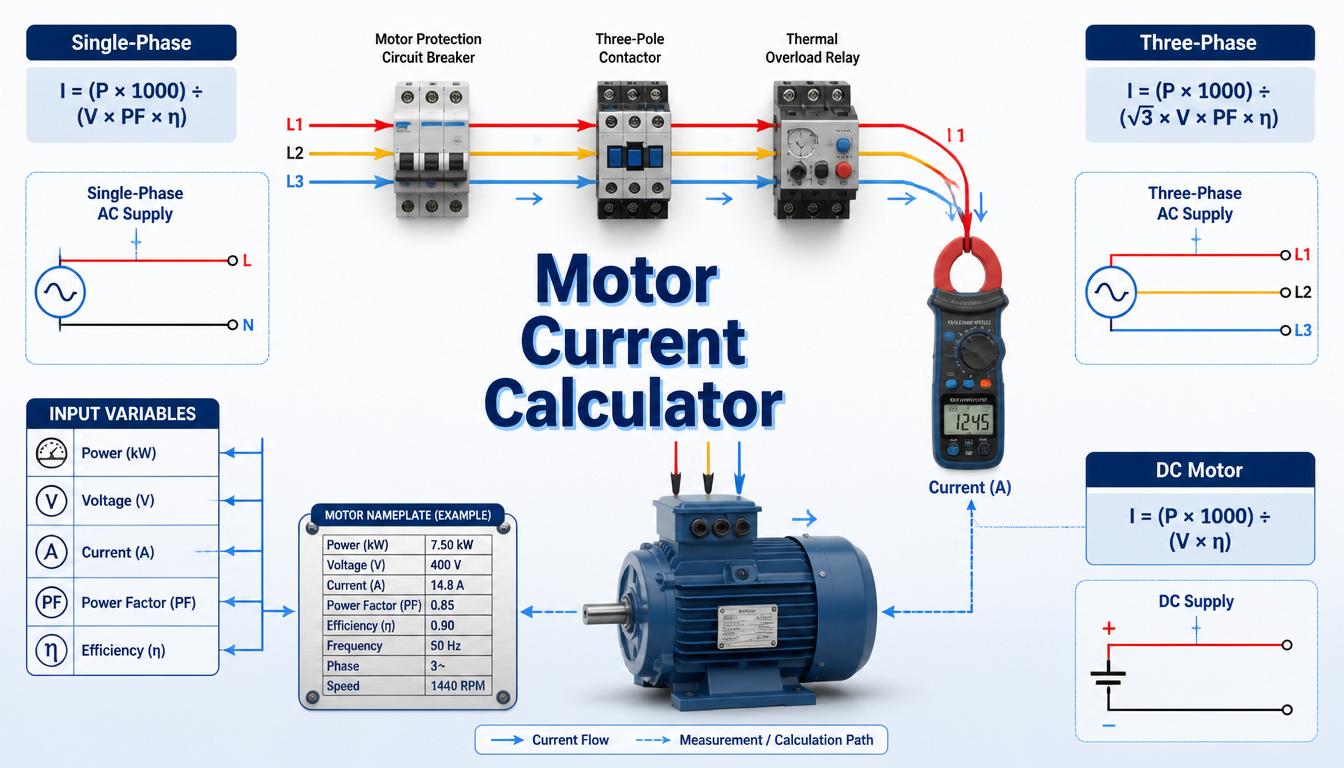
This guide explains how a Motor Current Calculator works, the formulas used for both single-phase and three-phase motors, practical engineering examples, and common mistakes to avoid in industrial electrical systems.
What Is a Motor Current Calculator?
A Motor Current Calculator is an electrical engineering tool used to calculate the expected full-load current (FLA) of an AC motor. By entering the motor power, supply voltage, efficiency, and power factor, the calculator quickly determines the motor’s current during normal operation.
This calculation is widely used during electrical design, motor installation, maintenance, troubleshooting, and industrial automation projects. Engineers rely on motor current calculations to correctly size electrical components and ensure safe operation.
The calculator supports both single-phase and three-phase induction motors, making it suitable for residential, commercial, and industrial applications.
How Does a Motor Current Calculator Work?
The calculator applies standard electrical engineering formulas based on motor type.
- Enter motor power (kW or HP).
- Select single-phase or three-phase.
- Enter supply voltage.
- Enter power factor.
- Enter motor efficiency.
- Click Calculate.
The calculator instantly determines the expected Full Load Current (FLA), reducing manual calculations and improving engineering accuracy.
Step-by-Step Process
- Select the motor type (Single Phase or Three Phase).
- Enter motor power.
- Enter supply voltage.
- Enter motor efficiency.
- Enter power factor.
- Click the Calculate button.
- The calculator displays the Full Load Current (FLA).
- Use the calculated value for cable sizing, breaker selection, overload relay settings, and protection design.
Motor Current Calculator Formula
Three-Phase Motor
I = (P × 1000) ÷ (√3 × V × PF × η)
Single-Phase Motor
I = (P × 1000) ÷ (V × PF × η)
Formula Explanation
| Symbol | Description |
|---|---|
| I | Motor Current (Amps) |
| P | Motor Power (kW) |
| V | Supply Voltage (Volts) |
| PF | Power Factor |
| η | Motor Efficiency |
| √3 | 1.732 (Three Phase Constant) |
Interactive Motor Current Calculator
Use the calculator below to determine the Full Load Current (FLA) of single-phase and three-phase motors instantly.
⚡ Motor Current Calculator
Calculate single-phase and three-phase motor current.
Calculated Current
Enter motor values.
Single Phase: I = P × 1000 ÷ (V × PF × η)
Three Phase: I = P × 1000 ÷ (√3 × V × PF × η)
Example 1 – Calculate Current for a 7.5 kW Three-Phase Motor
Given:
- Motor Power = 7.5 kW
- Voltage = 415 V
- Power Factor = 0.85
- Efficiency = 90%
Using the Motor Current Calculator, the full-load current is approximately 13.64 A. This value helps engineers select the correct MCCB, overload relay, cable size, and contactor.
Example 2 – Calculate Current for a 2 HP Single-Phase Motor
Given:
- Motor Power = 2 HP
- Voltage = 230 V
- Power Factor = 0.80
- Efficiency = 85%
The Motor Current Calculator converts the motor rating into electrical current and provides an estimated full-load current of 9.54 A. This helps when selecting breakers, cables, and overload protection for residential and commercial installations.
Example 3 – Selecting an MCCB Based on Motor Current
After calculating the Full Load Current (FLA), engineers can select an MCCB with an appropriate current rating and tripping characteristics.
For example, if the calculated motor current is 32 A, an engineer may select a 40 A MCCB after considering starting current and applicable electrical standards.
Proper protection improves system reliability and minimizes nuisance tripping.
Example 4 – Selecting Cable Size Using Motor Current
The calculated motor current is one of the most important parameters when selecting power cable size.
Engineers must also consider installation method, ambient temperature, grouping factor, and voltage drop before final cable selection.
Using the Motor Current Calculator reduces calculation errors and improves electrical safety.
My Experience with Motor Current Calculator
During industrial maintenance and automation projects, I have found that calculating motor current before selecting electrical components saves significant time during installation and commissioning. Incorrect current calculations often result in undersized cables, nuisance breaker trips, and overload relay settings that do not properly protect the motor.
In one installation, calculating the expected motor current before wiring the control panel helped us select the correct contactor, MCCB, and overload relay on the first attempt. This avoided unnecessary shutdowns and reduced troubleshooting time during commissioning.
Whether working with PLC control panels, VFD systems, soft starters, or conventional motor starters, I always recommend calculating the expected Full Load Current before selecting protection devices.
Applications of a Motor Current Calculator
Industrial Applications
- Motor sizing
- MCC panel design
- Motor protection
- Cable sizing
- Power distribution systems
- Industrial maintenance
Electrical Applications
- Circuit breaker selection
- Contactor sizing
- Overload relay settings
- Voltage drop calculations
- Electrical panel design
Automation Applications
- PLC control panels
- VFD applications
- Soft starter installations
- Motor control centers (MCC)
- Process automation
Advantages of a Motor Current Calculator
- Reduces manual calculations.
- Improves engineering accuracy.
- Saves installation time.
- Supports safer electrical design.
- Helps select proper electrical components.
- Useful for students and professionals.
- Reduces wiring and protection mistakes.
Limitations
- Results depend on accurate input values.
- Does not replace manufacturer data.
- Actual running current may vary depending on load.
- Environmental conditions can affect motor performance.
- Motor starting current is much higher than full-load current.
Common Mistakes
- Ignoring motor efficiency.
- Using incorrect power factor.
- Selecting a cable based only on current.
- Confusing line voltage with phase voltage.
- Ignoring voltage drop.
- Using HP instead of kW without conversion.
- Selecting undersized circuit breakers.
- Not verifying motor nameplate data.
After finding motor current, confirm conductor capacity with the Cable Size Calculator and check long feeder losses with the Voltage Drop Calculator.
Frequently Asked Questions
What is a Motor Current Calculator?
A Motor Current Calculator estimates the full load current (FLA) of single-phase and three-phase motors using motor power, voltage, power factor, and efficiency.
Why is motor current important?
Motor current is used to select cables, circuit breakers, overload relays, contactors, VFDs, and other electrical protection devices.
Can I use this calculator for three-phase motors?
Yes. The calculator supports both single-phase and three-phase induction motors.
Is the calculated current the starting current?
No. The calculator provides Full Load Current (FLA). Motor starting current is usually several times higher.
Can I use the calculator for VFD applications?
Yes. It helps estimate the motor current before selecting a VFD with the correct current rating.
Does efficiency affect motor current?
Yes. Lower efficiency increases the current required to produce the same output power.
Can students use this calculator?
Absolutely. It is suitable for engineering students, electricians, technicians, and automation professionals.
Should I always verify the result with the motor nameplate?
Yes. The motor nameplate should always be used as the final reference during installation and maintenance.
Related Electrical Calculators
Helpful Electrical Engineering Resources
For additional technical information about electric motors and electrical engineering, refer to the following trusted resources:
- Electric Motor – Wikipedia
- National Electrical Manufacturers Association (NEMA)
- International Electrotechnical Commission (IEC)
These organizations publish valuable information on motor standards, electrical engineering principles, safety practices, and industrial applications.
Conclusion
A Motor Current Calculator is a valuable engineering tool for calculating the full-load current of single-phase and three-phase motors. Accurate current calculations help engineers select the correct cables, circuit breakers, overload relays, contactors, VFDs, and other electrical components while improving safety and system reliability.
Whether you are designing a new electrical installation, troubleshooting an industrial motor, or learning electrical engineering fundamentals, understanding motor current calculations is essential. By entering a few basic motor parameters, you can obtain accurate Full Load Current values within seconds and reduce manual calculation errors.
At TechVoltLab, our goal is to provide practical engineering calculators, industrial automation tutorials, PLC programming guides, and electrical resources that help students, electricians, technicians, and engineers solve real-world problems with confidence.
Explore More Engineering Calculators
Discover more free electrical and automation calculators designed for electricians, PLC programmers, maintenance technicians, and engineers.