 Tech Volt Lab Automation | PLC | SCADA | Electrical | Electronics

Related Articles

A Current Calculator helps electricians, engineers, maintenance technicians, PLC programmers, students, and panel builders calculate electrical current in amperes. Depending on the selected method, current can be calculated from voltage and resistance, electrical power, apparent power, power factor, efficiency, or the amount of electric charge transferred over time. Knowing the expected current is necessary when selecting cables, circuit breakers, fuses, contactors, overload relays, transformers, power supplies, and other electrical equipment. An incorrect current value can result in undersized conductors, overheating, excessive voltage drop, nuisance tripping, or equipment that cannot carry the required load.
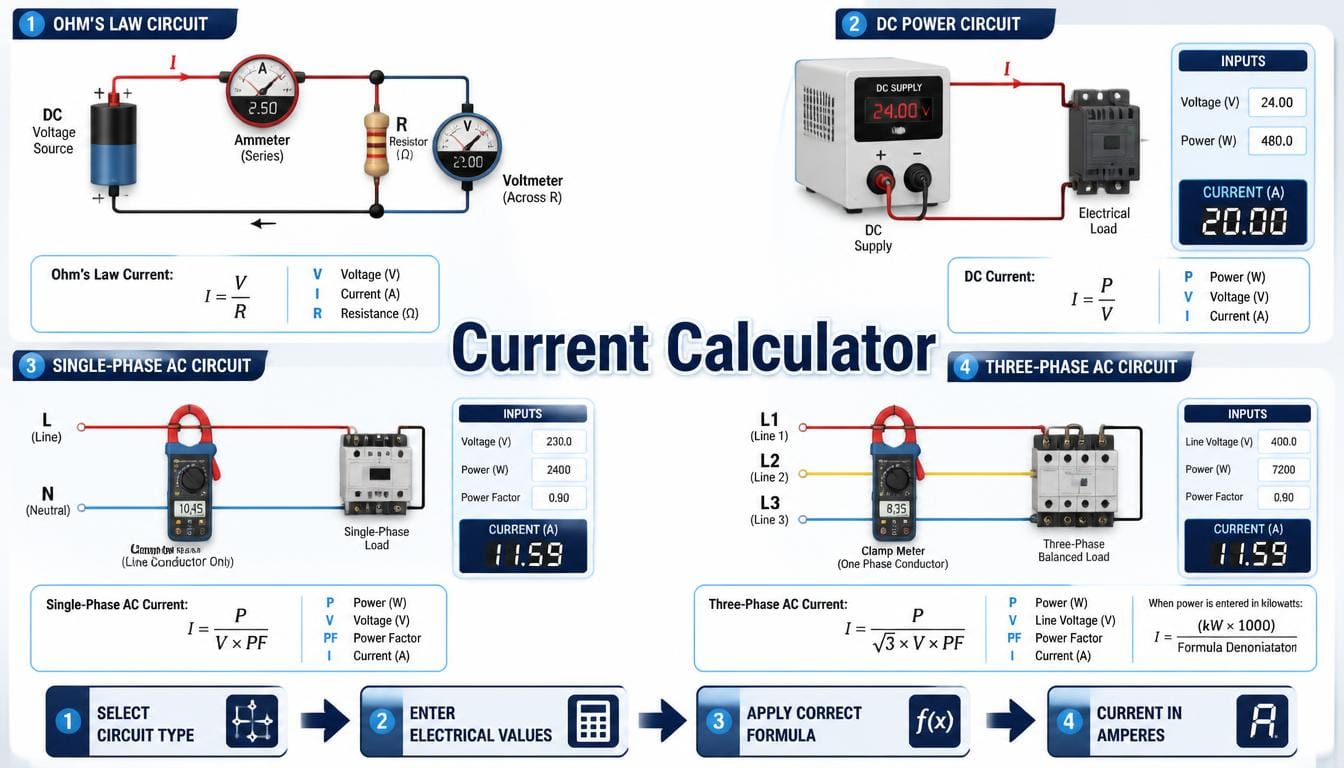
This guide explains the main current formulas for DC, single-phase AC, and balanced three-phase AC circuits. It also covers practical calculation examples, power factor, efficiency, measurement methods, limitations, and common mistakes. Critical results should always be compared with equipment nameplates, manufacturer documentation, and applicable electrical requirements.
What Is a Current Calculator?
A Current Calculator is an electrical engineering tool that determines how much electric current flows through a circuit or load. Current is measured in amperes, represented by the symbol A. Smaller values may be expressed in milliamperes or microamperes.
According to the basic current relationship, one ampere represents one coulomb of electric charge passing a point in one second. In practical electrical work, current is more commonly calculated from circuit voltage, resistance, real power, apparent power, power factor, and efficiency.
The correct formula depends on the circuit type. A resistive DC circuit can be solved using Ohm’s law, while an AC load may require power factor. Balanced three-phase calculations also include the √3 factor and normally use line-to-line voltage.
How Does a Current Calculator Work?
The calculator asks the user to select the type of electrical system and the known values. It then applies the appropriate current formula and converts the result into amperes, milliamperes, or another selected unit.
- Select DC, single-phase AC, or three-phase AC.
- Select the known values, such as power, voltage, or resistance.
- Enter the power factor for an AC load when required.
- Enter equipment efficiency when using mechanical output power.
- Check whether power is entered in watts or kilowatts.
- Calculate the expected current.
- Compare the result with the nameplate or measured current.
The calculated current represents the operating condition described by the inputs. Starting current, inrush current, harmonic current, transient current, and short-circuit current are different conditions and normally require separate calculations.
Step-by-Step Process
- Identify whether the circuit is DC, single-phase AC, or three-phase AC.
- Determine whether the entered power is electrical input or mechanical output.
- Confirm the supply voltage and whether it is line-to-line or line-to-neutral.
- Enter resistance when using Ohm’s law.
- Enter power factor for an AC load where applicable.
- Enter efficiency only when converting output power into required input power.
- Convert kilowatts into watts if the selected formula requires watts.
- Calculate the expected current.
- Check the result against the equipment nameplate or technical documentation.
- Use the result as one input to cable, protection, and equipment-selection calculations.
Current Calculator Formula
Current Using Ohm’s Law
I = V ÷ R
Ohm’s law calculates current when voltage and resistance are known. Voltage must be entered in volts and resistance in ohms to obtain current in amperes.
DC Current from Power
I = P ÷ V
For a basic DC load, current equals electrical input power divided by supply voltage. Converter efficiency may need to be included when the entered power is measured on the output side of a power converter.
Single-Phase AC Current
I = P ÷ (V × PF)
This formula calculates single-phase current when the entered power is real electrical input power. Power factor must be expressed as a decimal, such as 0.90 rather than 90.
Single-Phase Current from Output Power
I = Pout ÷ (V × PF × η)
When the power value represents useful mechanical or electrical output, efficiency is included to estimate the higher input power required by the equipment. Efficiency must not be applied again if the entered value is already electrical input power.
Three-Phase AC Current
I = P ÷ (√3 × V × PF)
This formula applies to a reasonably balanced three-phase load when P is real electrical input power, and V is line-to-line voltage. The constant √3 is approximately 1.732.
Three-Phase Current from Output Power
I = Pout ÷ (√3 × V × PF × η)
Efficiency is added when power represents the output of a motor or another energy-conversion device. Actual phase currents can differ when the load is unbalanced or contains harmonics.
Single-Phase Current from Apparent Power
I = (S × 1000) ÷ V
When apparent power is entered in kVA, multiply it by 1,000 and divide by voltage. Power factor is not added because it is already reflected in the relationship between kVA and real power.
Three-Phase Current from Apparent Power
I = (S × 1000) ÷ (√3 × V)
This formula is commonly used to calculate the line current of a transformer, generator, UPS, or other balanced three-phase source from its kVA rating.
Current from Electric Charge and Time
I = Q ÷ t
Electric current is the rate at which charge moves through a point. One ampere equals one coulomb of charge transferred per second.
Total Current in Parallel Circuits
Itotal = I1 + I2 + I3 + …
The total current entering parallel branches equals the sum of the individual branch currents. In a series circuit, the same current flows through every component.
Formula Explanation
| Symbol | Description |
|---|---|
| I | Electrical current in amperes (A) |
| Itotal | Total current in amperes |
| V | Supply voltage in volts (V) |
| R | Electrical resistance in ohms (Ω) |
| P | Real electrical input power in watts (W) |
| Pout | Useful output power in watts |
| PF | Power factor expressed as a decimal |
| η | Equipment efficiency expressed as a decimal |
| S | Apparent power in kilovolt-amperes (kVA) |
| Q | Electric charge in coulombs (C) |
| t | Time in seconds |
| √3 | Three-phase constant, approximately 1.732 |
Common Current Unit Conversions
| Current Unit | Equivalent Value |
|---|---|
| 1 kiloampere (kA) | 1,000 amperes |
| 1 ampere (A) | 1,000 milliamperes |
| 1 milliampere (mA) | 0.001 ampere |
| 1 milliampere (mA) | 1,000 microamperes |
| 1 microampere (µA) | 0.000001 ampere |
Interactive Current Calculator
Use the calculator below to calculate electrical current for DC, single-phase AC, and three-phase AC circuits using voltage, resistance, power, power factor, efficiency, or apparent power.
⚡ Current Calculator
Calculate electrical current for DC, single-phase AC, or three-phase AC loads.
Current Result
Enter values and press Calculate.
DC: I = P ÷ V
Single phase: I = P ÷ (V × PF × η)
Three phase: I = P ÷ (√3 × V × PF × η)
Example 1 – Current of a 24 V DC Load
Given:
- DC load power = 120 W
- Supply voltage = 24 V DC
I = 120 ÷ 24
I = 5 A
The calculated input current is 5 A when the 120 W value represents electrical power drawn from the 24 V supply. If the load is connected through a converter, its efficiency and input-voltage range may change the actual source current.
Example 2 – Current from DC Power and Voltage
A 120 W DC load operating at 24 V draws 5 A. Select DC, enter 120 W and 24 V, and the calculator returns 5 A.
Example 3 – Single-Phase Equipment Current
Given:
- Mechanical output power = 3 kW or 3,000 W
- Supply voltage = 230 V
- Power factor = 0.90
- Efficiency = 85% or 0.85
I = 3,000 ÷ (230 × 0.90 × 0.85)
I ≈ 17.05 A
The estimated input current is approximately 17.05 A. The actual current should be checked against the equipment nameplate because power factor and efficiency vary with design and operating load.
Example 4 – Three-Phase Load Current
Given:
- Mechanical output power = 15 kW or 15,000 W
- Line voltage = 415 V
- Power factor = 0.86
- Efficiency = 90% or 0.90
I = 15,000 ÷ (1.732 × 415 × 0.86 × 0.90)
I ≈ 26.96 A
The estimated balanced line current is approximately 26.96 A. The result represents the expected running current at the stated output, power factor, and efficiency. Starting current can be several times higher and requires a separate equipment-specific check.
Practical Field Considerations for Current Calculations
Before selecting a formula, confirm whether a power rating describes input or output. Heating equipment often lists electrical input power, while an electric motor normally lists mechanical shaft output. Applying efficiency to an input-power value a second time produces an incorrect current result.
Power factor is not the same as efficiency. Power factor describes the relationship between real and apparent power in an AC circuit, while efficiency compares output power with input power. Both values may be required in an equipment-current calculation.
A three-phase formula normally assumes a balanced load. In real installations, individual phase currents can differ because of unequal single-phase loading, winding problems, supply-voltage imbalance, or equipment faults. Measure all phases rather than relying on one reading.
Nonlinear loads such as VFDs, UPS systems, computers, rectifiers, and LED drivers can draw distorted current waveforms. A true-RMS instrument may be required to obtain a meaningful current measurement. Harmonic currents may also affect neutral conductors, transformers, and cable heating.
A clamp meter is often safer and more practical for measuring load current because the circuit does not need to be opened. The clamp must surround one current-carrying conductor, not the complete cable containing both outgoing and return conductors. Use a meter with the correct AC or DC capability, range, safety category, and condition for the installation.
Applications of a Current Calculator
Electrical Applications
- Cable and conductor sizing
- Circuit-breaker and fuse selection
- Transformer and generator calculations
- DC power-supply sizing
- Electrical load estimation
Industrial Applications
- Machine feeder calculations
- Pumps, fans, compressors, and conveyors
- Heaters and process equipment
- MCC and distribution-panel design
- Maintenance and overload investigation
Automation Applications
- PLC control-panel load calculations
- 24 V DC control-power supplies
- VFD and soft-starter input calculations
- Solenoid, relay, and contactor circuits
- Current monitoring and alarm systems
Advantages of a Current Calculator
- Supports DC, single-phase, and three-phase calculations.
- Calculates current from voltage, resistance, power, or kVA.
- Includes power factor and efficiency when required.
- Reduces repetitive manual calculations.
- Helps compare expected and measured current.
- Supports preliminary cable and protection studies.
- Helps students understand electrical relationships.
Limitations
- The result depends on accurate voltage, power factor, and efficiency values.
- Basic three-phase formulas assume a balanced load.
- Starting and inrush current are not included automatically.
- Harmonics and distorted waveforms may require additional analysis.
- Actual current changes with equipment load and operating conditions.
- The result does not automatically determine cable or breaker size.
- Manufacturer nameplate information remains the final equipment reference.
Common Mistakes
- Using the DC formula for an AC load with a poor power factor.
- Using the single-phase formula for a three-phase circuit.
- Confusing line voltage with phase voltage.
- Forgetting to convert kilowatts into watts.
- Entering percentages instead of decimals.
- Confusing power factor with efficiency.
- Applying efficiency to electrical input power twice.
- Treating running current as starting current.
- Using one-phase measurement to represent an unbalanced system.
- Placing a clamp meter around all conductors of a normal circuit together.
Check voltage, resistance, and current relationships with the Ohm’s Law Calculator. To translate current into energy use over time, continue with the Power Consumption Calculator.
Frequently Asked Questions
What is a Current Calculator?
A Current Calculator determines electrical current from values such as voltage, resistance, power, power factor, efficiency, apparent power, or electric charge.
What is the unit of electrical current?
The SI unit of electric current is the ampere, represented by A. Smaller currents may be expressed in milliamperes or microamperes.
How do I calculate current using Ohm’s law?
Divide the voltage across the load by its resistance. Voltage in volts divided by resistance in ohms produces current in amperes.
Why is power factor included in an AC calculation?
Power factor relates real power to apparent power. A lower power factor requires more current to deliver the same real power at the same voltage.
Why is √3 used in a three-phase current formula?
The √3 factor comes from the relationship between line and phase quantities in a balanced three-phase system.
Is calculated current the same as starting current?
No. The basic power formulas calculate expected running current. Motors, transformers, capacitors, and electronic power supplies can draw much higher temporary starting or inrush current.
Can I select a breaker directly from calculated current?
No. Breaker selection also depends on load type, conductor capacity, starting current, fault level, trip curve, installation rules, and equipment requirements.
How should current be measured safely?
Use a suitable meter with the correct current type, range, and safety category. Follow the instrument instructions and applicable electrical safety procedures.
Related Electrical Calculators
Helpful Electrical Engineering Resources
Conclusion
A Current Calculator provides a practical way to calculate amperes for DC, single-phase AC, and balanced three-phase AC circuits. It can solve for current from voltage and resistance, real power, apparent power, power factor, efficiency, or electric charge.
Accurate results depend on choosing the correct circuit type and understanding whether power represents input or output. Power factor, efficiency, phase balance, harmonics, starting conditions, and load variation can all affect the actual current measured in service.
Tech Volt Lab provides practical electrical and automation calculators for engineers, electricians, PLC technicians, maintenance professionals, and students. Use the calculated value as an initial engineering reference and confirm critical current values against equipment documentation, applicable requirements, and suitable measurements.
Explore More Engineering Calculators
Discover more free electrical and automation calculators designed for electricians, PLC programmers, maintenance technicians, and engineers.
View All Calculators