 Tech Volt Lab Automation | PLC | SCADA | Electrical | Electronics

Related Articles

An Ohm’s law calculator is one of the most useful tools for students, electricians, technicians, and engineers who work with electrical circuits. Instead of manually solving equations, this calculator allows you to quickly determine voltage, current, or resistance by entering known values.
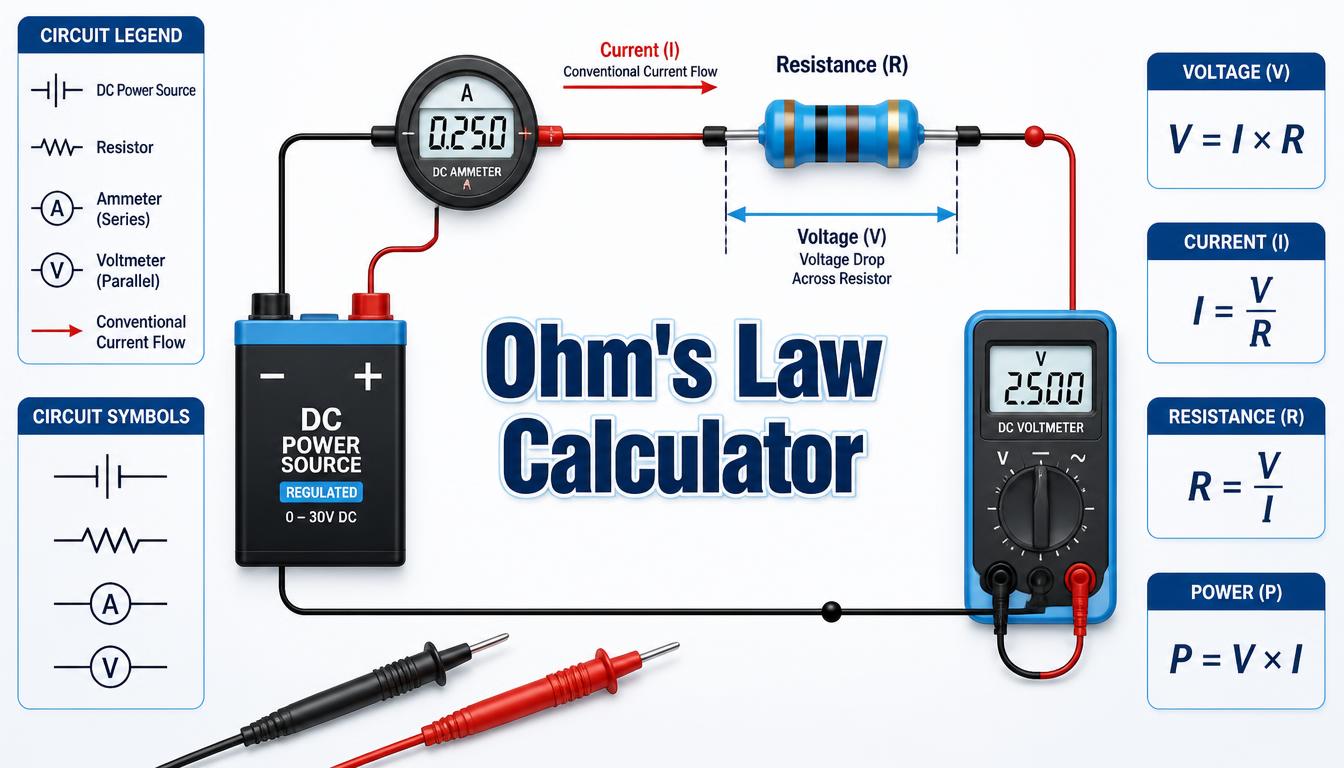
Whether you are learning basic electronics, troubleshooting electrical equipment, or designing industrial control systems, an Ohm’s Law Calculator can save time and reduce calculation errors. This guide explains how the calculator works, the formulas behind it, practical examples, and real-world applications.
What Is an Ohm’s Law Calculator?
An Ohm’s Law calculator is a tool that uses Ohm’s Law equations to calculate unknown electrical values. Ohm’s Law describes the relationship between voltage, current, and resistance in an electrical circuit.
The calculator can determine:
- Voltage (V)
- Current (I)
- Resistance (R)
- Electrical Power (P)
By entering any two known values, the calculator automatically computes the third.
This makes it an excellent tool for:
-
- Electrical engineering students
- PLC programmers
- Industrial technicians
- Maintenance engineers
- Electronics hobbyists
- Arduino enthusiasts
How Does an Ohm’s Law Calculator Work?
The calculator uses mathematical relationships defined by Ohm’s Law.
When a user enters current and resistance, the calculator determines voltage.
When voltage and current are entered, the calculator determines resistance.
When voltage and resistance are known, the calculator determines current.
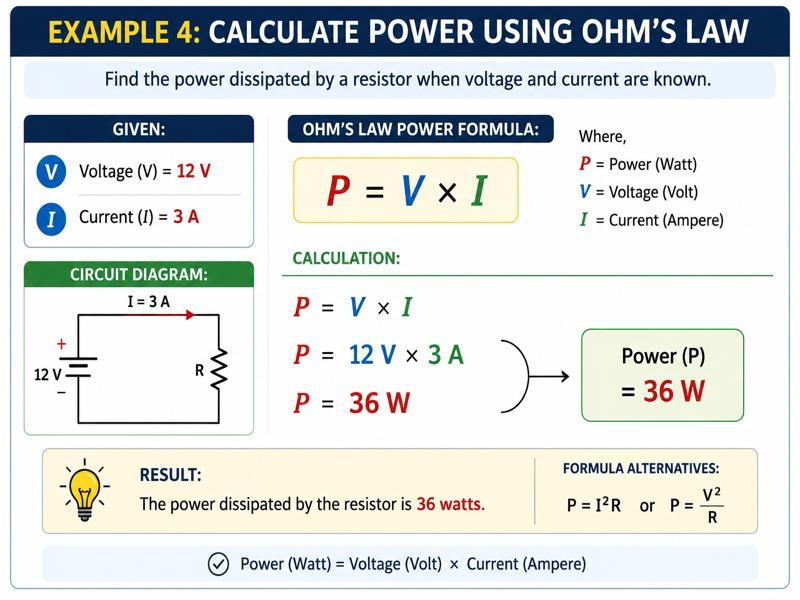
When voltage and current are known, the calculator determines power.
The process happens instantly, eliminating the need for manual calculations.
Step-by-Step Process
- Enter any two known values.
- Click Calculate or allow automatic calculation.
- The calculator processes the formula.
- The unknown value is displayed.
- Verify the result for your application.
Ohm’s Law Formula
The primary equation is:
V = I × R
Where:
- V = Voltage (Volts)
- I = Current (Amperes)
- R = Resistance (Ohms)
Additional formulas include:
I = V ÷ R
R = V ÷ I
Power can also be calculated using:
P = V × I
Where:
- P = Power (Watts)
Interactive Ohm’s Law Calculator
Use the calculator below to instantly determine voltage, current, and resistance.
Calculate voltage, current, resistance, or power using Ohm’s Law. Select calculation type and enter values.⚡ Ohm’s Law Calculator
Calculated Result
Voltage: V = I × R
Current: I = V ÷ R
Resistance: R = V ÷ I
Power: P = V × I
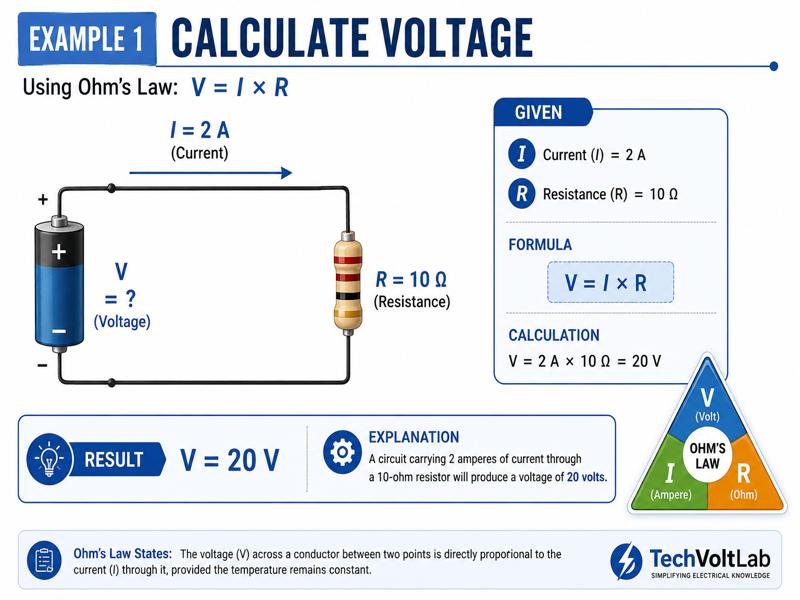
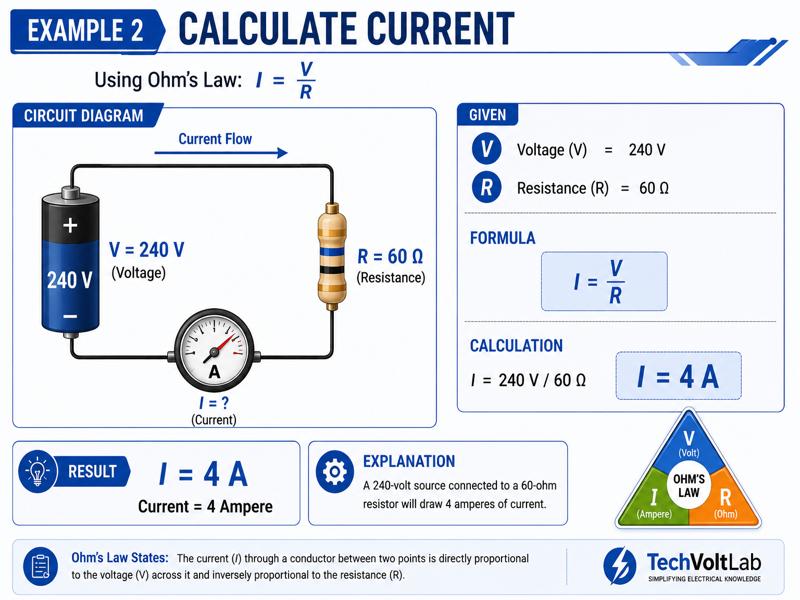
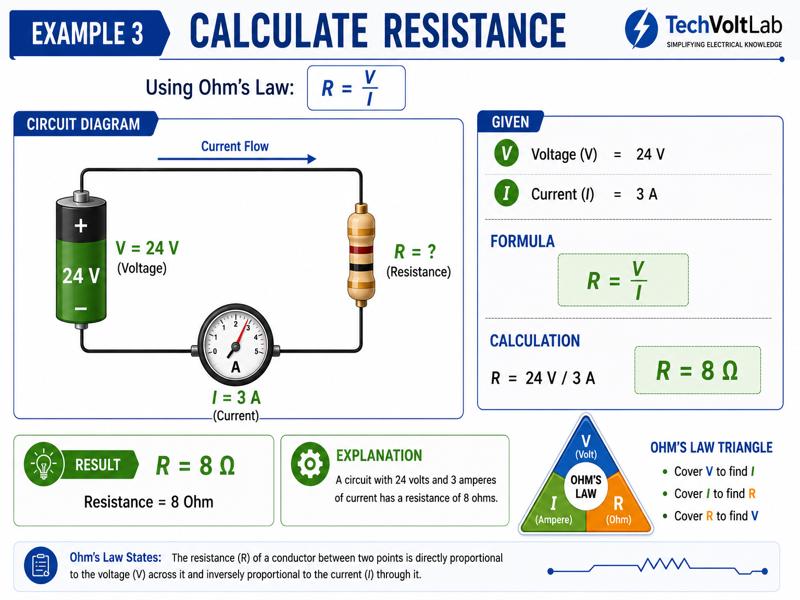
In my experience, Ohm’s Law is one of the first formulas every electrician and PLC technician should understand. During troubleshooting, I often use voltage, current, and resistance calculations to verify wiring, sensors, and power supplies. Even a simple calculation can quickly identify wiring issues or incorrect component values.
Applications of an Ohm’s Law Calculator
Industrial Applications
- Motor control circuits
- PLC panel design
- Power distribution systems
- Industrial automation projects
Electrical Applications
- Cable sizing calculations
- Circuit troubleshooting
- Electrical maintenance
- Residential wiring projects
Automation Applications
- Sensor circuit analysis
- Control panel design
- HMI power calculations
- Field device verification
Advantages of an Ohm’s Law Calculator
- Fast calculations
- Reduces human error
- Beginner-friendly
- Suitable for education
- Useful in industrial environments
- Improves troubleshooting efficiency
Limitations
- Assumes ideal circuit conditions
- Does not account for temperature effects
- Cannot replace detailed engineering analysis
- Requires accurate input values
Common Mistakes
- Entering incorrect units
- Mixing volts and millivolts
- Confusing amperes with milliamperes
- Using inaccurate resistance values
- Ignoring power calculations
Frequently Asked Questions
What is Ohm’s Law?
Ohm’s Law describes the relationship between voltage, current, and resistance in an electrical circuit. It is one of the most important electrical principles used in electronics, automation, and industrial systems.
Why is Ohm’s Law important?
Ohm’s Law helps engineers, technicians, and students calculate electrical values accurately. It is widely used in circuit design, troubleshooting, and electrical maintenance.
Can I calculate power using Ohm’s Law?
Yes. Electrical power can be calculated using P = V × I, where P is power in watts, V is voltage, and I is current.
Is this calculator suitable for beginners?
Yes. This Ohm’s Law Calculator is beginner-friendly and suitable for students, hobbyists, electricians, and professional engineers.
Can I use this calculator for PLC panels?
Yes. It can assist with basic electrical calculations commonly used in PLC programming, control panels, industrial automation systems, and field devices.
What values can this Ohm’s Law Calculator calculate?
This calculator can compute voltage, current, resistance, and power from user-entered values.
Related Electrical Calculators
- Voltage Drop Calculator
- Motor Current Calculator
- kW to HP Calculator
- Power Consumption Calculator
- Cable Size Calculator
Helpful Electrical Engineering Resources
These resources provide additional information about Ohm’s Law, electrical circuits, voltage, current, resistance, and power calculations.
Conclusion
An Ohm’s law calculator is an essential tool for anyone working with electricity, electronics, PLC programming, and automation. By entering known values, you can quickly determine voltage, current, or resistance without manual calculations. Use the calculator above whenever you need fast and accurate electrical calculations for educational, industrial, or troubleshooting purposes.
At TechVoltLab, our goal is to provide practical engineering tools, calculators, tutorials, and resources that help students, technicians, electricians, PLC programmers, and automation engineers expand their skills and solve real-world problems more efficiently.