 Tech Volt Lab Automation | PLC | SCADA | Electrical | Electronics

Related Articles

A Voltage Drop Calculator is an essential tool for electricians, electrical engineers, PLC technicians, and industrial automation professionals. It helps determine how much voltage is lost as electrical current travels through a conductor. Excessive voltage drop can reduce equipment performance, cause motor-starting problems, create PLC power-supply issues, and increase energy losses. Calculate voltage loss in electrical cables to improve equipment performance and ensure proper conductor sizing. Whether you are designing a new electrical installation, sizing cables for a control panel, troubleshooting field devices, or planning an industrial automation project, a Voltage Drop Calculator provides fast, accurate results without lengthy manual calculations.
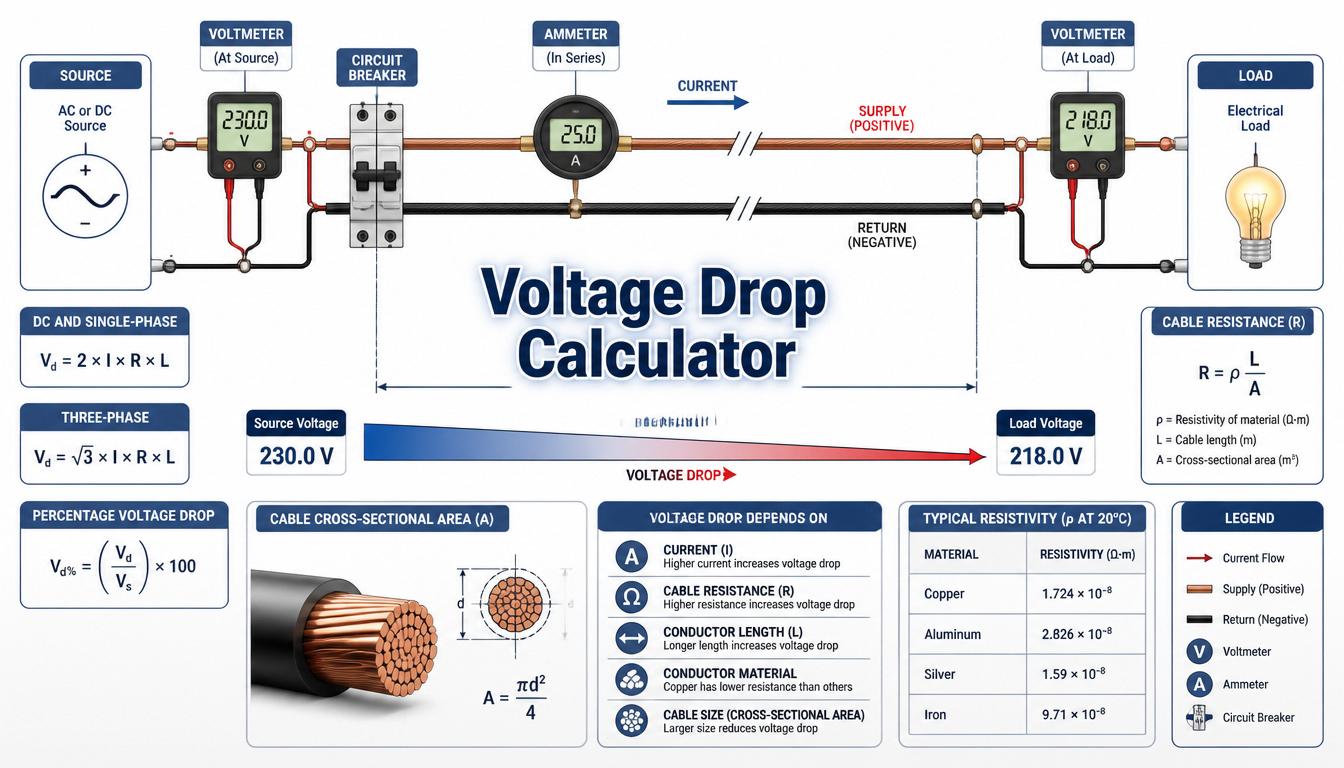
Whether you are designing a new electrical installation, sizing cables for a control panel, troubleshooting field devices, or planning an industrial automation project, a Voltage Drop Calculator provides fast, accurate results without lengthy manual calculations.
This guide explains how voltage drop works, the formulas used for calculations, practical examples, industrial applications, and common mistakes to avoid when selecting electrical cables.
What Is a Voltage Drop Calculator?
A Voltage Drop Calculator is a tool used to calculate the voltage drop that occurs when electrical current flows through a conductor. Every cable has some resistance, and as current flows through that resistance, a portion of the voltage is lost.
The calculator helps determine:
- Voltage drop in volts (V)
- Voltage drop percentage (%)
- Expected load voltage
- Cable performance over distance
- Compliance with electrical standards
By entering values such as supply voltage, cable length, conductor size, and load current, the calculator instantly determines the expected voltage loss.
This makes it a valuable tool for:
- Electrical engineering students
- Industrial electricians
- PLC programmers
- Control panel builders
- Maintenance technicians
- Automation engineers
- Electrical contractors
How Does a Voltage Drop Calculator Work?
The calculator uses electrical formulas that account for conductor resistance, current flow, cable length, and system type. As the cable length increases or the current demand rises, the voltage drop also increases.
The calculator automatically applies the appropriate formula based on whether the circuit is single-phase or three-phase, then displays the voltage loss and remaining voltage available at the load.
Step-by-Step Process
- Enter the supply voltage.
- Enter the load current.
- Select the cable type and conductor size.
- Enter the cable length.
- Select single-phase or three-phase operation.
- Click Calculate.
- Review the voltage drop result and percentage.
Voltage Drop Formula
The Voltage Drop Calculator uses standard electrical engineering formulas based on the circuit type, conductor material, cable length, cable size, load current, and power factor. These formulas provide a more practical and accurate calculation for real-world electrical installations than simplified resistance-only equations.
DC Circuit Formula
Voltage Drop (V) = (2 × I × L × ρ) ÷ A
Single-Phase AC Formula
Voltage Drop (V) = (2 × I × L × ρ × PF) ÷ A
Three-Phase AC Formula
Voltage Drop (V) = (√3 × I × L × ρ × PF) ÷ A
Where:
- Vd = Voltage Drop (Volts)
- I = Load Current (Amperes)
- L = One-way Cable Length (Meters)
- ρ = Conductor Resistivity (Copper or Aluminum)
- A = Cable Cross-Sectional Area (mm²)
- PF = Power Factor (used for AC circuits only)
- √3 = 1.732 (used for three-phase circuits)
Engineering Note: Some textbooks use the simplified formulas Voltage Drop = 2 × Current × Resistance × Length for single-phase circuits and Voltage Drop = √3 × Current × Resistance × Length for three-phase circuits. In those equations, the conductor resistance is already known. This calculator automatically determines the conductor resistance based on the selected cable material and size, making it more practical for everyday electrical design, installation, and maintenance work.
Interactive Voltage Drop Calculator
Use the calculator below to instantly calculate voltage drop for electrical installations, motor circuits, PLC panels, and industrial automation systems.
⚡ Voltage Drop Calculator
Calculate voltage drop for DC, single-phase, and three-phase circuits.
Voltage Drop Result
Enter values and press Calculate.
DC: Vd = 2 × I × L × ρ ÷ A
Single Phase: Vd = 2 × I × L × ρ × PF ÷ A
Three Phase: Vd = √3 × I × L × ρ × PF ÷ A
Single-Phase Voltage Drop Example
Suppose a 230V single-phase circuit supplies a load drawing 20A through a 50-meter copper cable with a cross-sectional area of 4 mm². By selecting the circuit type, conductor material, cable size, cable length, load current, and power factor in the Voltage Drop Calculator, you can instantly determine the voltage drop, percentage voltage drop, and the remaining voltage available at the load.
This information helps electricians and engineers verify whether the selected cable complies with recommended voltage drop limits. If the calculated voltage drop is too high, increasing the cable size or reducing the cable length can improve system performance and ensure connected equipment receives sufficient operating voltage.
Three-Phase Voltage Drop Example
Consider a 415V three-phase motor drawing 45A, installed 120 meters from the distribution panel using a 25 mm² copper cable with a power factor of 0.85. Entering these values into the Voltage Drop Calculator provides the voltage drop, percentage voltage drop, and final voltage at the motor terminals.
These calculations are essential when designing motor feeders, MCC panels, industrial power distribution systems, and long cable runs. They help engineers determine whether the selected conductor size is adequate or if a larger cable is needed to minimize voltage loss, improve energy efficiency, and ensure reliable equipment operation.
My Experience with Voltage Drop Calculations
During PLC panel installations and industrial automation projects, voltage drop is one of the first electrical checks I perform before commissioning equipment. Long cable runs supplying motors, sensors, and field devices can experience significant voltage losses if conductor sizing is not selected correctly.
I have seen situations where PLC inputs failed to operate reliably because field devices were receiving insufficient voltage. Performing a voltage drop calculation early in the design stage helps avoid costly troubleshooting and improves overall system reliability.
Applications of a Voltage Drop Calculator
Industrial Applications
- Motor control circuits
- MCC panel design
- Power distribution systems
- Industrial automation projects
Electrical Applications
- Cable sizing calculations
- Electrical installations
- Generator connections
- Transformer feeders
Automation Applications
- PLC control panels
- Remote I/O systems
- Sensor wiring circuits
- Field instrumentation
Advantages of a Voltage Drop Calculator
- Fast and accurate calculations
- Reduces design errors
- Improves equipment performance
- Supports proper cable selection
- Helps meet electrical standards
- Useful for students and professionals
Limitations
- Results depend on accurate input values
- Does not replace detailed engineering studies
- May not account for all temperature effects
- Actual cable conditions may vary
Common Mistakes
- Ignoring cable length
- Using an incorrect conductor size
- Confusing single-phase and three-phase formulas
- Entering incorrect current values
- Ignoring voltage drop percentage limits
- Not considering future load expansion
Before finalizing conductor size, verify the selected cable with our Cable Size Calculator. If the load current is unknown, calculate it first with the Current Calculator.
Frequently Asked Questions
What is voltage drop?
Voltage drop is the reduction in electrical voltage that occurs as current travels through a conductor. It is caused by cable resistance and increases with longer cable lengths and higher current loads.
Why is voltage drop important?
Excessive voltage drop can reduce equipment performance, cause motors to overheat, affect PLC operation, and lead to inefficient electrical systems. Proper voltage drop calculations help ensure reliable operation.
What is an acceptable voltage drop percentage?
Many electrical standards recommend limiting voltage drop to approximately 3% for branch circuits and 5% for the total electrical installation. Always follow local electrical codes and project requirements.
How do I calculate voltage drop?
Voltage drop is calculated using cable resistance, conductor length, and load current. A Voltage Drop Calculator performs these calculations automatically and provides quick, accurate results.
Does cable length affect voltage drop?
Yes. Longer cable runs create greater resistance, which increases voltage drop. This is why cable length is a critical factor when sizing conductors for electrical installations.
Does cable size affect voltage drop?
Yes. Larger conductors have lower resistance, which reduces voltage drop. Selecting the correct cable size helps maintain voltage levels and improve system efficiency.
Can this calculator be used for three-phase systems?
Yes. A Voltage Drop Calculator can be used for both single-phase and three-phase electrical systems by applying the appropriate formula for the circuit type.
What happens if the voltage drop is too high?
High voltage drop can cause poor equipment performance, dim lighting, motor starting issues, increased energy losses, and potential damage to sensitive electrical devices.
Related Electrical Calculators
- Ohm’s Law Calculator
- Motor Current Calculator
- Cable Size Calculator
- kW to HP Calculator
- Transformer Calculator
Helpful Electrical Engineering Resources
Conclusion
A Voltage Drop Calculator is a valuable tool for electricians, engineers, PLC technicians, and industrial automation professionals who need accurate electrical calculations. By quickly determining voltage loss in cables, the calculator helps ensure equipment receives the correct operating voltage, improves system reliability, and supports proper cable selection.
Whether you are designing a new electrical installation, sizing conductors for a motor circuit, troubleshooting voltage-related issues, or planning an industrial control panel, understanding voltage drop is essential for safe and efficient operation. Even small voltage losses can affect the performance of motors, PLCs, sensors, and other electrical equipment when cable runs are long or loads are high.
Use the Voltage Drop Calculator above whenever you need fast and reliable results for single-phase or three-phase electrical systems. Accurate voltage drop calculations can help reduce energy losses, prevent equipment problems, and ensure compliance with electrical engineering best practices.
At Tech Volt Lab, our mission is to provide practical engineering calculators, PLC programming resources, electrical tutorials, and industrial automation guides that help students, technicians, electricians, and engineers solve real-world challenges with confidence.
Explore More Electrical Calculators
Continue learning with our
Ohm’s Law Calculator
To quickly calculate voltage, current, resistance, and power for electrical and industrial automation applications.