 Tech Volt Lab Automation | PLC | SCADA | Electrical | Electronics

Related Articles

An LED Resistor Calculator helps electronics technicians, electrical engineers, automation professionals, students, and hobbyists select a suitable current-limiting resistor for an LED circuit. It uses the supply voltage, LED forward voltage, desired forward current, and number of LEDs to calculate the required resistance and minimum resistor power dissipation. A standard LED cannot normally be connected directly across a fixed-voltage supply. Once its forward voltage is reached, a small change in voltage can produce a large increase in current. Without proper current control, the LED may overheat, lose brightness over time, or fail immediately. A series resistor provides a simple method of limiting current in low-power indicator circuits.
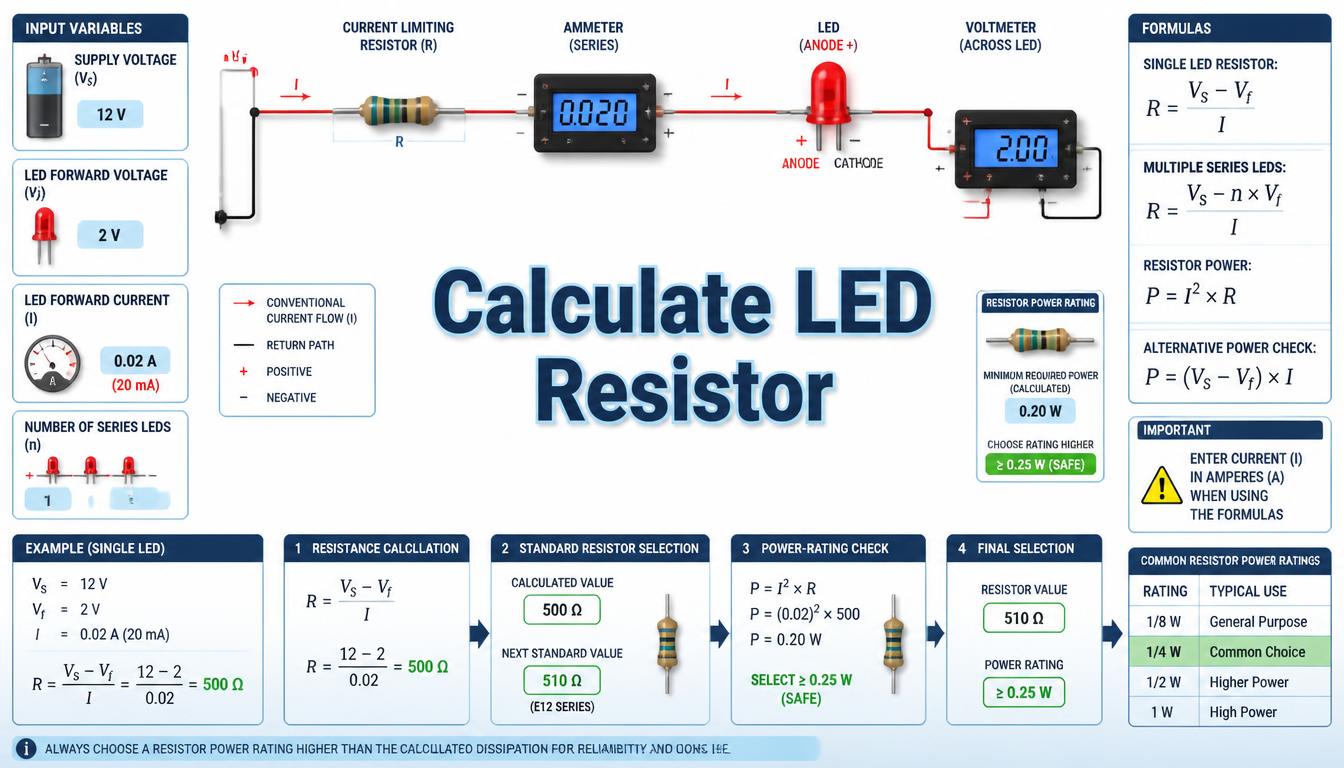
This guide explains the LED resistor formula, forward voltage, current conversion, resistor wattage, series and parallel LED arrangements, practical examples, and common design mistakes. Always confirm the LED’s electrical limits from its datasheet because forward voltage and permitted current vary between products.
What Is an LED Resistor Calculator?
An LED Resistor Calculator is an electronics tool used to calculate the resistance required between a voltage source and one or more LEDs. The resistor drops the portion of the supply voltage that is not used by the LEDs and limits the circuit current to the selected value.
The calculator can also determine how much power the resistor will dissipate as heat. This is important because choosing the correct resistance but an insufficient wattage rating can make the resistor run excessively hot or fail during continuous operation.
This calculation is commonly used for panel indicators, breadboard projects, microcontroller outputs, relay-status lamps, optocoupler inputs, test circuits, and low-power lighting. High-power LEDs and circuits with a wide supply-voltage range usually require a regulated constant-current driver instead of a basic resistor.
How Does an LED Resistor Calculator Work?
The calculator subtracts the total LED forward voltage from the supply voltage. The remaining voltage must be dropped across the resistor. Ohm’s law is then used to divide this voltage by the desired LED current.
-
- Enter the maximum expected supply voltage.
-
- Enter the LED forward voltage from its datasheet.
-
- Enter the required LED current in milliamperes.
-
- Enter the number of LEDs connected in series.
-
- Calculate the required resistance.
-
- Select a suitable standard resistor value.
-
- Check resistor power dissipation and temperature derating.
If the exact calculated resistance is unavailable, a nearby higher standard value is generally selected to keep current below the intended value. After choosing the standard resistor, the actual current should be recalculated rather than assuming it remains equal to the original target.
Step-by-Step Process
-
- Identify the supply voltage and its possible tolerance.
- Find the LED’s forward-voltage range in the manufacturer’s datasheet.
- Select an operating current below the LED’s permitted limit.
- Count the LEDs connected in one series string.
- Add the forward voltages of all series-connected LEDs.
- Subtract the total LED voltage from the supply voltage.
- Convert LED current from milliamperes to amperes.
- Calculate the required series resistance.
- Select an available standard resistor value.
- Calculate resistor power and select a comfortably rated component.
- Verify the circuit under maximum supply voltage and minimum LED forward voltage.
LED Resistor Calculator Formula
Single LED Resistor Formula
R = (Vs − Vf) ÷ If
The supply voltage minus the LED forward voltage gives the voltage across the resistor. Dividing this voltage by LED current in amperes produces resistance in ohms.
Multiple LEDs Connected in Series
R = [Vs − (n × Vf)] ÷ If
When identical LEDs are connected in series, their forward voltages are added. The same current flows through every LED and through the resistor. The supply voltage must be higher than the total forward voltage by enough margin for reliable current control.
LED Current Conversion
IA = ImA ÷ 1000
Current must be entered in amperes when using Ohm’s law directly. For example, 10 mA equals 0.010 A, while 20 mA equals 0.020 A.
Resistor Power Formula
PR = VR × If
PR = If2 × R
PR = VR2 ÷ R
All three equations calculate resistor power dissipation in watts. The selected resistor should have a power rating comfortably above the calculated dissipation after considering ambient temperature, enclosure ventilation, duty cycle, and manufacturer derating information.
Actual Current with a Standard Resistor
Iactual = [Vs − (n × Vf)] ÷ Rselected
After selecting an available standard resistance, this formula shows the expected circuit current. The result should remain within the LED and driving-device limits under worst-case operating conditions.
Formula Explanation
| Symbol | Description |
|---|---|
| R | Required current-limiting resistance in ohms (Ω) |
| Rselected | Available standard resistor selected for the circuit |
| Vs | Supply voltage in volts (V) |
| Vf | Forward voltage of one LED in volts |
| VR | Voltage dropped across the resistor |
| If | Desired LED forward current in amperes |
| Iactual | Calculated current with the selected resistor |
| n | Number of identical LEDs in one series string |
| PR | Power dissipated by the resistor in watts |
Typical LED Forward Voltage Ranges
The following values are broad reference ranges rather than fixed design values. Forward voltage depends on LED construction, current, temperature, manufacturing variation, and the specific part number. Use the actual datasheet for the selected LED.
| LED Type or Color | Typical Forward-Voltage Range |
|---|---|
| Infrared LED | Approximately 1.1–1.5 V |
| Red LED | Approximately 1.7–2.2 V |
| Yellow LED | Approximately 1.8–2.4 V |
| Traditional green LED | Approximately 1.8–2.5 V |
| Blue LED | Approximately 2.7–3.5 V |
| White LED | Approximately 2.8–3.6 V |
Interactive LED Resistor Calculator
Use the calculator below to enter supply voltage, LED forward voltage, desired current, and number of series LEDs to calculate resistance and resistor power.
⚡ LED Resistor Calculator
Calculate resistor values for LEDs connected in series or parallel branches.
LED Resistor Result
Enter values and press Calculate.
Series: R = (Vs − n × Vf) ÷ I
Parallel branches: R(each) = (Vs − Vf) ÷ I
P = I² × R
Example 1 – Red LED from a 5 V Supply
Given:
-
- Supply voltage = 5 V
-
- Red LED forward voltage = 2 V
-
- Desired LED current = 10 mA or 0.010 A
R = (5 − 2) ÷ 0.010
R = 300 Ω
If a 300 Ω resistor is unavailable, a 330 Ω standard value can be selected. The resulting current is:
Iactual = (5 − 2) ÷ 330 ≈ 0.00909 A = 9.09 mA
PR = 3 × 0.00909 ≈ 0.027 W
A commonly available resistor with a power rating comfortably above 0.027 W will have adequate thermal margin under normal conditions. The current must also remain within the output-current limit if the LED is driven directly by a microcontroller or logic device.
Example 2 – Three White LEDs from a 12 V Supply
Given:
-
- Supply voltage = 12 V
-
- Number of series LEDs = 3
-
- Forward voltage per LED = 3 V
-
- Desired current = 20 mA or 0.020 A
Total LED voltage = 3 × 3 = 9 V
R = (12 − 9) ÷ 0.020 = 150 Ω
PR = 3 × 0.020 = 0.060 W
The calculated resistance is 150 Ω, and the resistor dissipates approximately 0.060 W at the stated values. Supply tolerance and LED forward-voltage variation should be checked before selecting the final resistance and wattage.
Example 3 – Panel Indicator LED from a 24 V DC Supply
Given:
-
- Supply voltage = 24 V DC
-
- LED forward voltage = 2.1 V
-
- Desired current = 10 mA or 0.010 A
R = (24 − 2.1) ÷ 0.010
R = 2,190 Ω
A nearby standard value of 2.2 kΩ can be used. The actual current is:
Iactual = 21.9 ÷ 2,200 ≈ 9.95 mA
PR = 21.9 × 0.00995 ≈ 0.218 W
A resistor rated only slightly above 0.218 W would have little thermal margin, so a higher practical wattage should be chosen after checking the enclosure temperature and applying the manufacturer’s derating. Industrial 24 V supplies may also experience tolerance and switching transients that require additional circuit protection.
Example 4 – Three LEDs Connected in Parallel
Given for each branch:
-
- Supply voltage = 5 V
-
- Blue LED forward voltage = 3.2 V
-
- Desired current per LED = 10 mA or 0.010 A
-
- Number of parallel LED branches = 3
Resistance per branch = (5 − 3.2) ÷ 0.010 = 180 Ω
Total supply current = 3 × 10 mA = 30 mA
Each parallel LED should have its own 180 Ω resistor. Using a single shared resistor for several parallel LEDs can result in unequal current because small forward-voltage differences cause one branch to carry more current than another. The supply and switching device must also support the combined branch current.
Practical Field Considerations for LED Resistor Selection
The LED’s maximum forward-current rating should not automatically be used as its normal operating current. Many modern LEDs provide adequate indication at a fraction of the maximum rating. Reducing current can lower power consumption, reduce heat, and extend component life while still providing sufficient brightness.
Forward voltage is not a perfectly fixed value. It varies between individual LEDs and changes with current and junction temperature. A conservative calculation should use the maximum expected supply voltage and an appropriate low forward-voltage value when checking the highest possible current.
When an LED is driven from a PLC, microcontroller, logic gate, transistor, or optocoupler circuit, include the voltage drop of the switching device where it materially affects the calculation. The output’s permitted source or sink current must not be exceeded.
Resistor power turns into heat. A small resistor installed near other hot components or inside a sealed enclosure can operate at a higher temperature than expected. Use the resistor manufacturer’s derating curve when ambient temperature, continuous duty, or reliability is important.
A resistor is suitable for basic low-current LED circuits with a reasonably stable supply. High-power LEDs, long LED strings, battery-powered equipment with wide voltage variation, and precision lighting systems are better controlled with a dedicated constant-current driver.
Applications of an LED Resistor Calculator
Electronics Applications
-
- Breadboard and prototype circuits
-
- Microcontroller status LEDs
-
- PCB power and signal indicators
-
- Transistor and logic-output circuits
-
- Educational electronics projects
Industrial and Automation Applications
-
- PLC input and output indication
-
- Control-panel status lamps
-
- Relay and contactor status circuits
-
- Optocoupler input circuits
-
- Sensor and actuator diagnostic indicators
Repair and Maintenance Applications
-
- Replacing damaged indicator LEDs
-
- Checking overheated series resistors
-
- Modifying indicator brightness
-
- Verifying replacement component values
-
- Troubleshooting control and display boards
Advantages of an LED Resistor Calculator
-
- Calculates resistance without repeated manual work.
-
- Supports single and multiple series LEDs.
-
- Helps convert milliamperes into amperes correctly.
-
- Calculates resistor power dissipation.
-
- Helps compare calculated and standard resistor values.
-
- Reduces mistakes involving forward voltage.
-
- Supports electronics education and practical design.
Limitations
-
- The result depends on accurate supply and forward-voltage values.
-
- LED forward voltage changes with current and temperature.
-
- Supply-voltage tolerance may change the actual current.
-
- The calculation does not predict LED brightness precisely.
-
- Resistor control may be inefficient at high supply voltages.
-
- High-power LEDs normally require a constant-current driver.
-
- Datasheet limits and thermal conditions must still be checked.
Common Mistakes
-
- Connecting an LED directly to a voltage source.
-
- Entering milliamperes as though they were amperes.
-
- Ignoring the LED’s forward voltage.
-
- Using the maximum current as the normal design current.
-
- Forgetting to add the voltage of series-connected LEDs.
-
- Using one shared resistor for parallel LED branches.
-
- Choosing a resistor without checking power dissipation.
-
- Ignoring supply tolerance and industrial transients.
-
- Exceeding a microcontroller or PLC output rating.
-
- Using a simple resistor where a constant-current driver is required.
Frequently Asked Questions
What is an LED Resistor Calculator?
An LED Resistor Calculator determines the current-limiting resistance and resistor power required from supply voltage, LED forward voltage, current, and number of series LEDs.
Why does an LED need a resistor?
A resistor limits current through the LED. Without suitable current control, a small voltage increase can cause excessive current, overheating, reduced life, or immediate failure.
What is LED forward voltage?
Forward voltage is the approximate voltage across an LED while it conducts at a specified current. Its value depends on the LED type, current, temperature, and manufacturing variation.
Should I choose a higher or lower standard resistor?
When the exact value is unavailable, a nearby higher resistance is commonly selected to keep current below the intended value. Recalculate actual current with the selected resistor.
How do I calculate resistor wattage?
Multiply the voltage across the resistor by LED current, or use I²R. Select a resistor rating above the calculated power after considering temperature and derating.
Can multiple series LEDs use one resistor?
Yes. The same current flows through all LEDs in a series string, so one resistor can limit the string current when sufficient supply-voltage margin is available.
Can parallel LEDs share one resistor?
Each parallel branch should have its own resistor. Differences in LED forward voltage can otherwise cause unequal current sharing.
Can I use a resistor with a high-power LED?
A resistor may be unsuitable for high-power LEDs because current changes with supply voltage and LED temperature. A regulated constant-current driver is generally the better solution.
Related Electrical Calculators
Helpful Electronics Resources
Conclusion
An LED Resistor Calculator provides a straightforward way to determine the resistance and power rating needed for a basic LED circuit. It can be used for a single LED, a series string, or separate parallel branches when the supply voltage, forward voltage, and intended current are known.
A reliable design should account for supply tolerance, LED forward-voltage variation, resistor power, ambient temperature, output-device limits, and the LED manufacturer’s recommendations. After selecting a standard resistor value, recalculate the actual current and confirm that it remains within the permitted range.
Tech Volt Lab provides practical electrical, electronics, and automation calculators for engineers, electricians, PLC technicians, maintenance professionals, and students. Use the calculated value as a design reference and verify critical component ratings before assembling or modifying a circuit.
Explore More Engineering Calculators
Discover more free electrical and automation calculators designed for electricians, PLC programmers, maintenance technicians, and engineers.
View All Calculators