 Tech Volt Lab Automation | PLC | SCADA | Electrical | Electronics

Related Articles

An Electrical Charge Calculator calculates electric charge from current and time, converts coulombs to ampere-hours, determines the number of elementary charges, and calculates the charge stored by a capacitor. Electricians, electronics technicians, engineers, automation professionals, maintenance personnel, and students can use it for electrical and electronic calculations.
Electric charge is fundamental to current flow, battery capacity, capacitor operation, electrostatic systems, sensor circuits, and electronic equipment. Correct calculations require a clear distinction between charge in coulombs, current in amperes, battery capacity in ampere-hours, capacitance in farads, and energy in joules.
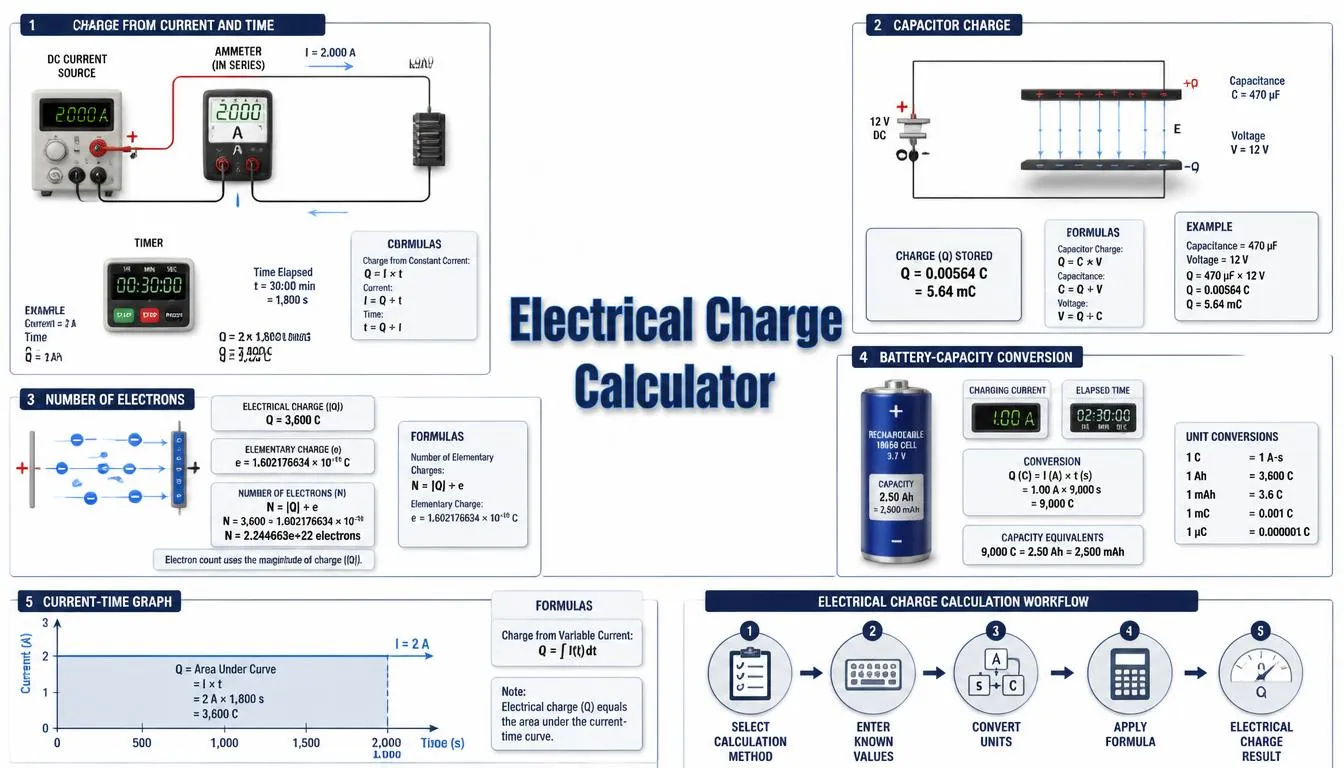
This guide explains the principal electrical charge formulas, unit conversions, capacitor relationships, elementary charge, stored energy, and four practical examples. Accurate results depend on using compatible units and recognizing the assumptions behind constant-current, battery, and capacitor calculations.
What Is an Electrical Charge Calculator?
An Electrical Charge Calculator determines the quantity of electric charge transferred, stored, or represented by the entered electrical values. The SI unit of electric charge is the coulomb, represented by the symbol C.
Depending on the selected calculation, the required inputs may include current in amperes, time in seconds, battery capacity in ampere-hours, capacitance in farads, capacitor voltage, or the number of elementary charges. The output may be coulombs, millicoulombs, microcoulombs, ampere-hours, electron quantity, current, time, capacitance, or voltage.
The calculator is useful for capacitor circuits, battery-capacity conversions, current-flow analysis, charging systems, electronic design, laboratory exercises, and industrial control applications. It provides a mathematical result and does not automatically determine a safe capacitor, battery, conductor, charger, or protective-device rating.
How Does an Electrical Charge Calculator Work?
The calculator applies the formula that matches the available values. If current and time are known, it multiplies them to calculate transferred charge. If capacitance and voltage are known, it calculates the magnitude of charge stored on each capacitor plate.
- Select charge from current and time, capacitor charge, elementary charge, or unit conversion.
- Enter the known electrical values.
- Select amperes, milliamperes, seconds, minutes, hours, farads, or the appropriate available units.
- Convert percentages or metric prefixes where required.
- Calculate and review the result with its unit.
- Compare component-related results with manufacturer documentation.
The result depends on the entered operating condition. Real batteries and capacitors may be affected by voltage variation, leakage current, internal resistance, temperature, tolerance, aging, charging profile, and discharge rate.
Step-by-Step Process
- Select the required electrical charge calculation.
- Enter the primary known value, such as current, capacitance, or battery capacity.
- Select the correct unit for the entered value.
- Enter time, voltage, charge, or the remaining required value.
- Convert minutes to seconds when the formula requires seconds.
- Convert microfarads or millifarads to farads for manual calculations.
- Calculate and check whether the result is in C, mC, µC, Ah, or another unit.
- Confirm whether the calculation assumes constant current or constant voltage.
- Compare practical component calculations with manufacturer specifications and measured data.
Electrical Charge Calculator Formula
Electric current represents the rate at which charge passes a point. When current remains constant during the selected period, electrical charge is calculated using:
Q = I × t
When current is entered in amperes and time in seconds, the calculated charge is in coulombs. One ampere is equivalent to one coulomb per second.
1 A = 1 C/s
1 C = 1 A × 1 s
Calculate Current from Charge
I = Q ÷ t
This formula calculates average current when transferred charge and elapsed time are known. Enter charge in coulombs and time in seconds to obtain current in amperes.
Calculate Time from Charge
t = Q ÷ I
This formula calculates the theoretical time required for a constant current to transfer a specified charge. Actual charging time may differ when current changes with voltage, temperature, state of charge, or charger control.
Ampere-Hour and Coulomb Conversion
QC = CAh × 3,600
CAh = QC ÷ 3,600
1 Ah = 3,600 C
1 mAh = 3.6 C
An ampere-hour is a unit of charge commonly used for battery capacity. It is not a unit of electrical energy. Voltage must also be known before ampere-hours can be converted into watt-hours.
Energy in Wh = Nominal voltage × Capacity in Ah
This energy relationship is a simplified nominal estimate. Actual usable battery energy depends on battery chemistry, discharge current, voltage limits, temperature, age, depth of discharge, and system efficiency.
Elementary Charge Formula
Q = n × e
n = |Q| ÷ e
e = 1.602176634 × 10⁻¹⁹ C
The magnitude of the elementary charge is an exactly defined value. The formula calculates how many elementary-charge units correspond to a given charge magnitude. An electron carries charge −e, while a proton carries charge +e.
Capacitor Charge Formula
Q = C × V
C = Q ÷ V
V = Q ÷ C
For these formulas, Q is the magnitude of charge stored on either capacitor plate, C is capacitance in farads, and V is the potential difference across the capacitor in volts. Using farads and volts produces charge in coulombs.
The two capacitor plates carry equal-magnitude charges with opposite signs, +Q and −Q. The capacitor as a complete component, remains electrically neutral when it stores separated charge in this idealized description.
Capacitor Stored Energy
E = ½ × C × V²
E = ½ × Q × V
E = Q² ÷ (2 × C)
Capacitor charge and capacitor energy are different quantities. Charge is measured in coulombs, while stored energy is measured in joules. Do not report a charge result using C when C is intended to mean capacitance; the context and unit must remain clear.
Electrical Work and Charge
W = Q × V
Q = W ÷ V
This relationship calculates the work associated with moving charge through a potential difference. If Q is in coulombs and V is in volts, W is in joules. It should not be confused with the one-half factor used for energy stored while an ideal capacitor is charged from zero voltage to its final voltage.
Metric Charge and Capacitance Conversions
1 C = 1,000 mC = 1,000,000 µC
1 mC = 10−3 C
1 µC = 10−6 C
1 mF = 10−3 F
1 µF = 10−6 F
1 nF = 10−9 F
Metric-prefix conversion is especially important in capacitor calculations because practical capacitor values are commonly expressed in microfarads, nanofarads, or picofarads rather than whole farads.
Formula Explanation
| Symbol | Description |
|---|---|
| Q | Electrical charge in coulombs |
| QC | Electrical charge expressed in coulombs |
| I | Constant or average electric current in amperes |
| t | Elapsed time in seconds unless otherwise stated |
| C | Capacitance in farads when used in capacitor formulas |
| CAh | Battery charge capacity in ampere-hours |
| V | Potential difference in volts |
| n | Number of elementary-charge units |
| e | Magnitude of elementary charge, 1.602176634 × 10⁻¹⁹ C |
| E | Energy stored by a capacitor in joules |
| W | Electrical work or transferred energy in joules |
| Ah | Ampere-hour, equal to 3,600 coulombs |
| mAh | Milliampere-hour, equal to 3.6 coulombs |
| F | Farad, equal to one coulomb per volt |
Interactive Electrical Charge Calculator
Use the calculator below to enter the required values and obtain the calculated engineering result.
Select a calculation mode, enter values, and press Calculate. Enter values and press Calculate.Electrical Charge Calculator
Result
Mode-dependent engineering equations
Example 1 – Calculate Charge from Current and Time
A circuit carries a constant current of 2.5 A for four minutes. Calculate the transferred charge in coulombs and ampere-hours.
Given: I = 2.5 A and t = 4 minutes
Time conversion: t = 4 × 60 = 240 seconds
Formula: Q = I × t
Calculation: Q = 2.5 × 240 = 600 C
Ampere-hours: CAh = 600 ÷ 3,600 ≈ 0.1667 Ah
Final result: Q = 600 C or approximately 0.1667 Ah
The result assumes that current remains at 2.5 A throughout the complete four-minute period. If current changes, a time-varying measurement or integration method is required.
Example 2 – Calculate Capacitor Charge
A 470 µF capacitor is charged to 24 V. Calculate the magnitude of stored charge and the ideal stored energy.
Capacitance conversion: C = 470 × 10−6 F = 0.000470 F
Charge formula: Q = C × V
Charge: Q = 0.000470 × 24 = 0.01128 C
Charge conversion: Q = 11.28 mC
Stored energy: E = ½ × 0.000470 × 24²
E = 0.13536 J
Final result: The capacitor stores a charge magnitude of 0.01128 C or 11.28 mC and ideal energy of approximately 0.135 J at 24 V.
Example 3 – Convert Battery Capacity to Coulombs
A battery has a rated capacity of 7.2 Ah. Convert this charge capacity to coulombs and calculate the ideal discharge time at a constant current of 1.2 A.
Charge: Q = 7.2 × 3,600
Q = 25,920 C
Ideal time: t = 7.2 Ah ÷ 1.2 A = 6 hours
Final result: The rated battery capacity is 25,920 C, and its ideal constant-current discharge time is 6 hours.
Actual runtime may be shorter because of discharge-rate effects, temperature, battery age, voltage cut-off, conversion losses, and usable depth-of-discharge limitations. Use the battery manufacturer’s discharge data for final runtime planning.
Example 4 – Calculate the Number of Electrons
Calculate approximately how many electrons correspond to a charge magnitude of 1 µC.
Charge conversion: Q = 1 µC = 1 × 10⁻⁶ C
Formula: n = |Q| ÷ e
Calculation: n = (1 × 10⁻⁶) ÷ (1.602176634 × 10⁻¹⁹)
Final result: n ≈ 6.242 × 10¹² electrons
This result represents the number of elementary-charge magnitudes. Because electrons carry negative charge, an excess of this number of electrons corresponds to a charge of approximately −1 µC.
Practical Field Considerations for Electrical Charge Calculations
The formula Q = I × t assumes constant current. Battery chargers, capacitor-charging circuits, solar controllers, and electronic power converters frequently operate with changing current. In these applications, logged current data or charge integration provides a more representative result.
Battery ampere-hour capacity is normally specified under defined discharge conditions. A 100 Ah battery may not deliver exactly 100 Ah under every current, temperature, voltage cut-off, age, and operating condition.
Capacitance tolerance directly affects stored charge at a given voltage. Leakage current, dielectric absorption, equivalent series resistance, temperature, aging, and applied voltage can also influence practical capacitor behavior.
Capacitors can retain hazardous charge after the power source is disconnected. Follow appropriate isolation, discharge, verification, and safe-working procedures. Do not assume that a capacitor is discharged merely because equipment is switched off.
Measurement instruments also affect results. Small currents and charges may require specialized equipment with suitable resolution, input impedance, bandwidth, isolation, and calibration rather than a general-purpose multimeter.
Applications of an Electrical Charge Calculator
Electronics Applications
- Calculating charge stored by capacitors.
- Reviewing charging and discharging circuits.
- Converting microcoulombs and millicoulombs.
- Supporting sensor and signal-conditioning calculations.
Battery and Energy-Storage Applications
- Converting ampere-hours into coulombs.
- Estimating ideal constant-current discharge time.
- Comparing battery charge capacities.
- Supporting preliminary charger calculations.
Industrial and Automation Applications
- Reviewing charge transferred by constant-current equipment.
- Checking capacitor-based timing and hold-up circuits.
- Supporting electrostatic and sensing applications.
- Comparing calculated charge with logged current data.
Educational Applications
- Understanding the relationship between current, charge, and time.
- Practising coulomb and ampere-hour conversions.
- Studying capacitor charge and energy.
- Calculating elementary-charge quantities.
Advantages of an Electrical Charge Calculator
- Reduces repetitive charge calculations.
- Calculates charge from current and time.
- Converts coulombs to ampere-hours.
- Supports capacitor charge calculations.
- Calculates the number of elementary charges.
- Supports consistent metric-prefix conversions.
- Helps verify manual engineering calculations.
- Supports electronics education and preliminary design work.
Limitations
- The basic current-time formula assumes constant or average current.
- Battery ampere-hour ratings depend on specified test conditions.
- Capacitor tolerance and leakage affect practical charge storage.
- Actual charging and discharging current may vary with time.
- Temperature and aging can affect batteries and capacitors.
- Small-charge measurements may require specialized instruments.
- A charge result does not determine a complete component rating.
- The calculator does not replace manufacturer documentation or professional judgment.
Common Mistakes
- Entering time in minutes when the formula requires seconds.
- Confusing electrical charge in coulombs with current in amperes.
- Treating ampere-hours as a unit of energy.
- Using microfarads directly as farads without conversion.
- Confusing the symbol C for coulombs with C used for capacitance.
- Assuming battery current remains constant.
- Using QV instead of ½QV for the stored energy in an ideal capacitor.
- Ignoring capacitor tolerance, leakage, and voltage rating.
- Assuming rated battery capacity is fully usable.
- Working on a capacitor without verifying that it is discharged.
Relate charge to circuit current with the Current Calculator and estimate stored charge using the Capacitor Calculator.
Frequently Asked Questions
What is an Electrical Charge Calculator?
It calculates electric charge from current and time, capacitor values, battery capacity, or a quantity of elementary charges.
What is the electrical charge formula?
For constant current, the formula is Q = I × t, where charge is in coulombs, current is in amperes, and time is in seconds.
What is one coulomb?
One coulomb is the amount of charge transferred by a current of one ampere during one second.
How many coulombs are in one ampere-hour?
One ampere-hour equals 3,600 coulombs because one hour contains 3,600 seconds.
How is capacitor charge calculated?
Use Q = C × V, where capacitance is in farads and voltage is in volts, to obtain charge in coulombs.
Is capacitor charge the same as stored energy?
No. Charge is measured in coulombs, while capacitor energy is measured in joules and can be calculated using E = ½CV².
Can battery Ah be converted into Wh?
Yes. Multiply nominal voltage by ampere-hour capacity for a simplified nominal watt-hour value.
Why can actual battery charge differ from its rating?
Available charge depends on battery chemistry, discharge current, temperature, age, voltage cut-off, operating conditions, and manufacturer test methods.
Related Tech Volt Lab Resources
Helpful Electrical Engineering Resources
Final Thoughts
An Electrical Charge Calculator determines charge from current and time, converts coulombs and ampere-hours, calculates elementary-charge quantity, and evaluates capacitor charge from capacitance and voltage.
These calculations support battery analysis, capacitor circuits, charging systems, electronic design, automation equipment, maintenance, and electrical education. Their reliability depends on correct units and realistic assumptions about current, voltage, time, and component behavior.
Use the Electrical Charge Calculator from Tech Volt Lab as a practical calculation and verification tool. Confirm important results with component manufacturer information, battery discharge data, measured operating values, applicable safety requirements, and professional engineering judgment.
Explore More Engineering Calculators
Discover more free electrical and automation calculators designed for electricians, PLC programmers, maintenance technicians, and engineers.
View All Calculators