 Tech Volt Lab Automation | PLC | SCADA | Electrical | Electronics

Related Articles
A Power Consumption Calculator estimates how much electrical energy an appliance, machine, motor, or complete electrical load uses over a specified period. Electricians, engineers, maintenance technicians, automation professionals, facility managers, and students can use it to convert equipment power and operating time into watt-hours or kilowatt-hours. Knowing the energy consumption of electrical equipment is useful for estimating electricity bills, comparing appliances, planning backup systems, evaluating energy-saving opportunities, and monitoring industrial operating costs. A device with a high power rating does not necessarily consume the most energy; its actual consumption also depends on how long and how frequently it operates.
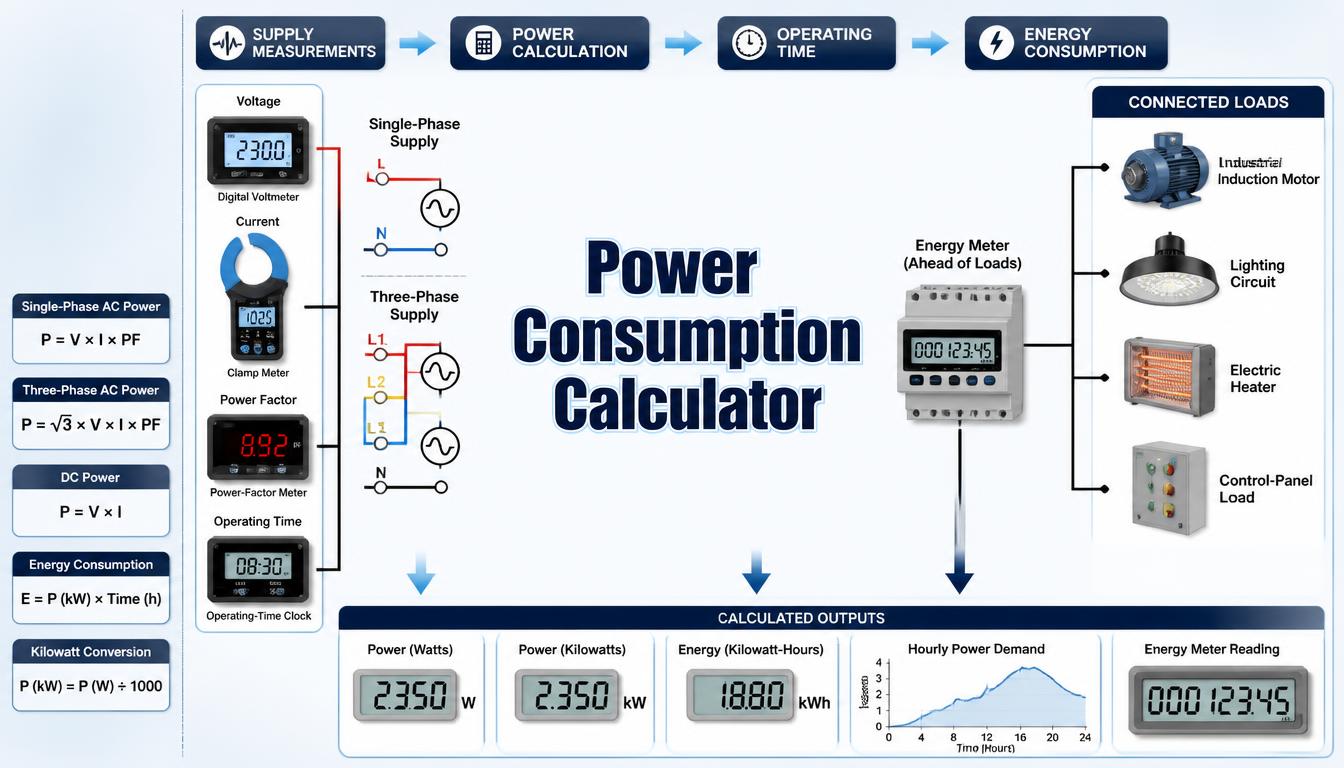
This guide explains the formulas used to calculate electrical energy consumption, the difference between power and energy, step-by-step calculation methods, practical examples, cost estimation, field considerations, and common mistakes. Correct power ratings, operating hours, duty cycles, and electricity tariffs are necessary for a realistic estimate.
What Is a Power Consumption Calculator?
A Power Consumption Calculator is an electrical tool that converts the power rating of a load and its operating duration into electrical energy consumption. The result is normally expressed in watt-hours (Wh) or kilowatt-hours (kWh), which are units of energy rather than instantaneous power.
The calculator can be used for lighting, heaters, air conditioners, pumps, motors, computers, household appliances, production machines, control panels, and other electrical loads. Depending on its available inputs, it may also estimate daily, monthly, and yearly electricity consumption and calculate the corresponding energy cost.
The calculated result is an estimate when the actual load varies during operation. For critical energy audits or billing verification, technicians should compare the estimate with readings from an approved energy meter, smart meter, power analyzer, or utility meter.
How Does a Power Consumption Calculator Work?
The calculator multiplies the electrical power consumed by the equipment by the number of hours it operates. If power is entered in watts, the result is divided by 1,000 to convert watt-hours into kilowatt-hours. It can then multiply the energy result by the electricity tariff to estimate operating cost.
-
- Enter the rated or measured power of the electrical load.
-
- Select the correct power unit, such as watts or kilowatts.
-
- Enter the number of operating hours per day.
-
- Enter the number of operating days for the required period.
-
- Enter the electricity tariff if an operating-cost estimate is required.
-
- Calculate and review the energy consumption in kWh.
For equipment that cycles on and off, changes speed, or operates under varying loads, the average input power or duty cycle should be used instead of assuming continuous operation at the nameplate rating.
Step-by-Step Process
-
- Identify the electrical appliance, machine, or group of loads to be calculated.
-
- Find its input power rating in watts or kilowatts from the nameplate or technical documentation.
-
- Use a power meter when the equipment has a variable or uncertain power demand.
-
- Enter the average number of hours the equipment operates each day.
-
- Enter the number of operating days in the calculation period.
-
- Apply a realistic duty-cycle factor if the equipment does not run continuously.
-
- Enter the applicable cost per kWh if electricity cost is required.
-
- Click Calculate and review the daily, monthly, or yearly energy result.
-
- Compare estimated values with meter readings when higher accuracy is required.
Power Consumption Calculator Formula
Energy Consumption in Kilowatt-Hours
E = (P × t) ÷ 1000
This formula is used when power is entered in watts. Multiplying watts by operating hours produces watt-hours. Dividing the result by 1,000 converts watt-hours into kilowatt-hours.
When Power Is Entered in Kilowatts
E = PkW × t
No division by 1,000 is required when the load power is already expressed in kilowatts. For example, a 2 kW load operating for three hours consumes 6 kWh, assuming it draws 2 kW continuously.
Consumption for Multiple Operating Days
Eperiod = PkW × h × d
This formula calculates energy over several days, where operating hours per day are multiplied by the number of operating days. It is useful for weekly, monthly, and annual estimates.
Electricity Cost Formula
Cost = E × R
The energy consumed in kWh is multiplied by the applicable electricity rate per kWh. Taxes, fixed service charges, demand charges, fuel adjustments, and time-of-use pricing may need to be added separately.
Formula with Duty Cycle
E = PkW × t × D
Duty cycle is entered as a decimal. For example, a load operating for half of the available time has a duty cycle of 0.50. This method is useful for thermostatically controlled heaters, compressors, pumps, refrigerators, and machines with intermittent operating cycles.
Formula Explanation
| Symbol | Description |
|---|---|
| E | Electrical energy consumption in kilowatt-hours (kWh) |
| Eperiod | Total energy used during the selected calculation period |
| P | Electrical power in watts (W) |
| PkW | Electrical power in kilowatts (kW) |
| t | Total operating time in hours |
| h | Operating hours per day |
| d | Number of operating days |
| D | Duty cycle expressed as a decimal from 0 to 1 |
| R | Electricity tariff or rate per kWh |
| Cost | Estimated energy charge in the selected currency |
Interactive Power Consumption Calculator
Use the calculator below to enter the power rating, operating time, and other required values to estimate electrical energy consumption.
⚡ Power Consumption Calculator
Calculate electrical energy consumption and estimated running cost.
Power Consumption Result
Enter values and press Calculate.
Energy (kWh) = Power (kW) × Hours × Days × Quantity
Estimated Cost = Energy (kWh) × Electricity Rate
Example 1 – Daily and Monthly Consumption of an Air Conditioner
Given:
-
- Input power = 1,500 W
-
- Operating time = 6 hours per day
-
- Calculation period = 30 days
Daily energy = (1,500 × 6) ÷ 1,000 = 9 kWh
Monthly energy = 9 × 30 = 270 kWh
The estimated consumption is 9 kWh per day and 270 kWh over 30 days. Actual air-conditioner consumption may be lower or higher because compressors cycle, cooling demand changes, ambient temperature varies, and inverter-driven units adjust their output. A measured average input power produces a more reliable result than the maximum nameplate rating.
Example 2 – Electricity Cost of an Electric Heater
Given:
-
- Heater power = 2 kW
-
- Operating time = 4 hours per day
-
- Operating period = 30 days
-
- Electricity tariff = 0.30 AED per kWh
Monthly energy = 2 × 4 × 30 = 240 kWh
Estimated cost = 240 × 0.30 = 72 AED
Under these assumptions, the heater consumes approximately 240 kWh and produces an energy charge of 72 AED during the month. The final utility bill may differ because the calculation excludes fixed charges, taxes, tiered tariffs, demand charges, and other adjustments.
Example 3 – Industrial Motor Energy Consumption
Given:
-
- Measured input power = 6.1 kW
-
- Operating time = 8 hours per shift
-
- Operating days = 25 days
Energy per shift = 6.1 × 8 = 48.8 kWh
Monthly energy = 48.8 × 25 = 1,220 kWh
The estimated monthly energy consumption is 1,220 kWh. For a motor, the shaft-output rating should not automatically be treated as electrical input power. Motor efficiency, mechanical loading, power factor, supply conditions, and operating pattern affect the actual electrical demand. Input power measured by a suitable three-phase power analyzer is preferable for a detailed energy assessment.
Example 4 – Refrigerator Consumption Using Duty Cycle
Given:
-
- Running power = 200 W or 0.20 kW
-
- Available time = 24 hours per day
-
- Estimated duty cycle = 40% or 0.40
-
- Calculation period = 30 days
Daily energy = 0.20 × 24 × 0.40 = 1.92 kWh
Monthly energy = 1.92 × 30 = 57.6 kWh
Using a 40% duty cycle gives an estimated monthly consumption of 57.6 kWh. The compressor duty cycle may change with room temperature, thermostat setting, door opening, stored contents, ventilation, and equipment condition. A plug-in energy meter can provide a better average over several representative days.
Practical Field Considerations for Power Consumption Calculations
In practical installations, the equipment nameplate is a useful starting point, but it may show maximum input, rated output, current, capacity, or another operating value. Before performing the calculation, confirm what the stated rating represents. Confusing motor shaft output with electrical input or using an appliance’s maximum rating as its continuous demand can produce an unrealistic energy estimate.
Loads controlled by thermostats, pressure switches, PLC sequences, timers, variable-frequency drives, and production demand rarely operate continuously at one fixed power level. For these applications, use measured average power, separate the operating cycle into stages, or apply a realistic duty-cycle factor.
For three-phase machines and nonlinear electronic loads, voltage and current readings alone may not provide accurate real-power consumption. Power factor, phase balance, harmonics, and changing load conditions can affect the result. A compatible power analyzer or energy meter should be used when measurement accuracy is important.
Electricity cost also requires the correct tariff structure. A simple energy rate produces an approximate consumption charge, but many commercial and industrial bills include demand charges, time-of-use rates, reactive-energy penalties, taxes, and fixed fees. Review the applicable utility tariff before using an estimated cost for budgeting.
Applications of a Power Consumption Calculator
Industrial Applications
-
- Estimating machine and production-line energy use
-
- Comparing operating schedules and duty cycles
-
- Preparing preliminary energy budgets
-
- Identifying high-consumption equipment
-
- Evaluating potential energy-saving projects
Electrical and Automation Applications
-
- Estimating control-panel energy consumption
-
- Evaluating motors, pumps, fans, VFDs, and heaters
-
- Planning energy monitoring with PLC or SCADA systems
-
- Comparing measured consumption with expected operation
-
- Supporting generator, UPS, and battery-energy studies
Residential and Commercial Applications
-
- Estimating appliance operating costs
-
- Comparing lighting and air-conditioning options
-
- Calculating office-equipment consumption
-
- Estimating monthly electricity use
-
- Understanding which loads contribute most to a bill
Advantages of a Power Consumption Calculator
-
- Converts watts and operating hours into energy consumption.
-
- Reduces repetitive manual calculations.
-
- Provides daily, monthly, or yearly estimates.
-
- Helps estimate the energy portion of electricity cost.
-
- Supports comparisons between appliances and machines.
-
- Helps identify energy-saving opportunities.
-
- Demonstrates the relationship between power, time, and energy.
Limitations
-
- The result depends on the accuracy of the entered power and operating time.
-
- Nameplate ratings may not represent average power consumption.
-
- Variable loads require measured average power or a realistic operating profile.
-
- A simplified cost calculation may exclude taxes, fixed fees, and demand charges.
-
- Standby consumption may require a separate calculation.
-
- The calculation does not replace an energy meter or professional energy audit.
-
- Actual consumption may change with load, temperature, maintenance condition, and user behavior.
Common Mistakes
-
- Confusing kilowatts of power with kilowatt-hours of energy.
-
- Forgetting to divide watts by 1,000 when calculating kWh.
-
- Using minutes as though they were hours.
-
- Assuming equipment operates continuously at its rated power.
-
- Ignoring standby or idle consumption.
-
- Using motor-output power as electrical input power.
-
- Ignoring power factor when estimating three-phase real power from voltage and current.
-
- Applying an incorrect electricity tariff.
-
- Ignoring different operating schedules on weekends and holidays.
-
- Treating an estimated result as a verified meter reading.
Frequently Asked Questions
What is a Power Consumption Calculator?
A Power Consumption Calculator estimates the electrical energy consumed by a load based on its power rating and operating time. Results are commonly displayed in Wh or kWh.
How do I calculate power consumption in kWh?
Multiply power in kilowatts by operating time in hours. If the power is in watts, multiply it by the number of hours and divide the result by 1,000.
What is the difference between kW and kWh?
A kilowatt measures power at a particular moment, while a kilowatt-hour measures energy used over time. A 1 kW load operating for one hour consumes 1 kWh.
Can the calculator estimate an electricity bill?
It can estimate the energy charge by multiplying kWh by the electricity rate. The final bill may also include fixed fees, taxes, demand charges, and tariff adjustments.
Should I use rated or measured power?
Rated power is suitable for a preliminary estimate. Measured average input power is normally better for equipment with changing loads, operating cycles, or variable-speed control.
How is duty cycle used in an energy calculation?
Multiply power and available operating time by the duty cycle expressed as a decimal. A 40% duty cycle is entered as 0.40.
Can I calculate the consumption of several appliances?
Yes. Calculate each appliance separately using its own power and operating time, then add the individual kWh results to obtain total consumption.
Why can actual consumption differ from the calculated value?
Actual consumption can vary because of duty cycle, changing load, supply conditions, temperature, equipment efficiency, standby use, maintenance condition, and user behavior.
Related Electrical Calculators
Helpful Electrical Engineering Resources
Conclusion
A Power Consumption Calculator provides a practical way to convert equipment power and operating time into Wh or kWh. It can be used to estimate the daily, monthly, or annual consumption of household appliances, commercial equipment, control systems, and industrial machinery.
Reliable results require correct units, realistic operating hours, and an appropriate power value. Equipment with variable loading or intermittent operation may require an average measured input or duty-cycle adjustment. Critical results should be compared with manufacturer documentation and readings from a suitable energy meter or power analyzer.
Tech Volt Lab provides practical electrical and automation calculators that help technicians, students, and engineers understand formulas and evaluate real-world systems. Use calculated consumption as a planning estimate and apply the relevant technical, tariff, and installation requirements before making final decisions.
Explore More Engineering Calculators
Discover more free electrical and automation calculators designed for electricians, PLC programmers, maintenance technicians, and engineers.
View All Calculators