 Tech Volt Lab Automation | PLC | SCADA | Electrical | Electronics

Related Articles

Power conversion is a routine task in electrical and mechanical engineering. Whether you’re selecting an electric motor, configuring a Variable Frequency Drive (VFD), replacing industrial equipment, or comparing manufacturer specifications, you may encounter power ratings expressed in either kilowatts (kW) or horsepower (HP).
A KW to HP Calculator makes this conversion quick, accurate, and hassle-free. Although kilowatts are the standard SI unit of power, horsepower is still widely used for electric motors, pumps, compressors, generators, and other industrial machinery. Because equipment manufacturers around the world use different rating systems, engineers and technicians often need to convert between these units before selecting or replacing a motor. Performing the conversion correctly helps ensure that the chosen equipment matches the required load and operating conditions.
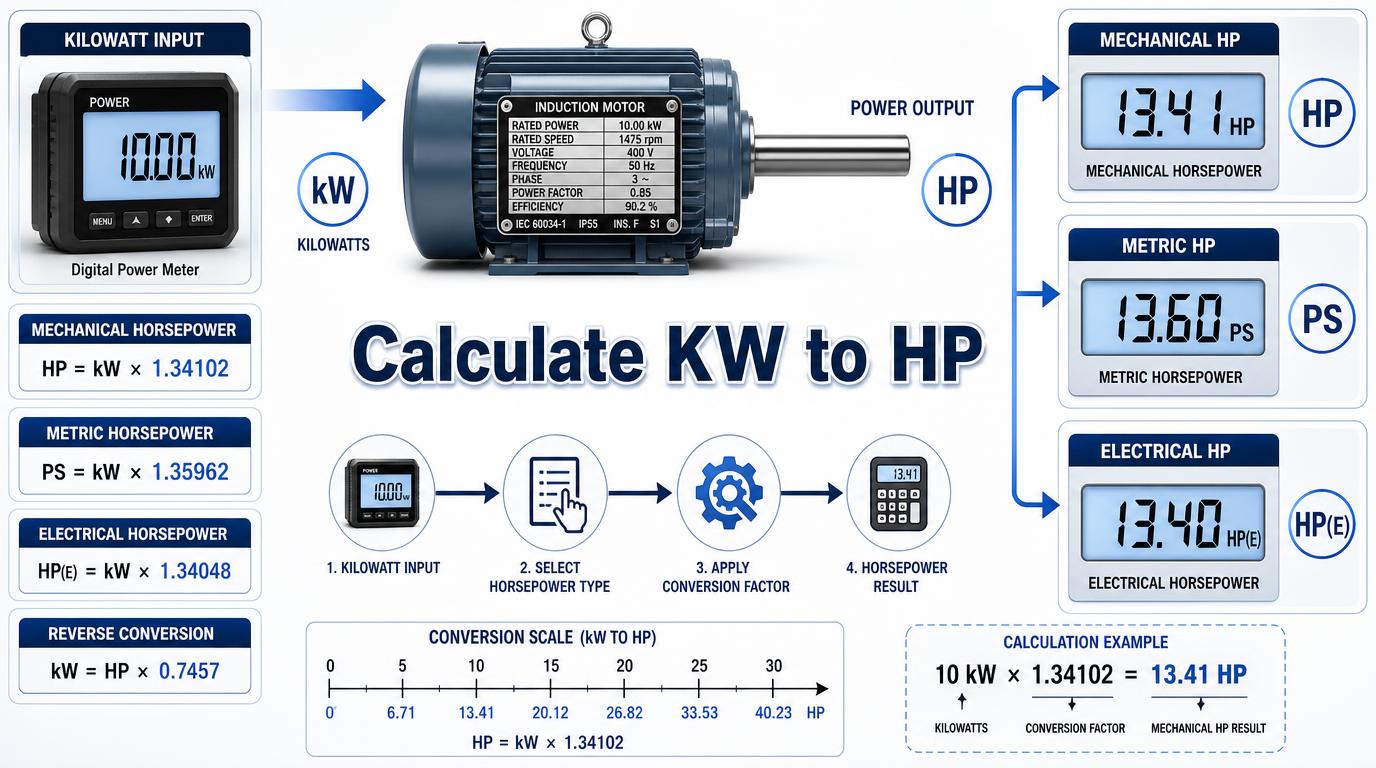
While the calculation itself is straightforward, using a dedicated conversion tool saves time and reduces the chance of manual errors. This is especially valuable during plant maintenance, equipment upgrades, project design, and troubleshooting, where accurate information is essential for making reliable engineering decisions.
In this guide, you’ll learn how to convert kilowatts to horsepower, understand the formula behind the calculation, explore practical engineering examples, and discover where this conversion is commonly used in industrial, electrical, and automation applications. Whether you’re an electrician, PLC technician, automation engineer, maintenance professional, or engineering student, this guide will help you perform power conversions with confidence.
What Is a KW to HP Calculator?
A KW to HP Calculator is a simple engineering tool that converts power from kilowatts (kW) to horsepower (HP). It uses a standard conversion factor to provide an accurate result within seconds, eliminating the need for manual calculations. This makes it a valuable resource for anyone working with electric motors, industrial machinery, or mechanical equipment.
Power ratings are not always displayed using the same unit. In many countries, motor manufacturers specify output power in kilowatts because it is the internationally recognized SI unit. However, horsepower is still widely used in older equipment, North American industries, and many equipment catalogs. As a result, engineers and technicians often need to convert between these units when comparing products or selecting replacement motors.
Using a conversion calculator helps avoid mistakes that could lead to undersized or oversized equipment. For example, selecting the wrong motor may affect machine performance, increase energy consumption, or shorten equipment life. A quick and accurate conversion allows you to compare specifications with confidence before making purchasing or design decisions.
This calculator is commonly used by electrical engineers, industrial electricians, PLC programmers, automation engineers, maintenance technicians, mechanical engineers, consultants, and engineering students. It is equally useful in manufacturing plants, commercial buildings, water treatment facilities, HVAC systems, agricultural applications, and educational laboratories where motor power calculations are part of everyday work.
Whether you are preparing technical documentation, selecting a VFD, replacing an existing motor, or simply verifying a nameplate rating, converting kilowatts into horsepower is a basic but essential engineering task.
How Does a KW to HP Calculator Work?
The calculator performs a straightforward mathematical conversion using a fixed relationship between kilowatts and horsepower. Once a power value is entered in kilowatts, it multiplies that value by the standard conversion factor to determine the equivalent horsepower. Since this factor is internationally accepted, the calculation remains accurate regardless of the application.
The standard conversion is:
1 kW = 1.341022 HP
For example, if an electric motor has a rated output of 7.5 kW, the calculation is:
7.5 × 1.341022 = 10.06 HP
This means the motor delivers approximately 10 horsepower. In practice, engineers normally compare this value with the nearest standard motor rating available from the manufacturer.
Modern online calculators perform this calculation instantly, making them useful during equipment selection, commissioning, maintenance, and troubleshooting. Instead of relying on printed conversion charts or performing manual calculations with a calculator, engineers can obtain consistent results in just a few seconds.
Although the conversion itself is simple, it is important to remember that motor selection should never be based on power alone. Other factors such as voltage, current, frequency, efficiency, speed (RPM), duty cycle, enclosure type, service factor, and starting method should also be considered before selecting or replacing electrical equipment.
Step-by-Step Process
- Identify the Motor Power
Locate the power rating on the equipment nameplate, technical datasheet, or manufacturer’s documentation. Ensure the value is expressed in kilowatts (kW). - Enter the kW Value
Type the kilowatt value into the calculator. Most calculators accept both whole numbers and decimal values such as 0.75, 2.2, 5.5, or 18.5. - Perform the Conversion
The calculator automatically multiplies the entered value by the standard conversion factor of 1.341022. - Read the Horsepower Result
The equivalent horsepower is displayed instantly. Depending on the application, the result may be rounded to two decimal places for easier reference. - Verify Before Equipment Selection
Before purchasing or installing a motor, confirm other important specifications including supply voltage, operating frequency, full-load current, RPM, frame size, mounting arrangement, insulation class, and service factor. Matching horsepower alone does not guarantee compatibility.
Following these simple steps helps ensure accurate power conversion and supports better engineering decisions during design, maintenance, and equipment replacement projects.
KW to HP Calculator Formula
Formula
Horsepower (HP) = Kilowatts (kW) × 1.341022
Formula Explanation
The conversion from kilowatts to horsepower is based on an internationally recognized conversion factor. Since one kilowatt is equal to approximately 1.341022 horsepower, multiplying the power value in kilowatts by this constant provides the equivalent horsepower. This formula is widely used in electrical engineering, mechanical engineering, and industrial automation when comparing motor ratings or selecting replacement equipment.
Variable Definitions
- HP = Horsepower
- kW = Kilowatts (power)
- 1.341022 = Standard conversion factor from kilowatts to horsepower
Worked Example
An industrial water pump is driven by a motor rated at 15 kW. To determine the equivalent horsepower:
HP = 15 × 1.341022
HP = 20.12 HP
This means a 15 kW motor produces approximately 20 horsepower. During equipment replacement, this conversion helps engineers compare motor ratings from different manufacturers while ensuring the selected motor meets the required power output.
Quick kW to HP Conversion Table
| Power in kW | Power in HP |
|---|---|
| 0.75 kW | 1.01 HP |
| 1.5 kW | 2.01 HP |
| 2.2 kW | 2.95 HP |
| 3.7 kW | 4.96 HP |
| 5.5 kW | 7.38 HP |
| 7.5 kW | 10.06 HP |
| 11 kW | 14.75 HP |
| 15 kW | 20.12 HP |
| 22 kW | 29.50 HP |
| 37 kW | 49.62 HP |
This table gives quick reference values, while the KW to HP Calculator is better when you need an exact result for any custom motor power rating.
Interactive KW to HP Calculator
Use this KW to HP Calculator to convert kilowatts into horsepower instantly. Enter the motor power in kW, and the tool will show the equivalent HP value for motor sizing, VFD selection, equipment comparison, and maintenance work.
⚡ kW to HP Calculator
Convert kilowatts to horsepower and horsepower to kilowatts.
Conversion Result
Enter a power value.
Mechanical: 1 kW = 1.341022 HP
Metric: 1 kW = 1.35962 metric HP
Example 1: Converting a 5.5 kW Motor to Horsepower
A maintenance technician needs to replace a centrifugal pump motor rated at 5.5 kW. The replacement motor catalog lists power ratings only in horsepower.
Using the conversion formula:
HP = 5.5 × 1.341022 = 7.38 HP
The nearest standard motor size is 7.5 HP. The engineer can now compare motor specifications confidently before ordering the replacement.
Example 2: Selecting a VFD for an Industrial Conveyor
An automation engineer is configuring a Variable Frequency Drive (VFD) for a conveyor system powered by an 11 kW induction motor. The VFD documentation specifies motor compatibility in horsepower.
Calculation:
HP = 11 × 1.341022 = 14.75 HP
The engineer selects a 15 HP VFD that matches the motor’s electrical characteristics and application requirements.
Example 3: Comparing Motor Specifications from Different Manufacturers
During a plant upgrade, two motor suppliers provide quotations using different power units. One motor is rated at 15 kW, while the other is listed as 20 HP.
Using the conversion formula:
15 × 1.341022 = 20.12 HP
The engineer confirms that both motors deliver nearly the same output power, allowing other factors such as efficiency, frame size, warranty, and price to influence the final purchasing decision.
Example 4: Motor Replacement During Preventive Maintenance
An industrial air compressor uses a motor rated at 22 kW. The available spare motor is identified only as 30 HP.
Calculation:
22 × 1.341022 = 29.50 HP
The converted value confirms that the spare motor closely matches the original equipment. After verifying voltage, speed, mounting arrangement, and full-load current, the maintenance team safely installs the replacement motor.
My Experience with a KW to HP Calculator
While working on industrial automation and electrical maintenance projects, I’ve found that one of the most common challenges is comparing equipment from different manufacturers. Some motor nameplates display power in kilowatts, while older documentation, imported machinery, or supplier catalogs often use horsepower.
During one motor replacement project, the existing machine had a 15 kW motor, but the replacement supplier only stocked motors rated in horsepower. Instead of manually calculating the conversion each time, using a reliable conversion calculator allowed the maintenance team to confirm that a 20 HP motor was the correct equivalent before checking other specifications.
I’ve also seen this conversion used frequently when configuring VFDs, preparing electrical documentation, reviewing equipment quotations, and training junior technicians. Although the calculation itself is simple, having a dedicated calculator reduces the risk of mistakes and speeds up engineering decisions, especially during plant shutdowns where every minute counts.
Applications of a KW to HP Calculator
Industrial Applications
- Motor replacement planning
- Pump and compressor selection
- Manufacturing equipment upgrades
- Machine specification comparison
- Preventive maintenance planning
Electrical Applications
- Motor sizing
- Electrical panel documentation
- Generator comparison
- Power system calculations
- Engineering design projects
Automation Applications
- Variable Frequency Drive (VFD) selection
- PLC-controlled motor systems
- Industrial automation projects
- SCADA documentation
- Machine commissioning and troubleshooting
Advantages of a KW to HP Calculator
- Provides fast and accurate power conversion.
- Reduces manual calculation errors.
- Saves time during equipment selection.
- Helps compare motors from different manufacturers.
- Useful for electricians, engineers, and students.
- Supports motor replacement planning.
- Improves engineering documentation accuracy.
- Easy to use on computers and mobile devices.
Limitations
- Converts power units only and does not determine motor suitability.
- Does not consider efficiency or power factor.
- Cannot replace a complete motor selection calculation.
- Does not account for duty cycle or service factor.
- Mechanical installation requirements must still be verified separately.
- Voltage, frequency, RPM, and full-load current must always be checked before replacing a motor.
Common Mistakes
- Confusing kilowatts with kilovolt-amperes (kVA).
- Selecting a replacement motor based only on horsepower.
- Ignoring motor voltage and operating frequency.
- Overlooking frame size and shaft dimensions.
- Using rounded values for critical engineering calculations.
- Assuming all motors with the same horsepower have identical electrical characteristics.
- Not checking the manufacturer’s specifications before installation.
To avoid these issues, always use the power conversion as one part of the motor selection process. Confirm all electrical and mechanical specifications before purchasing or installing new equipment.
Why Use a KW to HP Calculator for Motor Selection?
A KW to HP Calculator is useful when motor ratings are shown in different units on nameplates, catalogs, quotations, or technical manuals. It helps electricians and engineers compare equipment quickly without depending on rough guesses.
For example, if a machine manual mentions a 22 kW motor and the supplier offers a 30 HP replacement, the calculator helps confirm that both ratings are very close. After that, you still need to check voltage, current, RPM, frame size, mounting type, and duty cycle before final selection.
Convert motor power first, then estimate full-load amperes with the Motor Current Calculator. For rotating-load checks, compare the result with the Torque Calculator.
Frequently Asked Questions (FAQs)1. How do I convert kW to HP?
Multiply the kilowatt value by 1.341022. For example, 10 kW × 1.341022 = 13.41 HP.
2. What is the formula for converting kilowatts to horsepower?
The standard formula is HP = kW × 1.341022.
3. Is horsepower the same as kilowatts?
No. Both measure power, but kilowatts are the SI unit of power, while horsepower is a traditional unit commonly used for motors, engines, pumps, and compressors.
4. Why do motor manufacturers use kW and HP?
Many international manufacturers use kilowatts because it is the SI unit. Horsepower is still common in older equipment, North American catalogs, and many motor applications.
5. Can I replace a 15 kW motor with a 20 HP motor?
15 kW is approximately 20.12 HP, so the power rating is very close. However, always check voltage, frequency, RPM, frame size, mounting type, full-load current, and service factor before replacing a motor.
6. Does this calculator work for three-phase motors?
Yes. This calculator only converts power units so that it can be used for single-phase motors, three-phase motors, pumps, compressors, generators, and other equipment.
7. Can I use kW to HP conversion for VFD selection?
Yes, it helps compare motor ratings. But when selecting a VFD, you should also consider motor current, supply voltage, overload capacity, application type, braking requirements, and duty cycle.
8. Is this conversion accurate for engineering calculations?
Yes. The conversion factor 1 kW = 1.341022 HP is accurate for standard power conversion. For final motor selection, always confirm the complete motor nameplate data.
Related Electrical Calculators
- HP to kW Calculator
- Motor Current Calculator
- Voltage Drop Calculator
Helpful Electrical Engineering Resources
1. IEC – International Electrotechnical Commission
Learn about international electrical standards used for motors, industrial equipment, and electrical installations.
2. NEMA – National Electrical Manufacturers Association
Provides motor standards, technical publications, and engineering resources widely used in industry.
3. IEEE – Institute of Electrical and Electronics Engineers
Offers engineering standards, research papers, and educational resources for electrical and automation professionals.
Conclusion
A kW-to-HP Calculator is a practical tool for anyone working with electric motors, pumps, compressors, VFDs, generators, and industrial machines. It makes kilowatt-to-horsepower conversion fast, accurate, and easy to understand during maintenance, design, troubleshooting, and equipment replacement work.
A reliable conversion calculator simplifies this task by providing accurate results within seconds, reducing manual calculation errors and saving valuable time. However, power conversion should always be considered alongside other important motor specifications such as voltage, frequency, current, speed, efficiency, frame size, and service factor. These factors are equally important when selecting or replacing industrial equipment.
We hope this guide has helped you understand not only the conversion formula but also its practical use in real-world applications. Bookmark this calculator for future projects and explore our other free electrical engineering calculators to simplify everyday calculations and improve engineering accuracy.
Explore More Free Electrical Calculators
Looking for more engineering tools? Tech Volt Lab offers free calculators for motor current, cable sizing, voltage drop, power factor, Ohm’s Law, and many other electrical calculations.
