 Tech Volt Lab Automation | PLC | SCADA | Electrical | Electronics

Related Articles

A Resistor Color Code Calculator helps electronics technicians, electrical engineers, automation professionals, students, and hobbyists decode the resistance value represented by colored bands on an axial resistor. By selecting the number of bands and their colors, the calculator determines resistance, multiplier, tolerance, and, where applicable, temperature coefficient. Resistor color bands provide a compact marking system for components that are too small for a complete printed value. Correctly reading these bands is important when repairing electronic circuits, assembling control boards, replacing damaged components, checking spare parts, and verifying resistor values before installation.
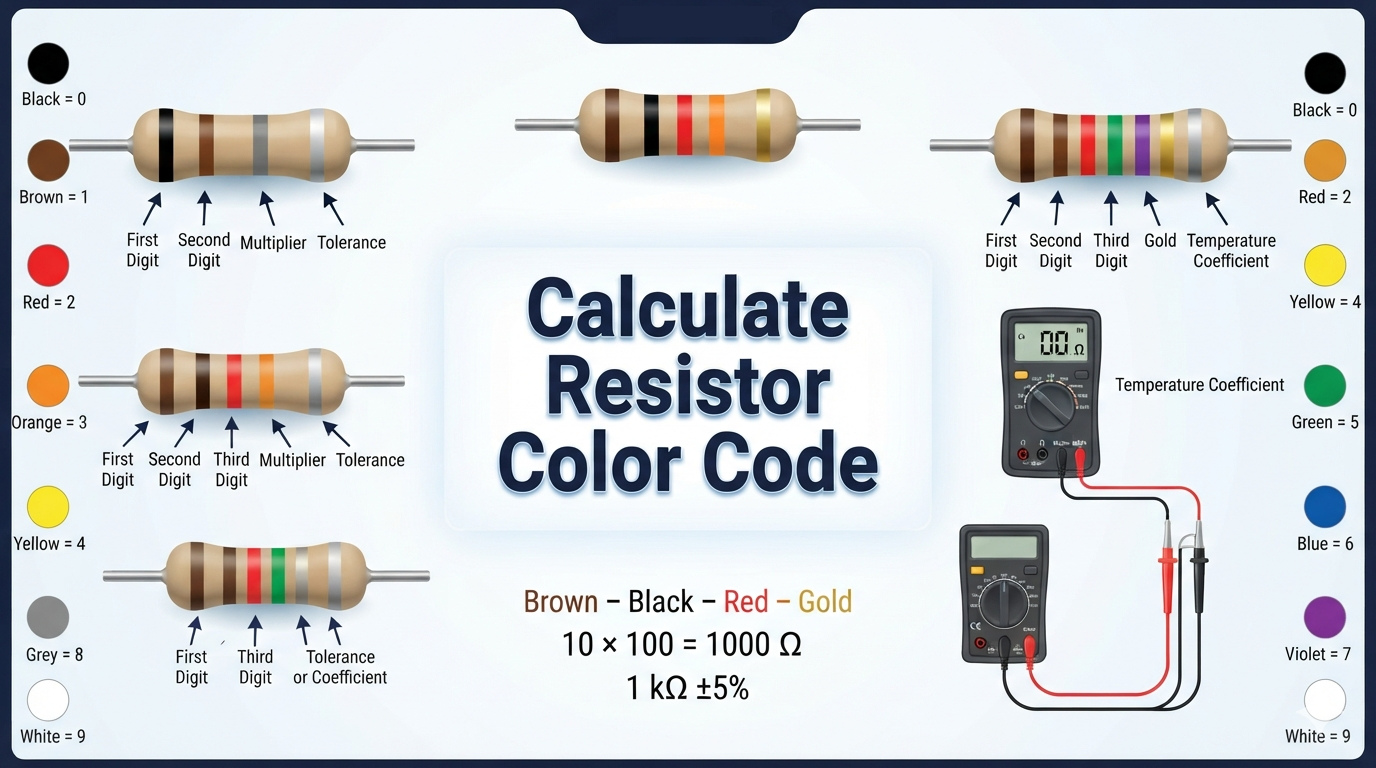
This guide explains how 4-band, 5-band, and 6-band resistor codes work, the meaning of each color, calculation formulas, tolerance ranges, practical examples, and common reading mistakes. For critical work, the decoded value should be confirmed with the component datasheet or a suitable resistance meter.
What Is a Resistor Color Code Calculator?
A Resistor Color Code Calculator is an electronics tool that converts a resistor’s colored bands into a numerical resistance value. Each color represents a digit, multiplier, tolerance, or temperature coefficient depending on its location and the total number of bands.
Most commonly encountered axial resistors use four, five, or six bands. A 4-band resistor contains two significant digits, a multiplier, and a tolerance band. A 5-band resistor contains three significant digits, a multiplier, and a tolerance band. A 6-band resistor normally adds a temperature-coefficient band to the 5-band arrangement.
The calculator reduces the chance of confusing similar colors, applying the wrong multiplier, or reading the bands from the wrong direction. It is particularly useful when decoding multiple resistors during circuit assembly, inspection, troubleshooting, or laboratory work.
How Does a Resistor Color Code Calculator Work?
The calculator assigns a numerical meaning to each selected color. It combines the significant digits into a number and multiplies that number by the multiplier represented by the next band. The tolerance band determines the permitted variation around the nominal resistance.
-
- Select a 4-band, 5-band, or 6-band resistor.
-
- Identify the correct reading direction.
-
- Select each band color in sequence.
-
- Combine the significant digits.
-
- Apply the multiplier band.
-
- Apply the tolerance percentage.
-
- Read the temperature coefficient when a sixth band is present.
For example, brown represents 1, black represents 0, and red represents a multiplier of 100. A 4-band resistor with brown, black, red, and gold bands has a nominal resistance of 1,000 Ω, or 1 kΩ, with a tolerance of ±5%.
Step-by-Step Process
-
- Count the number of colored bands on the resistor.
- Locate the tolerance band, which is often separated by a larger gap.
- Hold the resistor so the significant-digit bands begin on the left.
- Select 4-band, 5-band, or 6-band mode in the calculator.
- Enter the colors in the same order as they appear on the resistor.
- Read the calculated nominal resistance in Ω, kΩ, or MΩ.
- Review the tolerance and minimum-to-maximum resistance range.
- Check the temperature coefficient if the resistor has six bands.
- Confirm uncertain or critical values with a meter or datasheet.
Resistor Color Code Calculator Formula
Four-Band Resistor Formula
R = (10 × D1 + D2) × M
In a 4-band resistor, the first two bands are significant digits. The third band is the multiplier, and the fourth band indicates tolerance.
Five-Band Resistor Formula
R = (100 × D1 + 10 × D2 + D3) × M
A 5-band resistor uses three significant digits, allowing more precise resistance values to be marked. The fourth band is the multiplier, while the fifth is the tolerance band.
Six-Band Resistor Formula
R = (100 × D1 + 10 × D2 + D3) × M
The resistance calculation for a common 6-band resistor is the same as for a 5-band resistor. The sixth band normally indicates the temperature coefficient of resistance, commonly expressed in parts per million per kelvin (ppm/K).
Tolerance Range Formula
Rmin = R × (1 − T ÷ 100)
Rmax = R × (1 + T ÷ 100)
Tolerance defines the permitted variation from nominal resistance. A 1 kΩ resistor with ±5% tolerance may have an actual value between 950 Ω and 1,050 Ω when considered against its specified resistance tolerance.
Formula Explanation
| Symbol | Description |
|---|---|
| R | Nominal resistance in ohms (Ω) |
| D1 | First significant digit |
| D2 | Second significant digit |
| D3 | Third significant digit on 5-band and 6-band resistors |
| M | Multiplier represented by the multiplier band |
| T | Resistance tolerance as a percentage |
| Rmin | Minimum resistance permitted by the stated tolerance |
| Rmax | Maximum resistance permitted by the stated tolerance |
| ppm/K | Change in resistance per million parts for each kelvin of temperature change |
Resistor Color Digit and Multiplier Table
| Color | Digit | Common Multiplier |
|---|---|---|
| Black | 0 | ×1 |
| Brown | 1 | ×10 |
| Red | 2 | ×100 |
| Orange | 3 | ×1,000 |
| Yellow | 4 | ×10,000 |
| Green | 5 | ×100,000 |
| Blue | 6 | ×1,000,000 |
| Violet | 7 | ×10,000,000 |
| Grey | 8 | ×100,000,000 |
| White | 9 | ×1,000,000,000 |
| Gold | Not used | ×0.1 |
| Silver | Not used | ×0.01 |
Common Resistor Tolerance Colors
| Color | Tolerance |
|---|---|
| Brown | ±1% |
| Red | ±2% |
| Green | ±0.5% |
| Blue | ±0.25% |
| Violet | ±0.1% |
| Grey | ±0.05% |
| Gold | ±5% |
| Silver | ±10% |
| No band | ±20% |
Some specialized resistors and newer marking systems may use additional colors or band meanings. Always consult the component datasheet when the markings do not match the common arrangements shown above.
Interactive Resistor Color Code Calculator
Use the calculator below to select the number of bands and their colors, then decode the resistor value, multiplier, tolerance, and temperature coefficient.
⚡ Resistor Color Code Calculator
Decode 4-band and 5-band resistor color codes into resistance and tolerance.
Resistor Value Result
Select color bands and press Calculate.
4 Band: R = (D1D2) × Multiplier
5 Band: R = (D1D2D3) × Multiplier
Example 1 – Decode a 1 kΩ Four-Band Resistor
Given color bands:
-
- First band: Brown = 1
-
- Second band: Black = 0
-
- Third band: Red = ×100
-
- Fourth band: Gold = ±5%
R = (10 × 1 + 0) × 100
R = 10 × 100 = 1,000 Ω = 1 kΩ
Minimum value = 1,000 × 0.95 = 950 Ω
Maximum value = 1,000 × 1.05 = 1,050 Ω
The resistor has a nominal value of 1 kΩ with ±5% tolerance. Its resistance may fall between 950 Ω and 1,050 Ω within the stated tolerance specification.
Example 2 – Decode a 4.7 Ω Four-Band Resistor
Given color bands:
-
- First band: Yellow = 4
-
- Second band: Violet = 7
-
- Third band: Gold = ×0.1
-
- Fourth band: Gold = ±5%
R = (10 × 4 + 7) × 0.1
R = 47 × 0.1 = 4.7 Ω
This example shows why gold can be used as a multiplier band. It shifts the decimal position to produce resistance values below 10 Ω. The same gold color represents ±5% only when it is positioned as the tolerance band.
Example 3 – Decode a 10 kΩ Five-Band Resistor
Given color bands:
-
- First band: Brown = 1
-
- Second band: Black = 0
-
- Third band: Black = 0
-
- Fourth band: Red = ×100
-
- Fifth band: Brown = ±1%
R = (100 × 1 + 10 × 0 + 0) × 100
R = 100 × 100 = 10,000 Ω = 10 kΩ
Minimum value = 10,000 × 0.99 = 9,900 Ω
Maximum value = 10,000 × 1.01 = 10,100 Ω
The decoded value is 10 kΩ with ±1% tolerance. The third significant digit distinguishes the 5-band system from a normal 4-band resistor and supports the marking of more precise preferred values.
Example 4 – Decode a Six-Band Precision Resistor
Given color bands:
-
- First band: Orange = 3
-
- Second band: Orange = 3
-
- Third band: Black = 0
-
- Fourth band: Brown = ×10
-
- Fifth band: Brown = ±1%
-
- Sixth band: Red = commonly 50 ppm/K
R = 330 × 10 = 3,300 Ω = 3.3 kΩ
The resistor has a nominal value of 3.3 kΩ with ±1% tolerance. In the common 6-band arrangement, the red sixth band indicates a temperature coefficient of 50 ppm/K. Because specialized parts can use additional bands differently, the manufacturer’s datasheet remains the final reference.
Practical Field Considerations for Resistor Color Codes
The first practical challenge is determining the correct reading direction. The tolerance band is often gold, silver, or another precision-tolerance color and is commonly positioned farther from the other bands. Hold that band on the right before decoding from left to right.
Component age, overheating, contamination, poor lighting, and body color can make brown, red, orange, blue, violet, and grey bands difficult to distinguish. When colors are unclear, compare the resistor with known components under neutral white light and verify the final value with a resistance meter.
Measure an installed resistor carefully because surrounding circuit components can affect an in-circuit resistance reading. For a reliable measurement, disconnect power, discharge stored energy safely, and isolate one resistor lead from the circuit when required.
The color code does not normally identify a resistor’s power rating. Wattage is associated with construction, physical size, materials, thermal conditions, and manufacturer specifications. Two resistors with the same color bands may have the same resistance but different power ratings and operating capabilities.
Applications of a Resistor Color Code Calculator
Electronics Applications
-
- Decoding through-hole resistors
-
- Assembling prototype and production circuit boards
-
- Checking component kits and spare parts
-
- Replacing damaged resistors during repair
-
- Verifying values before soldering
Industrial and Automation Applications
-
- Repairing PLC input and output modules
-
- Inspecting control-panel electronic boards
-
- Checking signal-conditioning circuits
-
- Maintaining power-supply and interface boards
-
- Identifying resistors in sensor and actuator circuits
Educational Applications
-
- Learning resistance units and multipliers
-
- Practising 4-band, 5-band, and 6-band decoding
-
- Understanding tolerance ranges
-
- Preparing electronics laboratory exercises
-
- Checking manually calculated resistor values
Advantages of a Resistor Color Code Calculator
-
- Decodes resistor values without memorizing every multiplier.
-
- Supports common 4-band, 5-band, and 6-band arrangements.
-
- Displays resistance in readable Ω, kΩ, or MΩ units.
-
- Helps calculate minimum and maximum tolerance values.
-
- Reduces mistakes caused by misplaced decimal points.
-
- Saves time when checking multiple resistors.
-
- Supports electronics training and troubleshooting.
Limitations
-
- The result depends on selecting the correct band colors and reading direction.
-
- Faded or heat-damaged bands may be misidentified.
-
- Specialized resistors may use manufacturer-specific markings.
-
- The color bands do not normally provide the complete power rating.
-
- The nominal value does not confirm the resistor’s actual measured condition.
-
- In-circuit meter readings can be affected by parallel components.
-
- SMD resistors normally use printed codes rather than color bands.
Common Mistakes
-
- Reading the resistor from the wrong direction.
-
- Confusing brown with red or orange.
-
- Confusing blue with violet.
-
- Using a 4-band formula for a 5-band resistor.
-
- Treating the multiplier band as another significant digit.
-
- Using gold or silver as a significant digit.
-
- Ignoring tolerance when selecting a replacement.
-
- Assuming physical size changes the resistance value.
-
- Assuming the color code provides the resistor wattage.
-
- Measuring resistance in circuit without considering parallel paths.
Frequently Asked Questions
What is a Resistor Color Code Calculator?
A Resistor Color Code Calculator converts the colored bands on a resistor into its nominal resistance, multiplier, tolerance, and temperature coefficient where applicable.
How do I know which direction to read a resistor?
The tolerance band is commonly separated by a wider gap and should normally be positioned on the right. Read the significant-digit bands from left to right.
What is the difference between 4-band and 5-band resistors?
A 4-band resistor uses two significant digits, while a 5-band resistor uses three. The additional digit allows more precise resistance values to be marked.
What does the sixth resistor band mean?
On a common 6-band resistor, the sixth band indicates temperature coefficient in ppm/K. Specialized components may use extra bands differently, so consult the datasheet when uncertain.
What do gold and silver bands represent?
As multipliers, gold represents ×0.1 and silver represents ×0.01. As tolerance bands, gold commonly represents ±5%, and silver represents ±10%.
Can resistor color bands show wattage?
Not normally. Power rating depends on resistor construction, physical dimensions, materials, temperature, and manufacturer specifications rather than the standard resistance color code.
Why does my meter show a different resistance?
The difference may result from tolerance, temperature, component damage, meter accuracy, or parallel circuit paths when the resistor is measured in circuit.
Can this calculator decode SMD resistors?
A color-band calculator is intended mainly for axial resistors. SMD resistors generally require a separate calculator for three-digit, four-digit, or EIA-96 printed codes.
Related Electrical Calculators
Helpful Electrical Engineering Resources
Conclusion
A Resistor Color Code Calculator provides a convenient way to decode the significant digits, multiplier, tolerance, and temperature coefficient marked on axial resistors. It supports technicians and students who need to identify components quickly without manually memorizing every possible band combination.
Correct results depend on counting the bands correctly, identifying the reading direction, and distinguishing similar colors. When a resistor is faded, overheated, unusually marked, or installed in a complex circuit, verify its identity with the manufacturer’s documentation and confirm its value using an appropriate measurement method.
Tech Volt Lab provides practical electrical, electronics, and automation calculators for engineers, electricians, PLC technicians, maintenance professionals, and students. Use the decoded resistance as a technical reference and confirm the resistor’s tolerance, power rating, construction, and application requirements before selecting a replacement.
Explore More Engineering Calculators
Discover more free electrical and automation calculators designed for electricians, PLC programmers, maintenance technicians, and engineers.
View All Calculators