 Tech Volt Lab Automation | PLC | SCADA | Electrical | Electronics

Related Articles

An Electrical Power Calculator calculates electrical power from voltage, current, resistance, power factor, efficiency, and phase information. Electricians, engineers, PLC technicians, panel builders, maintenance professionals, automation specialists, and students can use it for DC, single-phase AC, and balanced three-phase AC calculations. Correct power calculations are important when reviewing equipment loads, power supplies, motors, transformers, generators, inverters, control panels, cables, and protective devices. Confusing watts with volt-amperes or ignoring power factor can produce significant errors in AC circuit calculations.
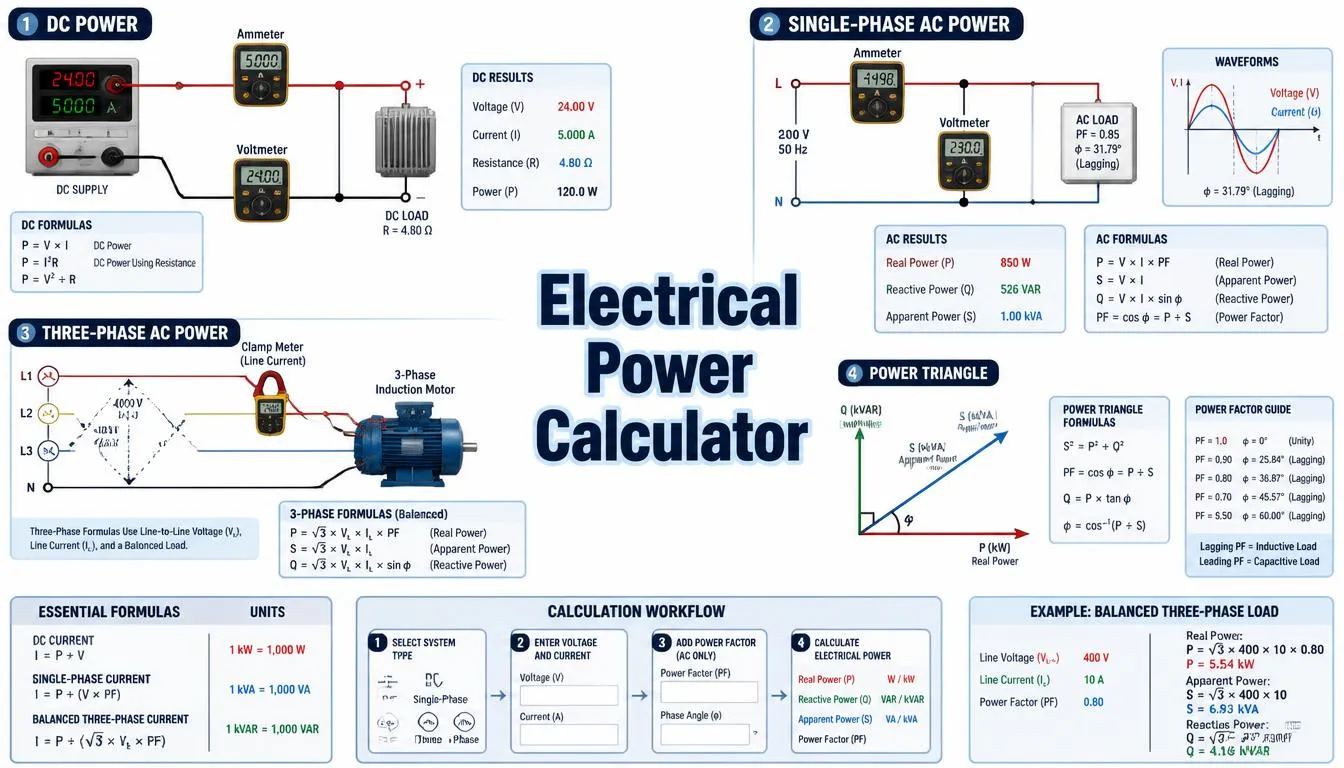
This guide explains real power, apparent power, reactive power, DC formulas, single-phase and three-phase formulas, efficiency, unit conversions, and practical calculation examples. Reliable results depend on using compatible units and identifying whether voltage and current values are DC, single-phase AC, or three-phase line values.
What Is an Electrical Power Calculator?
An Electrical Power Calculator determines the rate at which electrical energy is supplied, converted, or consumed. Depending on the selected calculation, it can determine power in watts or kilowatts, voltage in volts, current in amperes, resistance in ohms, apparent power in kVA, or reactive power in kVAR.
For a DC or purely resistive circuit, power can be calculated from voltage and current, current and resistance, or voltage and resistance. An AC calculation may also require power factor because voltage and current can be out of phase or affected by waveform distortion.
The calculator is useful for preliminary load studies, motor and heater calculations, power-supply selection, transformer loading, energy assessments, and troubleshooting. Its output is a calculated engineering value rather than an automatic final rating for cables, breakers, contactors, transformers, generators, or other equipment.
How Does an Electrical Power Calculator Work?
The calculator applies the formula that matches the electrical system and known input values. Selecting the correct calculation type is essential because DC, single-phase AC, and three-phase AC systems do not always use the same formula.
- Select DC, single-phase AC, or three-phase AC power.
- Select whether power, current, voltage, resistance, kVA, or kVAR is required.
- Enter the known voltage, current, resistance, or power value.
- Enter power factor and efficiency where the selected calculation requires them.
- Select the correct units, such as W, kW, V, A, Ω, kVA, or kVAR.
- Calculate and confirm the unit shown with the result.
The calculator provides a mathematical result from the entered information. It does not replace equipment nameplates, manufacturer documentation, measured operating data, applicable electrical standards, local regulations, protection coordination, or professional engineering judgment.
Step-by-Step Process
- Identify whether the circuit is DC, single-phase AC, or three-phase AC.
- Select the quantity that must be calculated.
- Enter the known voltage and confirm whether it is line-to-line, phase, or DC voltage.
- Enter the measured, rated, or estimated current.
- Enter the power factor for an AC real-power calculation.
- Enter efficiency as a decimal or percentage where input and output power are being compared.
- Convert milliamperes to amperes and watts to kilowatts where necessary.
- Calculate and review the result with its correct unit.
- Compare critical results with equipment documentation and field measurements.
- Apply appropriate safety margins, derating factors, and electrical regulations before selecting equipment.
Electrical Power Calculator Formula
Electrical power represents the rate of electrical energy transfer. The basic power formula for a DC circuit or an AC circuit where voltage and current are appropriately represented is:
P = V × I
In a DC circuit, this formula calculates power directly from voltage and current. In an AC circuit, V × I represents apparent power unless power factor is included to calculate real power.
DC Power Formula
P = V × I
I = P ÷ V
V = P ÷ I
When voltage is entered in volts and current in amperes, the power result is in watts. These formulas apply directly to steady DC values. Electronic converters and pulsed circuits may require average, RMS, or waveform-specific measurements.
Power Using Resistance
P = I² × R
P = V² ÷ R
R = V² ÷ P
These formulas are derived from Ohm’s law and are commonly used for resistive loads such as heaters and resistors. Resistance must be entered in ohms, current in amperes, and voltage in volts to obtain power in watts.
Single-Phase AC Real Power
P = V × I × PF
PkW = (V × I × PF) ÷ 1,000
I = (PkW × 1,000) ÷ (V × PF)
Voltage is the RMS voltage across the single-phase load, current is RMS load current, and PF is power factor expressed as a decimal. Enter an 85% power factor as 0.85 rather than 85.
For an ideal resistive load, voltage and current are in phase and power factor is approximately 1. Motors, transformers, discharge lighting, and electronic equipment can have a power factor below unity.
Balanced Three-Phase AC Real Power
P = √3 × VLL × IL × PF
PkW = (√3 × VLL × IL × PF) ÷ 1,000
IL = (PkW × 1,000) ÷ (√3 × VLL × PF)
These formulas apply to a reasonably balanced three-phase system using RMS line-to-line voltage and line current. The factor √3 is approximately 1.732. For an unbalanced installation, measure and evaluate individual phase values instead of relying only on the balanced-load formula.
An equivalent balanced three-phase formula using phase quantities is:
P = 3 × Vph × Iph × PF
Do not mix line-to-line voltage with a formula intended for phase voltage. Line and phase relationships also depend on whether the load is connected in star or delta.
Apparent Power Formula
Single-phase: SkVA = (V × I) ÷ 1,000
Three-phase: SkVA = (√3 × VLL × IL) ÷ 1,000
Apparent power is measured in VA or kVA and represents the combined voltage-current requirement placed on the electrical source. Transformers, generators, UPS systems, and similar equipment are commonly rated partly or primarily in VA or kVA.
PF = P ÷ S
Use corresponding units when applying this relationship, such as kW divided by kVA or watts divided by volt-amperes.
Reactive Power Formula
Q = √(S² − P²)
Single-phase: QkVAR = (V × I × sin φ) ÷ 1,000
Three-phase: QkVAR = (√3 × VLL × IL × sin φ) ÷ 1,000
PF = cos φ
Reactive power is measured in VAR or kVAR. The power-triangle relationship between kW, kVA, and kVAR is most directly applicable under sinusoidal conditions. Nonlinear loads and harmonics can require true-RMS and power-quality measurements.
Electrical Input and Output Power
η = Pout ÷ Pin
Pout = Pin × η
Pin = Pout ÷ η
Efficiency must be expressed as a decimal in the formulas. For example, 91% efficiency is entered as 0.91. Do not treat motor shaft-output power as electrical input power because electrical and mechanical losses occur inside the motor.
Power Unit Conversions
1 kW = 1,000 W
1 MW = 1,000 kW = 1,000,000 W
1 kVA = 1,000 VA
1 kVAR = 1,000 VAR
Watts and kilowatts measure power, while watt-hours and kilowatt-hours measure energy used over time. A 2 kW load operating for three hours consumes 6 kWh of electrical energy.
Formula Explanation
| Symbol | Description |
|---|---|
| P | Real electrical power in watts |
| PkW | Real electrical power in kilowatts |
| Pin | Electrical or mechanical input power in watts or kilowatts |
| Pout | Useful output power in watts or kilowatts |
| V | DC voltage or single-phase RMS voltage in volts |
| VLL | Three-phase RMS line-to-line voltage in volts |
| Vph | RMS phase voltage in volts |
| I | DC or single-phase RMS current in amperes |
| IL | Three-phase RMS line current in amperes |
| Iph | RMS phase current in amperes |
| R | Electrical resistance in ohms |
| S | Apparent power in VA or kVA |
| Q | Reactive power in VAR or kVAR |
| PF | Power factor expressed as a decimal from 0 to 1 |
| φ | Phase angle between voltage and current under sinusoidal conditions |
| η | Efficiency expressed as a decimal or percentage |
| √3 | Balanced three-phase conversion factor, approximately 1.732 |
Interactive Electrical Power Calculator
Use the calculator below to enter the required values and obtain the calculated engineering result.
Select a calculation mode, enter values, and press Calculate. Enter values and press Calculate.Electrical Power Calculator
Result
Mode-dependent engineering equations
Example 1 – Calculate DC Electrical Power
A 24 V DC load draws 5 A from its power supply. Calculate the electrical power consumed by the load.
Given: V = 24 V and I = 5 A
Formula: P = V × I
Calculation: P = 24 × 5 = 120 W
Final result: P = 120 W or 0.12 kW
The load requires 120 W at the stated operating point. When selecting a power supply, also consider starting current, transient demand, operating temperature, efficiency, ventilation, continuous rating, and manufacturer recommendations.
Example 2 – Calculate Single-Phase AC Power
A single-phase load operates at 230 V, draws 12 A, and has a power factor of 0.85. Calculate real power, apparent power, and reactive power.
Real power: P = (230 × 12 × 0.85) ÷ 1,000
P = 2.346 kW
Apparent power: S = (230 × 12) ÷ 1,000 = 2.76 kVA
Reactive power: Q = √(2.76² − 2.346²)
Q ≈ 1.454 kVAR
Final result: The load consumes approximately 2.346 kW of real power, requires 2.76 kVA of apparent power, and has approximately 1.454 kVAR of reactive power.
Example 3 – Calculate Balanced Three-Phase Power
A balanced three-phase load operates at 415 V line-to-line, draws 32 A, and has a power factor of 0.88. Calculate real, apparent, and reactive power.
Real power: P = (1.732 × 415 × 32 × 0.88) ÷ 1,000
P ≈ 20.24 kW
Apparent power: S = (1.732 × 415 × 32) ÷ 1,000
S ≈ 23.00 kVA
Reactive power: Q = √(23.00² − 20.24²)
Q ≈ 10.92 kVAR
Final result: The balanced load consumes approximately 20.24 kW, requires 23.00 kVA, and has approximately 10.92 kVAR of reactive power.
Example 4 – Calculate Motor Input Power and Current
A three-phase motor delivers 15 kW of mechanical output power. Its efficiency is 91%, its power factor is 0.86, and its line voltage is 400 V. Calculate electrical input power and estimated line current.
Efficiency as a decimal: η = 91 ÷ 100 = 0.91
Input power: Pin = 15 ÷ 0.91 ≈ 16.48 kW
Line current: I = (16.48 × 1,000) ÷ (1.732 × 400 × 0.86)
I ≈ 27.66 A
Final result: The estimated electrical input power is 16.48 kW, and the estimated line current is 27.66 A. Final cable, contactor, overload, and protective-device selection must use the motor nameplate, starting method, duty, installation conditions, coordination requirements, and applicable regulations.
Practical Field Considerations for Electrical Power Calculations
During commissioning, use suitable instruments to measure true RMS voltage, current, real power, apparent power, reactive power, and power factor. Calculating real AC power from voltage and current alone can be misleading when power factor is below unity.
Equipment nameplate values may represent rated conditions rather than the current operating point. Motor current, power factor, and efficiency change with load, while heaters and other resistive loads can change resistance as their temperature rises.
Nonlinear loads such as VFDs, rectifiers, UPS systems, LED drivers, and switched-mode power supplies can distort current waveforms. A simple displacement power-factor calculation may not represent true power factor, so an appropriate power-quality instrument may be required.
Three-phase formulas assume reasonably balanced phase voltages and currents. Where a system is unbalanced, inspect individual phase readings and neutral current. Significant imbalance can affect cables, motors, transformers, protection, and power measurements.
Calculated operating current is only one input to equipment selection. Cable capacity, voltage drop, short-circuit withstand, starting current, protective-device characteristics, ambient temperature, grouping, installation method, duty cycle, harmonics, and local electrical regulations must also be considered.
Applications of an Electrical Power Calculator
Industrial Applications
- Calculating motor, pump, fan, compressor, and heater loads.
- Reviewing machinery and production-line power requirements.
- Estimating generator and transformer loading.
- Comparing real, apparent, and reactive power.
Electrical Distribution Applications
- Preparing preliminary load schedules.
- Calculating feeder and panel power demand.
- Checking single-phase and three-phase current.
- Supporting power-factor and capacity reviews.
Automation Applications
- Sizing preliminary DC power-supply capacity for control systems.
- Reviewing PLC, HMI, sensor, relay, and solenoid loads.
- Estimating VFD and servo-system input requirements.
- Comparing calculated values with energy-meter readings.
Maintenance and Educational Applications
- Checking equipment power during troubleshooting.
- Comparing nameplate and measured operating values.
- Studying DC, single-phase, and three-phase formulas.
- Understanding the relationship among kW, kVA, kVAR, and power factor.
Advantages of an Electrical Power Calculator
- Reduces repetitive manual calculations.
- Supports DC, single-phase, and three-phase systems.
- Calculates power from different combinations of known values.
- Distinguishes real, apparent, and reactive power.
- Supports consistent W, kW, VA, kVA, VAR, and kVAR conversions.
- Helps compare equipment and operating conditions.
- Supports preliminary design and troubleshooting work.
- Helps students understand practical electrical formulas.
Limitations
- Results depend on accurate voltage, current, power factor, and efficiency inputs.
- Balanced three-phase formulas may not represent an unbalanced system.
- Calculated values may not include starting or transient demand.
- Power factor and efficiency can change with equipment loading.
- Basic formulas may not fully represent distorted waveforms.
- Nameplate values may differ from measured operating values.
- The result does not automatically select cables or protective devices.
- The calculator does not replace manufacturer documentation, applicable standards, or professional judgment.
Common Mistakes
- Using watts directly in a formula requiring kilowatts.
- Confusing electrical power in kW with energy in kWh.
- Treating kVA as if it were always equal to kW.
- Ignoring power factor in an AC real-power calculation.
- Entering 85 instead of 0.85 for an 85% power factor.
- Using line-to-neutral voltage in the shown three-phase line-voltage formula.
- Omitting √3 from a balanced three-phase calculation.
- Using motor output power as electrical input power.
- Ignoring waveform distortion and phase imbalance.
- Treating calculated current as the final equipment rating.
Check the input current with the Current Calculator and resistance-based DC power with the Ohm’s Law Calculator.
Frequently Asked Questions
What is an Electrical Power Calculator?
It calculates electrical power or related values from voltage, current, resistance, power factor, efficiency, and phase information.
What is the basic electrical power formula?
The basic DC formula is P = V × I, where power is in watts, voltage is in volts, and current is in amperes.
What is the three-phase power formula?
For a balanced system, P = √3 × VLL × IL × PF. Divide by 1,000 to convert watts to kilowatts.
What is the difference between kW and kVA?
kW measures real power that performs useful work, while kVA measures apparent power based on RMS voltage and current.
What is reactive power?
Reactive power is the non-working AC power exchanged with inductive or capacitive elements. It is measured in VAR or kVAR.
Should motor efficiency be included?
Yes, when converting between motor shaft-output power and electrical input power. Enter efficiency as a decimal, such as 0.91 for 91%.
Why can calculated power differ from a meter reading?
Differences can result from changing load, inaccurate inputs, waveform distortion, phase imbalance, meter accuracy, or using rated instead of measured values.
Can calculated current be used to select a breaker?
Not by itself. Load type, starting current, cable capacity, installation method, protection coordination, manufacturer data, and applicable regulations must also be considered.
Related Tech Volt Lab Resources
Helpful Electrical Engineering Resources
Final Thoughts
An Electrical Power Calculator determines power from voltage, current, resistance, power factor, efficiency, and phase configuration. It can calculate DC power, single-phase power, balanced three-phase power, apparent power, reactive power, and related electrical values.
These calculations support load studies, motor assessments, transformer and generator reviews, power-supply sizing, control-panel design, automation projects, maintenance, and electrical education. The reliability of the result depends on selecting the correct formula and entering realistic operating values.
Use the Electrical Power Calculator from Tech Volt Lab as a practical calculation and verification tool. Confirm important results using equipment nameplates, manufacturer documentation, field measurements, applicable standards, and a suitable engineering assessment before making final design or protection decisions.
Explore More Engineering Calculators
Discover more free electrical and automation calculators designed for electricians, PLC programmers, maintenance technicians, and engineers.
View All Calculators