 Tech Volt Lab Automation | PLC | SCADA | Electrical | Electronics

Related Articles

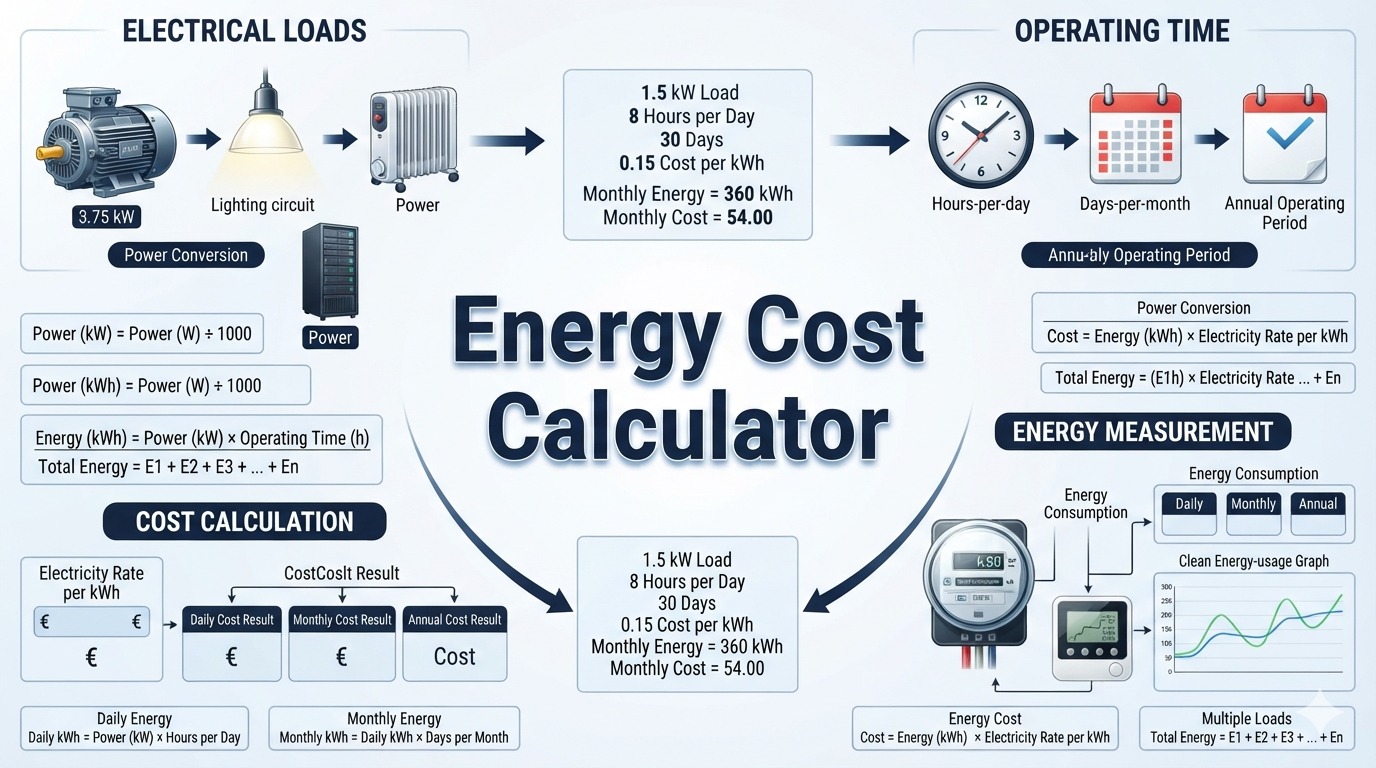
An Energy Cost Calculator estimates how much electrical energy an appliance, motor, machine, or group of loads consumes and what that energy may cost. Electricians, engineers, maintenance technicians, facility managers, business owners, and homeowners can use it to calculate daily, monthly, or annual electricity consumption from power, operating time, quantity, and tariff data. Energy cost calculations are useful when comparing equipment, planning operating schedules, reviewing electricity expenses, or estimating the financial benefit of an efficiency improvement. Even a moderate electrical load can produce a significant annual expense when it operates for many hours.
The result depends on correct power and runtime information. Nameplate power may not equal actual operating power, while tariffs may include time-of-use rates, demand charges, fixed fees, taxes, or other adjustments. This guide explains the main formulas, inputs, examples, and practical limitations behind the calculation.
What Is an Energy Cost Calculator?
An Energy Cost Calculator converts electrical power and operating time into energy consumption, normally expressed in kilowatt-hours. It then multiplies the calculated energy by the electricity rate to estimate the operating cost for a selected period.
Typical inputs include equipment power in watts or kilowatts, quantity, hours of operation, days of operation, electricity price per kWh, duty cycle, load factor, and efficiency. Depending on the calculator mode, the result may show daily energy, monthly energy, annual energy, operating cost, or estimated cost savings.
The calculator can be applied to lighting, heaters, air-conditioning equipment, pumps, fans, compressors, motors, household appliances, production machinery, and control panels. It provides an estimate rather than a final utility bill because billing methods and actual equipment loading can vary.
How Does an Energy Cost Calculator Work?
The calculator first converts the entered power into kilowatts. It then multiplies power by the operating time and equipment quantity. If a duty cycle or load factor is entered, the calculation adjusts the energy use to represent the expected operating condition.
- Select daily, monthly, annual, appliance, or motor energy calculation.
- Enter the rated or measured electrical power.
- Select watts or kilowatts.
- Enter the equipment quantity and operating time.
- Enter load factor, duty cycle, or efficiency where applicable.
- Enter the electricity tariff in cost per kWh.
- Calculate and review the energy and cost results.
The tool applies the appropriate engineering formula to the values provided. It does not replace a utility meter, tariff schedule, equipment data sheet, energy audit, manufacturer documentation, or professional assessment of a complex electrical system.
Step-by-Step Process
- Select the required calculation period, such as daily, monthly, or annual.
- Enter the equipment’s electrical input power.
- Select watts or kilowatts and verify the conversion.
- Enter the number of identical appliances or machines.
- Enter the operating hours and number of operating days.
- Enter the duty cycle or load factor when the equipment does not operate continuously at full load.
- For motor output ratings, enter an appropriate efficiency value.
- Enter the applicable electricity rate per kWh.
- Calculate the result and compare it with meter data or previous bills where available.
Energy Cost Calculator Formula
Electrical energy is calculated from power and time. Electricity cost is then calculated by multiplying the consumed energy by the applicable energy tariff.
Basic Energy Consumption Formula
E = P × t
In this formula, E is energy in kilowatt-hours, P is electrical input power in kilowatts, and t is operating time in hours. If the power is given in watts, convert it to kilowatts first:
PkW = PW ÷ 1,000
Energy Cost Formula
Cost = E × R
Here, R is the electricity rate per kilowatt-hour. The currency of the result matches the currency used for the tariff. For example, entering AED per kWh produces the result in AED, while entering dollars per kWh produces the result in dollars.
Multiple Appliances or Machines
E = P × t × Q
The symbol Q represents the number of identical loads. When the equipment has different power ratings or operating schedules, calculate each load group separately and then add the individual energy values:
Etotal = Σ(Pi × ti × Qi)
Daily, Monthly, and Annual Cost
Daily energy = P × hday × Q
Monthly energy = P × hday × dmonth × Q
Annual energy = P × hday × dyear × Q
Multiply the calculated energy by the applicable tariff to obtain the corresponding cost. Using the actual number of operating days is generally more reliable than assuming every month has the same number of days.
Duty Cycle or Load Factor
E = Prated × LF × t × Q
The load factor LF represents the average load as a fraction of the rated power. A machine operating at an average of 70% rated load uses an assumed factor of 0.70. For thermostatically controlled or cycling equipment, a duty cycle can be applied in the same mathematical way when the operating pattern is known.
Load factor and utility load factor are not always the same concept. In this calculator, the value represents the assumed fraction of rated power used during the entered operating time.
Motor Energy Cost
Pin = (Pout × LF) ÷ η
E = Pin × t
Cost = Pin × t × R
A motor nameplate kW rating commonly describes mechanical output power. To estimate electrical input power, divide the useful output at the assumed load by efficiency η. Both load factor and efficiency must be entered as decimals. Actual motor efficiency and power factor may change with loading.
Energy Cost with Different Tariffs
Total cost = Σ(Ei × Ri)
For time-of-use billing, calculate the energy consumed during each tariff period separately. Multiply off-peak, standard, and peak-period energy by their respective rates, and then add the results.
Energy Savings Formula
Energy savings = Eold − Enew
Cost savings = (Eold − Enew) × R
This formula compares two options operating for the same relevant period. If operating schedules or tariffs differ, calculate the complete cost of each option separately before comparing them.
Formula Explanation
| Symbol | Description |
|---|---|
| E | Electrical energy consumption in kilowatt-hours (kWh) |
| Etotal | Total energy consumed by all included loads in kWh |
| Eold | Energy consumed by the existing equipment in kWh |
| Enew | Energy consumed by the proposed equipment in kWh |
| P | Electrical input power in kilowatts (kW) |
| PW | Power in watts (W) |
| PkW | Power in kilowatts (kW) |
| Prated | Rated equipment power in kilowatts |
| Pin | Electrical input power in kilowatts |
| Pout | Useful motor output power in kilowatts |
| t | Total operating time in hours |
| hday | Operating hours per day |
| dmonth | Number of operating days per month |
| dyear | Number of operating days per year |
| Q | Quantity of identical appliances or machines |
| R | Electricity tariff or rate per kWh |
| LF | Average load factor or duty-cycle fraction entered as a decimal |
| η | Equipment efficiency entered as a decimal |
| Σ | Sum of multiple equipment or tariff-period values |
One kilowatt equals 1,000 watts, and one kilowatt-hour represents one kilowatt used for one hour. A 500 W appliance operating for two hours consumes 1 kWh. Power in kW describes the rate of energy use, while kWh describes the amount of energy consumed over time.
Interactive Energy Cost Calculator
Use the calculator below to enter the required values and obtain the calculated engineering result.
⚡ Energy Cost Calculator
Calculate electrical energy consumption and estimated operating cost.
Energy Cost Result
Enter values and press Calculate.
Energy = power (kW) × operating hours
Cost = energy × tariff
Example 1 – Calculate Monthly Heater Energy Cost
A 1.5 kW electric heater operates for six hours per day over 30 days. The electricity tariff is 0.30 AED per kWh.
Given: P = 1.5 kW, hday = 6 hours, dmonth = 30 days and R = 0.30 AED/kWh
Monthly energy: E = 1.5 × 6 × 30 = 270 kWh
Monthly cost: Cost = 270 × 0.30 = 81 AED
The estimated monthly energy consumption is 270 kWh, with an energy cost of 81 AED. A thermostatically controlled heater may consume less if it cycles off for part of the entered period, so measured runtime or a suitable duty cycle can improve the estimate.
Example 2 – Calculate Lighting Operating Cost
A workshop uses twenty 18 W LED lamps for ten hours per day, 26 days per month. The applicable electricity rate is 0.35 AED per kWh.
Total power: 20 × 18 W = 360 W
Convert to kilowatts: 360 ÷ 1,000 = 0.36 kW
Monthly energy: E = 0.36 × 10 × 26 = 93.6 kWh
Monthly cost: Cost = 93.6 × 0.35 = 32.76 AED
The lighting system uses an estimated 93.6 kWh per month and costs approximately 32.76 AED under the stated tariff. The calculation assumes all twenty lamps operate for the complete scheduled period.
Example 3 – Calculate Industrial Motor Energy Cost
A 15 kW motor operates at an average of 80% rated output with an assumed efficiency of 90%. It runs for ten hours per day over 300 days per year. The electricity rate is 0.32 AED per kWh.
Output at the assumed load: 15 × 0.80 = 12 kW
Estimated input power: Pin = 12 ÷ 0.90 = 13.33 kW
Annual operating time: 10 × 300 = 3,000 hours
Annual energy: E = 13.33 × 3,000 ≈ 40,000 kWh
Annual energy cost: Cost = 40,000 × 0.32 = 12,800 AED
The estimated annual energy cost is 12,800 AED. A measured input-power value usually provides a better estimate because motor loading and efficiency can vary throughout the operating cycle.
Example 4 – Compare Lighting Energy Savings
Ten 60 W lamps are being compared with ten 10 W replacement lamps. Both options operate for eight hours per day throughout 365 days, and the energy rate is 0.30 AED per kWh.
Existing lighting energy: Eold = (10 × 60 ÷ 1,000) × 8 × 365 = 1,752 kWh
Replacement lighting energy: Enew = (10 × 10 ÷ 1,000) × 8 × 365 = 292 kWh
Annual energy savings: 1,752 − 292 = 1,460 kWh
Annual cost savings: 1,460 × 0.30 = 438 AED
The calculated annual energy-cost difference is 438 AED. A complete financial comparison should also consider purchase price, installation cost, maintenance, product life, lighting performance, operating temperature, and any change in the operating schedule.
Practical Field Considerations for Energy Cost Calculations
Nameplate power is not always the same as actual operating power. A motor may run below rated load, a heater may cycle under thermostat control, and a compressor may alternate between loaded and unloaded operation. A plug-in energy meter, power analyzer, drive display, or properly installed submeter can provide more representative data.
Operating time should reflect the actual production or usage schedule. Include shutdown periods, weekends, seasonal operation, maintenance stops, standby time, and process changes where they materially affect consumption. Small errors in daily runtime can become significant when extended over a full year.
The basic cost formula normally covers energy charges only. Commercial and industrial bills may also include maximum-demand charges, time-of-use rates, power-factor adjustments, fixed service charges, taxes, fuel adjustments, or tariff blocks. These items should be calculated separately using the current utility schedule.
Standby power should not automatically be ignored. PLC systems, control transformers, network equipment, UPS units, displays, chargers, and electronic appliances may continue consuming power outside normal production hours. Measure or obtain the standby value when it affects the annual estimate.
For efficiency projects, compare equipment under equivalent operating conditions. A lower-rated machine is not necessarily more efficient if it must run longer or cannot meet the required production output. Energy cost is one part of a decision that may also involve reliability, safety, maintenance, process quality, and lifecycle cost.
Applications of an Energy Cost Calculator
Residential Applications
- Estimating the running cost of household appliances.
- Calculating air-conditioner, heater, and water-heater energy use.
- Comparing conventional and energy-efficient lighting.
- Reviewing standby power and daily usage schedules.
Commercial Applications
- Estimating office, retail, and warehouse electricity costs.
- Comparing lighting and HVAC operating schedules.
- Preparing preliminary budgets for electrical energy use.
- Evaluating operating-hour reduction proposals.
Industrial Applications
- Estimating motor, pump, fan, and compressor energy costs.
- Comparing machines with different power and efficiency ratings.
- Evaluating production and non-production operating schedules.
- Supporting preliminary energy-efficiency assessments.
Maintenance and Automation Applications
- Estimating the continuous energy use of control panels.
- Reviewing PLC-controlled equipment duty cycles.
- Comparing calculated consumption with energy-meter records.
- Identifying high-runtime loads for further investigation.
Advantages of an Energy Cost Calculator
- Converts watts, kilowatts, and operating time into kWh.
- Reduces repetitive daily, monthly, and annual calculations.
- Supports calculations for multiple identical loads.
- Helps compare existing and proposed equipment.
- Shows how runtime and tariff changes affect operating cost.
- Supports preliminary energy budgets and savings reviews.
- Helps students understand the relationship between kW and kWh.
Limitations
- The result depends on correct power, runtime, quantity, and tariff inputs.
- Nameplate power may differ from actual operating power.
- Motor loading and efficiency may change during operation.
- The basic calculation may not include demand charges or fixed fees.
- Time-of-use tariffs require separate calculations for each rate period.
- Seasonal and process-related changes can affect annual energy use.
- The result does not replace a utility meter or detailed energy audit.
- Manufacturer data and the current utility tariff remain important final references.
Common Mistakes
- Using watts directly in a formula that requires kilowatts.
- Confusing electrical power in kW with energy in kWh.
- Entering minutes as hours without conversion.
- Assuming equipment operates at full power continuously.
- Ignoring the number of identical appliances.
- Using motor output power as electrical input power.
- Entering percentages instead of decimal load and efficiency factors.
- Using an outdated or incorrect electricity tariff.
- Ignoring peak, off-peak, demand, fixed, and tax components of a bill.
- Treating an estimated cost as an exact utility bill.
For multiple connected devices, determine diversified demand with the Load Calculator. You can also compare daily and monthly energy use with the Power Consumption Calculator.
Frequently Asked Questions
What is an Energy Cost Calculator?
It estimates electrical energy consumption in kWh and operating cost from power, runtime, quantity, and electricity-rate information.
What is the basic energy cost formula?
Calculate energy using E = P × t, and then calculate cost using Cost = E × electricity rate.
What is the difference between kW and kWh?
Kilowatts measure electrical power at a given time. Kilowatt-hours measure the amount of energy used over a period.
How do I convert watts to kilowatts?
Divide the watt value by 1,000. For example, 750 W equals 0.75 kW.
Should I use motor input or output power?
Energy consumption is based on electrical input power. If only mechanical output power is known, account for motor load and efficiency.
Can the calculator handle equipment that cycles on and off?
A known duty cycle can be applied to estimate average consumption. Measured energy is preferable when the cycle varies significantly.
Why can the result differ from my electricity bill?
A bill may include varying tariffs, demand charges, fixed fees, taxes, adjustments, and energy used by loads not included in the calculation.
How can I improve the cost estimate?
Use measured input power, realistic operating hours, the current utility tariff, and separate calculations for different operating or tariff periods.
Related Electrical Calculators
Helpful Electrical Engineering Resources
Conclusion
An Energy Cost Calculator converts equipment power and operating time into energy consumption and estimated electricity cost. It can calculate daily, monthly, or annual results for appliances, lighting, motors, machines, and groups of electrical loads.
The calculation supports operating-cost reviews, energy budgets, equipment comparisons, efficiency projects, and maintenance planning. Its reliability depends on realistic power, runtime, load factor, efficiency, and tariff information.
Use the Energy Cost Calculator from Tech Volt Lab as a practical estimation and comparison tool. Verify important results with measured consumption, equipment documentation, the current utility tariff, and a detailed energy assessment where the financial decision is significant.
Explore More Engineering Calculators
Discover more free electrical and automation calculators designed for electricians, PLC programmers, maintenance technicians, and engineers.
View All Calculators