 Tech Volt Lab Automation | PLC | SCADA | Electrical | Electronics

Related Articles

A Coulomb Calculator applies Coulomb’s law to calculate the electrostatic force between two point charges. Engineers, electronics professionals, technicians, researchers, and students can also use it to determine an unknown charge or the separation distance when the remaining values are known.
Electrostatic force calculations are important when studying charged particles, capacitive systems, electrostatic sensors, high-voltage equipment, material handling, and scientific experiments. The magnitude of the force depends directly on both charges and inversely on the square of the distance between them.
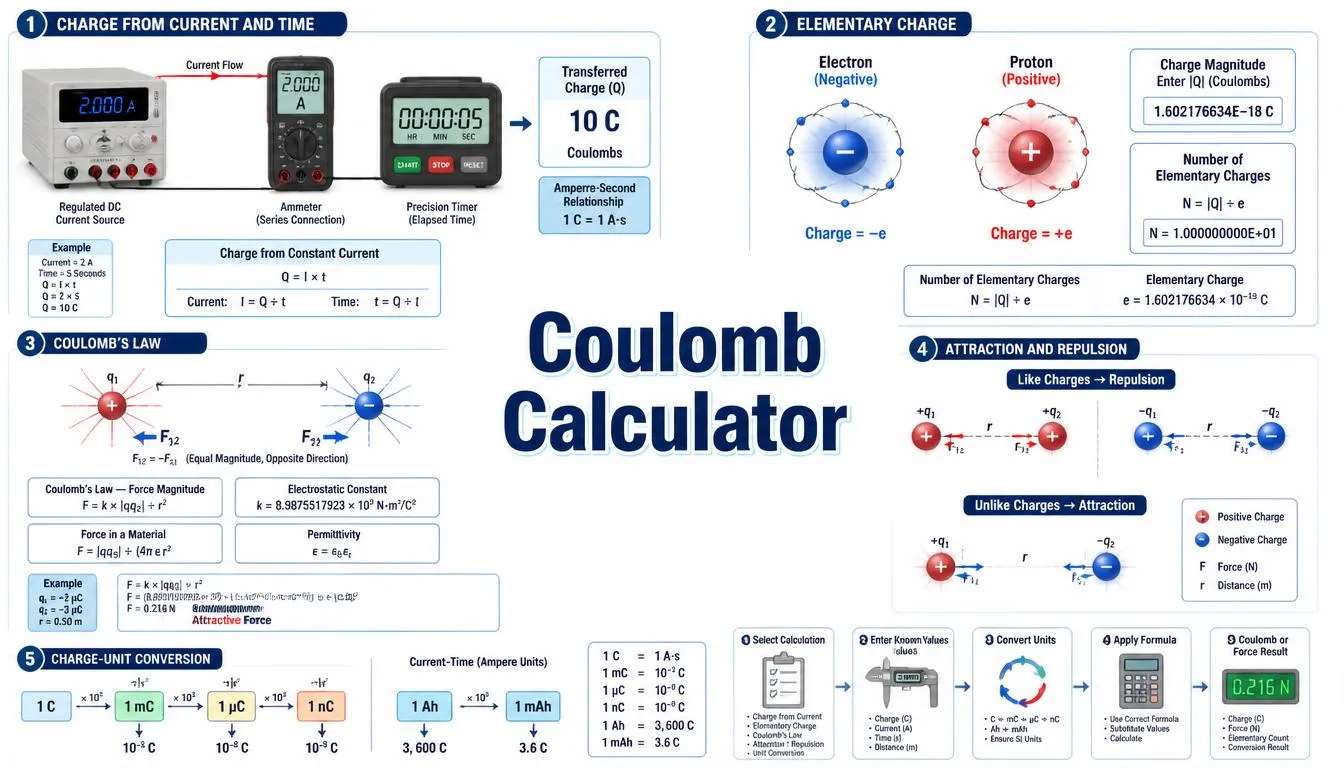
This guide explains Coulomb’s law, charge and distance conversions, attractive and repulsive forces, dielectric permittivity, electric field, and practical numerical examples. Correct results require charges in coulombs, distance in metres, and an appropriate assumption about the material between the charges.
What Is a Coulomb Calculator?
A Coulomb Calculator determines the magnitude of electrostatic force between two stationary point charges. Depending on the selected mode, its inputs may include two charge values and distance, force and one charge, or force and both charges.
The calculator can produce force in newtons, charge in coulombs, or separation distance in metres. Unit selectors may allow charges to be entered in coulombs, millicoulombs, microcoulombs, nanocoulombs, or picocoulombs, and distance to be entered in metres, centimetres, or millimetres.
This calculator focuses on Coulomb’s law and the force between charges. It differs from an Electrical Charge Calculator, which primarily calculates charge transfer using Q = I × t. The two pages therefore answer different engineering and physics calculation requirements.
How Does a Coulomb Calculator Work?
The calculator converts the entered charge and distance values into base SI units before applying Coulomb’s law. It calculates the force magnitude from the absolute values of the charges, then uses their signs to determine whether the interaction is attractive or repulsive.
- Select force, first charge, second charge, or distance.
- Enter the two known charge values with their signs.
- Select C, mC, µC, nC, or another available charge unit.
- Enter the centre-to-centre separation distance.
- Select vacuum, air, or a supported relative-permittivity value.
- Calculate and review the magnitude and force direction.
The calculator provides an idealized electrostatic result. It does not replace detailed field analysis, laboratory measurements, insulation coordination, high-voltage safety procedures, manufacturer documentation, applicable standards, or professional engineering judgment.
Step-by-Step Process
- Select the quantity that must be calculated.
- Enter the magnitude and sign of the first charge.
- Enter the magnitude and sign of the second charge.
- Select the correct unit for each charge.
- Enter the centre-to-centre distance between the charges.
- Convert centimetres or millimetres to metres for manual calculations.
- Enter relative permittivity if the charges are in a material medium rather than vacuum.
- Calculate and check the result unit.
- Use the charge signs to determine attraction or repulsion.
- Check whether the point-charge and electrostatic assumptions are reasonable for the application.
Coulomb Calculator Formula
Coulomb’s law states that the magnitude of the electrostatic force between two stationary point charges is proportional to the product of their charge magnitudes and inversely proportional to the square of their separation distance.
F = ke × |q1 × q2| ÷ r²
When q1 and q2 are entered in coulombs and r in metres, the force result is in newtons. The absolute-value signs are used to calculate force magnitude. Charge signs determine the direction of the interaction.
ke ≈ 8.98755 × 10⁹ N·m²/C²
The Coulomb constant shown above applies in vacuum and is normally a close approximation for air under ordinary conditions. It is related to vacuum permittivity by:
ke = 1 ÷ (4π × ε0)
ε0 ≈ 8.85419 × 10⁻¹² F/m
Attractive and Repulsive Force
Two charges with the same sign repel each other. Therefore, two positive charges repel and two negative charges also repel. Charges with opposite signs attract each other.
- q1q2 > 0: repulsive force.
- q1q2 < 0: attractive force.
The two charges exert forces of equal magnitude in opposite directions along the line connecting them. A scalar calculator normally reports the magnitude and attraction or repulsion rather than a complete vector.
Calculate the First Charge
|q1| = (F × r²) ÷ (ke × |q2|)
This rearranged formula calculates the magnitude of the first point charge when force, separation distance, and the second charge are known. The required charge sign must be determined from whether the specified force is attractive or repulsive.
Calculate the Second Charge
|q2| = (F × r²) ÷ (ke × |q1|)
The same relationship can be used to calculate the second charge magnitude. Charge values must not be zero in this rearranged expression because division by zero is undefined.
Calculate Separation Distance
r = √[(ke × |q1 × q2|) ÷ F]
This formula calculates the centre-to-centre distance between two point charges from charge magnitudes and electrostatic force. The result is in metres when SI units are used.
Coulomb’s Law in a Material Medium
F = |q1 × q2| ÷ (4π × ε × r²)
ε = εr × ε0
F = ke × |q1 × q2| ÷ (εr × r²)
Relative permittivity εr describes how an ideal linear, homogeneous, and isotropic material changes the electrostatic interaction compared with vacuum. Real materials may have frequency, temperature, field-strength, humidity, or directional dependencies that are not represented by one constant value.
Electric Field from a Point Charge
E = ke × |q| ÷ r²
F = |qtest| × E
Electric field is force per unit positive test charge and is measured in newtons per coulomb or volts per metre. The field points away from a positive source charge and toward a negative source charge.
Electrostatic Potential Energy
U = ke × q1 × q2 ÷ r
Potential energy is measured in joules. Unlike the force-magnitude formula, the signed product q1q2 is retained. The potential energy is positive for like charges and negative for unlike charges when zero potential energy is defined at infinite separation.
Charge and Distance Conversions
1 mC = 10−3 C
1 µC = 10−6 C
1 nC = 10−9 C
1 pC = 10−12 C
1 cm = 0.01 m
1 mm = 0.001 m
Metric-prefix conversion is critical because the force formula contains both a product of charges and the square of distance. Entering microcoulombs as whole coulombs or centimetres as metres can change the result by many orders of magnitude.
Formula Explanation
| Symbol | Description |
|---|---|
| F | Magnitude of electrostatic force in newtons |
| q1 | First point charge in coulombs |
| q2 | Second point charge in coulombs |
| q | Source point charge used for an electric-field calculation |
| qtest | Test charge placed in an electric field |
| r | Centre-to-centre separation distance in metres |
| ke | Coulomb constant, approximately 8.98755 × 10⁹ N·m²/C² in vacuum |
| ε0 | Vacuum permittivity in farads per metre |
| εr | Relative permittivity of the material medium |
| ε | Absolute permittivity of the material in farads per metre |
| E | Electric-field magnitude in N/C or V/m |
| U | Electrostatic potential energy in joules |
| π | Mathematical constant pi, approximately 3.14159 |
Interactive Coulomb Calculator
Use the calculator below to enter the required values and obtain the calculated engineering result.
Select a calculation mode, enter values, and press Calculate. Enter values and press Calculate.Coulomb Calculator
Result
Mode-dependent engineering equations
Example 1 – Calculate Electrostatic Force
Two point charges of +2 µC and −3 µC are separated by 0.10 m in air. Calculate the magnitude and type of electrostatic force.
Charge conversions: q1 = 2 × 10⁻⁶ C and q2 = −3 × 10⁻⁶ C
Formula: F = ke × |q1q2| ÷ r²
Calculation: F = (8.98755 × 10⁹) × |(2 × 10⁻⁶)(−3 × 10⁻⁶)| ÷ 0.10²
Final result: F ≈ 5.39 N, attractive
The charges have opposite signs, so each charge experiences a force directed toward the other charge.
Example 2 – Calculate Separation Distance
Two positive point charges of 2 µC and 8 µC produce a repulsive force of approximately 3.595 N. Calculate their separation distance in air.
Charge conversions: q1 = 2 × 10⁻⁶ C and q2 = 8 × 10⁻⁶ C
Formula: r = √[(ke × |q1q2|) ÷ F]
Calculation: r = √[((8.98755 × 109) × (2 × 10−6) × (8 × 10−6)) ÷ 3.595]
Final result: r ≈ 0.200 m or 20.0 cm
Because both charges are positive, the interaction is repulsive. Distance must represent the separation between the effective centres of the point charges.
Example 3 – Calculate an Unknown Charge
A point charge interacts with a 4 µC charge at a distance of 0.20 m. The force magnitude is 0.72 N. Calculate the unknown charge magnitude.
Known charge: q2 = 4 × 10⁻⁶ C
Formula: |q1| = (F × r²) ÷ (ke × |q2|)
Calculation: |q1| = (0.72 × 0.20²) ÷ [(8.98755 × 109) × (4 × 10−6)]
Final result: |q1| ≈ 8.01 × 10⁻⁷ C or 0.801 µC
The force magnitude determines only the magnitude of the unknown charge. If the force is attractive, the unknown charge must have the opposite sign to the 4 µC charge. If the force is repulsive, it must have the same sign.
Example 4 – Calculate Force in a Dielectric Medium
Two point charges of +5 nC are separated by 20 mm in an ideal material with a relative permittivity of 4. Calculate the electrostatic force.
Charge conversion: q1 = q2 = 5 × 10⁻⁹ C
Distance conversion: r = 20 mm = 0.020 m
Formula: F = ke × |q1q2| ÷ (εr × r²)
Calculation: F = (8.98755 × 109) × (5 × 10−9)² ÷ [4 × (0.020)²]
Final result: F ≈ 1.40 × 10⁻⁴ N or 0.140 mN, repulsive
The ideal dielectric reduces the force compared with the vacuum result. Actual material behavior should be confirmed from reliable permittivity data applicable to the operating temperature, frequency, moisture level, and field strength.
Practical Field Considerations for Coulomb’s Law
Coulomb’s law applies directly to point charges or spherically symmetric charge distributions viewed from outside the charged body. When the physical size of each charged object is not small compared with the separation distance, a distributed-charge or numerical field analysis may be required.
Distance is measured between charge centres, not automatically between the nearest visible surfaces. Because force varies with the inverse square of distance, even a small distance error can significantly affect the calculated result.
Charge can leak through air, insulation, surface contamination, moisture, measurement equipment, and surrounding structures. The assumed charge values may therefore change with time, especially in humid, dirty, or conductive environments.
For more than two charges, calculate the force produced by each source charge and add the forces as vectors. Magnitudes cannot normally be added directly unless all forces act along the same line and their directions are handled correctly.
High electric fields can cause corona, leakage, surface tracking, or dielectric breakdown before an ideal electrostatic condition is reached. Practical high-voltage work requires suitable insulation design, clearances, measurement techniques, standards, and safety procedures beyond a basic Coulomb calculation.
Applications of a Coulomb Calculator
Electronics and Sensor Applications
- Studying capacitive and electrostatic sensor principles.
- Estimating interactions between small charged objects.
- Supporting microelectromechanical-system studies.
- Reviewing electric-field and point-charge relationships.
Industrial Applications
- Understanding electrostatic material attraction and repulsion.
- Supporting preliminary electrostatic-separation studies.
- Reviewing charged-particle and powder-handling concepts.
- Evaluating simplified high-voltage electrostatic models.
Scientific Applications
- Calculating force between stationary point charges.
- Determining unknown charge or separation distance.
- Studying electric fields and potential energy.
- Applying the superposition principle to multiple charges.
Educational Applications
- Practising Coulomb’s law calculations.
- Learning charge and distance unit conversions.
- Understanding attractive and repulsive forces.
- Studying the inverse-square relationship.
Advantages of a Coulomb Calculator
- Reduces repetitive scientific-notation calculations.
- Calculates electrostatic force between two point charges.
- Solves for an unknown charge or distance.
- Supports microcoulomb and nanocoulomb conversions.
- Identifies attractive and repulsive interactions.
- Demonstrates the inverse-square distance relationship.
- Supports vacuum and simplified dielectric calculations.
- Helps verify manual physics and engineering calculations.
Limitations
- The basic formula assumes stationary point charges.
- Extended or irregular charge distributions may require integration or simulation.
- The distance must be measured between effective charge centres.
- Charge leakage can change actual charge values.
- Simple relative permittivity may not represent every material condition.
- Multiple-charge systems require vector superposition.
- Electrical breakdown and transient behavior are not predicted by the basic formula.
- The calculator does not replace detailed field analysis or professional judgment.
Common Mistakes
- Entering microcoulombs as whole coulombs.
- Using centimetres or millimetres without converting to metres.
- Forgetting to square the separation distance.
- Using surface-to-surface distance instead of centre-to-centre distance.
- Using charge signs incorrectly when determining direction.
- Adding multiple force magnitudes without considering vectors.
- Assuming vacuum permittivity applies exactly to every material.
- Applying the point-charge formula to large nearby objects.
- Confusing Coulomb’s law with the charge-transfer formula Q = I × t.
- Treating an ideal calculation as a complete high-voltage design.
After calculating electrostatic force, use the Current Calculator for current-based examples and the Capacitor Calculator for charge-storage applications.
Frequently Asked Questions
What is a Coulomb Calculator?
It applies Coulomb’s law to calculate electrostatic force, an unknown point charge, or the separation distance between two charges.
What is Coulomb’s law?
Coulomb’s law is F = ke|q1q2|/r², where force depends on both charges and the inverse square of their separation.
What is the value of the Coulomb constant?
In vacuum, the Coulomb constant is approximately 8.98755 × 10⁹ N·m²/C².
When is electrostatic force attractive?
The force is attractive when the two charges have opposite signs. Charges with the same sign repel.
Why must distance be squared?
Coulomb’s law is an inverse-square law. Doubling the distance reduces the force magnitude to one-quarter when all other values remain constant.
Can Coulomb’s law be used in air?
Vacuum values are often a close approximation for air, but environmental conditions, leakage, ionization, and breakdown can affect practical behavior.
Can the calculator handle multiple charges?
Calculate the force from each charge separately and combine the results as vectors using the superposition principle.
Is a Coulomb Calculator the same as an Electrical Charge Calculator?
No. This calculator focuses on electrostatic force between charges, while an Electrical Charge Calculator commonly calculates charge transfer from current and time.
Related Tech Volt Lab Resources
Helpful Electrical Engineering Resources
Final Thoughts
A Coulomb Calculator determines electrostatic force, point-charge magnitude, or separation distance using Coulomb’s law. It can also support simplified dielectric, electric-field, and potential-energy calculations.
These calculations are useful for electrostatics education, charged-particle analysis, sensor concepts, scientific studies, and preliminary high-voltage assessments. Reliable results require correct charge units, centre-to-centre distance, and reasonable point-charge and material assumptions.
Use the Coulomb Calculator from Tech Volt Lab as a practical calculation and verification tool. Confirm critical results with suitable measurements, material data, authoritative references, applicable safety requirements, and detailed engineering analysis where necessary.
Explore More Engineering Calculators
Discover more free electrical and automation calculators designed for electricians, PLC programmers, maintenance technicians, and engineers.
View All Calculators