 Tech Volt Lab Automation | PLC | SCADA | Electrical | Electronics

Related Articles

A Load Calculator estimates connected electrical load, demand load, current, real power, and apparent power from the values entered by the user. It is useful for electricians, electrical engineers, automation technicians, panel builders, maintenance teams, and students working with DC, single-phase, or three-phase electrical systems. Electrical load calculations help users understand how much power equipment may require and how much current a circuit may carry under specified conditions. These results can support preliminary planning for cables, breakers, contactors, transformers, generators, UPS systems, control panels, and distribution equipment.
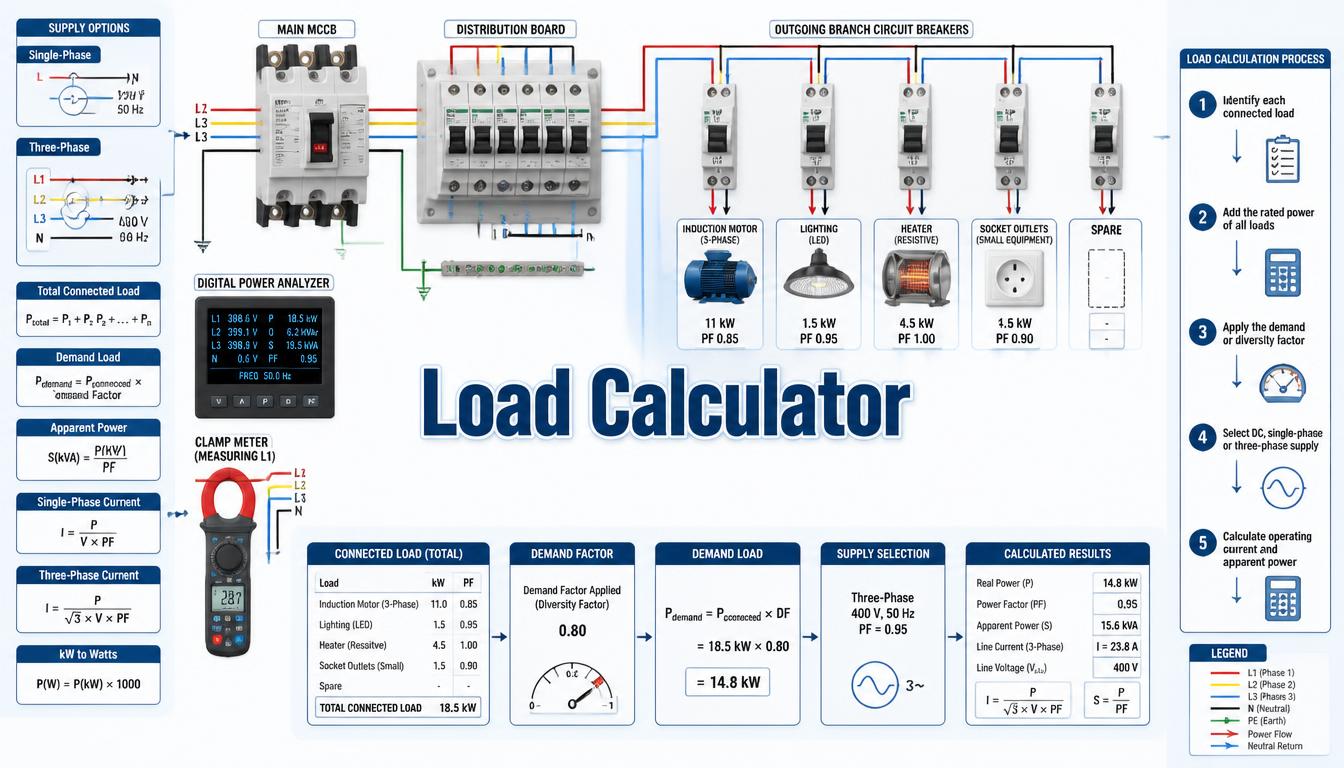
Reliable results require correct voltage, phase type, power factor, efficiency, equipment quantity, and operating assumptions. This guide covers the main load formulas, unit conversions, numerical examples, and practical limitations that should be considered before applying a calculated value to an electrical installation.
What Is a Load Calculator?
A Load Calculator is a tool for estimating the combined power demand or operating current of electrical equipment. Depending on the selected calculation type, it can add individual equipment ratings, apply an appropriate demand factor, convert kW to current, or calculate apparent power in kVA.
Common inputs include equipment power, quantity, voltage, supply phase, power factor, efficiency, and an applicable demand or utilization factor. Outputs may include total connected load in watts or kilowatts, estimated demand load, circuit current in amperes, and apparent power in volt-amperes or kilovolt-amperes.
The calculator provides a mathematical estimate based on the entered data. It does not determine final cable size, breaker rating, transformer capacity, or generator size by itself. Final selection may require load classification, continuous-load requirements, starting current, harmonics, temperature, installation method, expansion allowance, local regulations, and manufacturer information.
How Does a Load Calculator Work?
The calculator first identifies the selected calculation mode. It then applies the relevant electrical formula to the entered values. When multiple loads are listed, it can multiply each equipment rating by its quantity and add the individual results to determine the connected load.
- Select connected load, demand load, current, kW, or kVA calculation.
- Choose DC, single-phase AC, or three-phase AC where applicable.
- Enter equipment power, quantity, voltage, and other required values.
- Enter power factor and efficiency only when the selected formula requires them.
- Select the correct units, such as W, kW, VA, kVA, V, or A.
- Calculate the result and check the displayed unit.
A connected-load calculation represents the sum of the listed equipment ratings. Demand load attempts to represent the load expected to operate during the relevant period. The correct treatment of demand, diversity, continuous loads, and special equipment depends on the installation and applicable electrical requirements.
Step-by-Step Process
- Identify whether connected power, demand power, current, or apparent power is required.
- Select DC, single-phase AC, or three-phase AC.
- Enter the power rating and quantity of each electrical load.
- Select watts, kilowatts, volt-amperes, or kilovolt-amperes as appropriate.
- Enter the system voltage and confirm whether it is DC voltage, single-phase voltage, or three-phase line-to-line voltage.
- Enter power factor and efficiency when required by the formula.
- Apply a demand factor only when a suitable value has been established for the installation.
- Calculate and review the result with its unit.
- Compare the result with equipment nameplates, design information, measured demand, and applicable requirements.
Load Calculator Formula
The correct formula depends on whether the objective is to calculate total connected load, estimated demand, load current, or apparent power. AC calculations may also require power factor and efficiency.
Total Connected Load
Pconnected = Σ(Pi × Qi)
The connected load is the sum of the rated power of all listed equipment. For every load, multiply its individual power rating Pi by its quantity Qi, and then add the results. All ratings must be converted to the same unit before addition.
Estimated Demand Load
Pdemand = Pconnected × DF
The demand factor DF is entered as a decimal. For example, 75% is entered as 0.75. Where different groups have different operating patterns, calculate each group separately and add the adjusted results:
Pdemand = Σ(Pi × Qi × DFi)
A demand factor should not be guessed merely to reduce the calculated load. Use a factor permitted or supported by the applicable design method, operational data, local regulations, or qualified engineering assessment.
DC Load Current
I = P ÷ V
For a basic DC load, current I in amperes equals input power P in watts divided by voltage V in volts. If the stated power is useful output power from equipment with conversion losses, efficiency may also need to be included.
Single-Phase AC Load Current
I = Pin ÷ (V × PF)
This formula calculates single-phase AC when Pin is known real input power. Voltage is the RMS voltage across the load, and power factor is entered as a decimal between 0 and 1.
If the given value is useful output power, such as the mechanical output rating of a motor, include efficiency:
I = Pout ÷ (V × PF × η)
Three-Phase AC Load Current
I = Pin ÷ (√3 × VLL × PF)
For a balanced three-phase load, VLL is the line-to-line RMS voltage. When the stated power is useful output power rather than electrical input power, use:
I = Pout ÷ (√3 × VLL × PF × η)
The formulas assume reasonably balanced three-phase conditions. Actual phase currents may differ where single-phase loads are distributed unevenly or where voltage and current contain significant distortion.
Apparent Power in kVA
Single-phase: S = (V × I) ÷ 1,000
Three-phase: S = (√3 × VLL × I) ÷ 1,000
Apparent power S is expressed in kVA. Real input power can be obtained from apparent power using:
Pin = S × PF
When S is entered in kVA, the result is in kW. Power factor connects real power and apparent power, but it is not the same as efficiency. Power factor describes the relationship between kW and kVA, while efficiency describes the relationship between useful output power and input power.
Formula Explanation
| Symbol | Description |
|---|---|
| Pconnected | Total connected real power in watts or kilowatts |
| Pdemand | Estimated real-power demand in watts or kilowatts |
| Pi | Individual equipment power rating in watts or kilowatts |
| Qi | Quantity of identical loads |
| DF | Applicable demand factor entered as a decimal |
| I | Load or line current in amperes (A) |
| V | DC or single-phase RMS voltage in volts (V) |
| VLL | Three-phase line-to-line RMS voltage in volts (V) |
| Pin | Electrical real input power in watts or kilowatts |
| Pout | Useful output power in watts or kilowatts |
| PF | Power factor expressed as a decimal between 0 and 1 |
| η | Efficiency expressed as a decimal between 0 and 1 |
| S | Apparent power in volt-amperes or kilovolt-amperes |
| √3 | Three-phase conversion factor, approximately 1.732 |
| Σ | Sum of all listed load values |
Use consistent units throughout the calculation. One kilowatt equals 1,000 watts, and one kilovolt-ampere equals 1,000 volt-amperes. Convert percentages to decimals before substitution: 90% efficiency becomes 0.90, not 90.
Interactive Load Calculator
Use the calculator below to enter the required values and obtain the calculated engineering result.
Estimate connected load, demand load, and operating current. Enter values and press Calculate.⚡ Load Calculator
Load Result
Connected load = quantity × unit load
Demand load = connected load × demand factor
Three phase I = P ÷ (√3 × V × PF)
Example 1 – Calculate Total Connected Load
A small workshop area contains twelve 20 W lights, four 150 W workbench devices, and one 1.5 kW machine. Determine the total connected load.
Lighting load: 12 × 20 W = 240 W
Workbench load: 4 × 150 W = 600 W
Machine load: 1.5 kW × 1,000 = 1,500 W
Total connected load: 240 + 600 + 1,500 = 2,340 W
Final result: 2,340 W or 2.34 kW
This is the total rated load if all listed equipment is considered together. It does not yet include any permitted demand factor, starting current, future expansion, or circuit-specific design requirement.
Example 2 – Calculate Estimated Demand Load
An installation has a connected load of 12 kW. For this example, an established project demand factor of 75% applies to the specified load group.
Given: Pconnected = 12 kW and DF = 75%
Convert the factor: 75 ÷ 100 = 0.75
Formula: Pdemand = Pconnected × DF
Calculation: Pdemand = 12 × 0.75 = 9 kW
The estimated demand is 9 kW under the stated assumption. The 75% factor is an example value, not a universal design allowance. Use only demand factors supported by the applicable installation rules and load characteristics.
Example 3 – Calculate Single-Phase Load Current
A single-phase load consumes 4 kW of real input power at 230 V with a power factor of 0.85. Determine the operating current.
Given: Pin = 4 kW, V = 230 V and PF = 0.85
Convert power: 4 kW × 1,000 = 4,000 W
Formula: I = Pin ÷ (V × PF)
Calculation: I = 4,000 ÷ (230 × 0.85) = 20.46 A
The calculated operating current is approximately 20.46 A. Breaker and cable selection must also consider the load type, continuous operation, starting or inrush current, voltage drop, installation method, grouping, ambient temperature, protective coordination, and applicable regulations.
Example 4 – Workshop Demand and Three-Phase Current
Five 2,000 W workshop loads at an 80% demand factor produce an estimated load of 8,000 W. At 415 V three-phase and 0.85 power factor, the calculator returns approximately 13.10 A.
Practical Field Considerations for Load Calculations
Connected load and maximum demand are not automatically the same value. Connected load is generally based on installed equipment ratings, while maximum demand represents the highest demand occurring during a defined operating period. Loads that operate intermittently or at different times may not create their maximum demand simultaneously.
During commissioning, technicians should compare calculated current with nameplate information and measured phase currents. Large differences may indicate that the assumed power factor, efficiency, mechanical loading, operating sequence, or equipment rating does not represent the actual condition.
Motor, transformer, compressor, heater, lighting, and electronic loads do not behave identically. Motors can draw high starting current, transformers experience energization inrush, and nonlinear electronic loads may produce harmonic current. A simple steady-state load calculation may not represent these temporary or distorted conditions.
Three-phase load totals should also be reviewed phase by phase where significant single-phase equipment is connected. A balanced total kW value does not prove that individual phase currents or neutral current are acceptable. Actual distribution, harmonic content, and load operating patterns should be checked.
Before final selection, compare the calculated load with cable ampacity, voltage-drop results, protective-device characteristics, short-circuit ratings, equipment temperature limits, and available supply capacity. Appropriate allowance for approved future expansion may also be required by the project.
Applications of a Load Calculator
Electrical Distribution Applications
- Preparing preliminary connected-load schedules.
- Estimating feeder and distribution-board demand.
- Comparing real power in kW with apparent power in kVA.
- Checking single-phase and three-phase load current.
Industrial and Automation Applications
- Estimating machinery and control-panel operating loads.
- Reviewing PLC, HMI, power-supply, sensor, and actuator loads.
- Checking motor input requirements using power factor and efficiency.
- Supporting preliminary transformer, generator, and UPS planning.
Maintenance Applications
- Comparing calculated current with measured operating current.
- Investigating overloaded feeders and distribution equipment.
- Reviewing load changes before adding new machinery.
- Comparing present demand with available electrical capacity.
Educational Applications
- Understanding the difference between connected and demand load.
- Practising DC, single-phase, and three-phase formulas.
- Studying the effects of power factor and efficiency on current.
Advantages of a Load Calculator
- Reduces repetitive manual calculations.
- Combines multiple equipment ratings into one connected-load total.
- Supports DC, single-phase, and three-phase calculations.
- Helps distinguish real power from apparent power.
- Shows how power factor and efficiency affect current.
- Supports preliminary comparison of electrical design options.
- Provides useful values for troubleshooting and load reviews.
Limitations
- Results depend on correct equipment ratings and operating assumptions.
- A general demand factor may not be permitted for every load or installation.
- Steady-state formulas may not include motor starting or transformer inrush current.
- Unbalanced phases and harmonic currents require additional assessment.
- Actual power factor and efficiency can change with equipment loading.
- Calculated current does not determine cable or breaker size by itself.
- Environmental and installation conditions may require equipment derating.
- The calculator does not replace manufacturer documentation, applicable standards, local regulations, or professional judgment.
Common Mistakes
- Mixing watts and kilowatts in the same calculation.
- Entering a percentage as a whole number instead of a decimal.
- Confusing connected load with maximum demand.
- Using a demand factor without technical or regulatory justification.
- Confusing kW with kVA.
- Ignoring power factor for an AC load.
- Applying efficiency to known electrical input power unnecessarily.
- Omitting efficiency when converting useful motor output power into input current.
- Using phase-to-neutral voltage in a three-phase line-to-line formula.
- Treating calculated running current as the only basis for equipment selection.
After calculating total demand, estimate energy use with the Power Consumption Calculator. If you need conductor amperes for the same load, use the Current Calculator.
Frequently Asked Questions
What is a Load Calculator?
It is a tool that calculates connected load, estimated demand, current, real power, or apparent power from electrical equipment data.
What is connected electrical load?
Connected load is the sum of the rated power of the electrical equipment included in the calculation.
What is the difference between connected load and demand load?
Connected load represents installed ratings, while demand load estimates the portion expected to operate during the relevant demand period.
How is single-phase load current calculated?
For known real input power, use I = P ÷ (V × PF). Include efficiency when the stated power is useful output power.
How is three-phase load current calculated?
For a balanced load with known input power, use I = P ÷ (√3 × VLL × PF).
Why are power factor and efficiency different?
Power factor relates real power to apparent power, while efficiency relates useful output power to electrical input power.
Can the result be used to select a breaker or cable?
The result is a starting value. Final selection must consider protection rules, ampacity, voltage drop, starting current, installation conditions, derating, and applicable regulations.
Should the calculated load be compared with measured demand?
Yes, where suitable historical or measured data is available. Measurements should be interpreted using an appropriate demand interval and safe testing practices.
Related Electrical Calculators
Helpful Electrical Engineering Resources
Conclusion
A Load Calculator helps determine total connected power, estimated demand, single-phase or three-phase current, and apparent power. It also shows how equipment quantity, voltage, power factor, efficiency, and demand assumptions influence the calculated result.
These calculations are useful for load schedules, distribution reviews, motor circuits, control panels, transformers, generators, UPS systems, and maintenance planning. However, a steady-state calculation may not represent inrush current, harmonic effects, phase imbalance, environmental conditions, or every regulatory requirement.
Use the Load Calculator from Tech Volt Lab as a practical calculation and comparison tool. Before final equipment selection, verify critical results against manufacturer information, nameplate data, measured operating conditions, applicable standards, and local electrical regulations.
Explore More Engineering Calculators
Discover more free electrical and automation calculators designed for electricians, PLC programmers, maintenance technicians, and engineers.
View All Calculators