 Tech Volt Lab Automation | PLC | SCADA | Electrical | Electronics

Related Articles
Motor Full Load Current Chart provides calculated current estimates for 15 common three-phase motor ratings from 0.75 kW to 75 kW. This practical reference helps electricians, panel builders, maintenance technicians, students, and engineers compare motor currents before checking actual nameplate ratings.
This Motor Full Load Current Chart uses a 415 V three-phase supply, 0.85 power factor, and 90% efficiency. These assumptions make it easier to compare different motor sizes using the same calculation method.
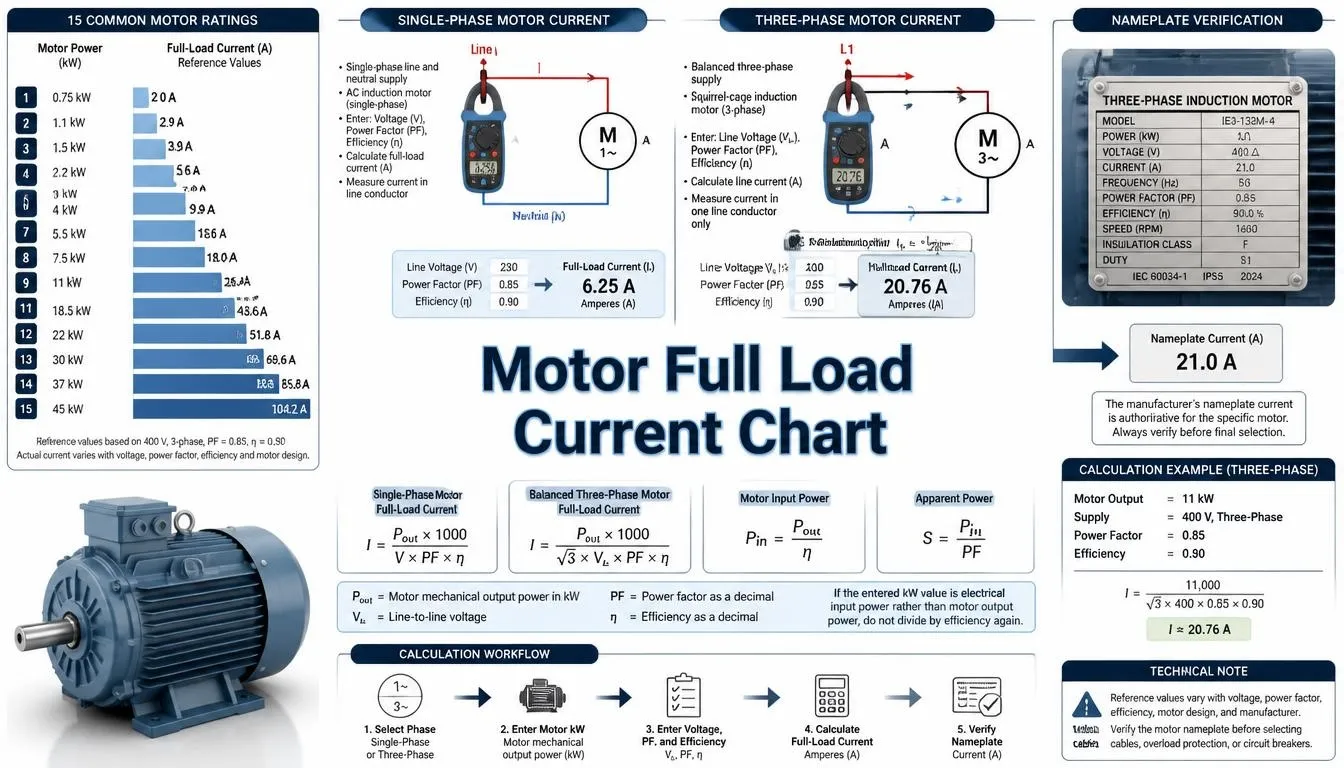
Three-Phase Motor Full Load Current Formula
You can estimate the full-load line current of a balanced three-phase motor using its rated output power, supply voltage, power factor, and efficiency.
I = Pout / (√3 × V × PF × η)
- I: Estimated motor line current in amperes (A)
- Pout: Rated mechanical output power in watts (W)
- V: Line-to-line voltage in volts (V)
- PF: Motor power factor as a decimal
- η: Motor efficiency as a decimal
- √3: Approximately 1.732
When the motor rating is expressed in kilowatts, multiply it by 1000 to convert it into watts before calculating current.
Motor Full Load Current Chart at 415 V
The Motor Full Load Current Chart below provides estimated running currents for 15 common motor ratings. All calculations assume 415 V, 0.85 power factor, and 90% efficiency.
These fixed assumptions are intended for comparison only. Smaller motors may have significantly different efficiency and power factor values, so actual rated currents can vary.
| Motor Output | Voltage | Power Factor | Efficiency | Calculated Current |
|---|---|---|---|---|
| 0.75 kW | 415 V | 0.85 | 90% | 1.36 A |
| 1.5 kW | 415 V | 0.85 | 90% | 2.73 A |
| 2.2 kW | 415 V | 0.85 | 90% | 4.00 A |
| 4 kW | 415 V | 0.85 | 90% | 7.27 A |
| 5.5 kW | 415 V | 0.85 | 90% | 10.00 A |
| 7.5 kW | 415 V | 0.85 | 90% | 13.64 A |
| 11 kW | 415 V | 0.85 | 90% | 20.00 A |
| 15 kW | 415 V | 0.85 | 90% | 27.28 A |
| 18.5 kW | 415 V | 0.85 | 90% | 33.64 A |
| 22 kW | 415 V | 0.85 | 90% | 40.01 A |
| 30 kW | 415 V | 0.85 | 90% | 54.56 A |
| 37 kW | 415 V | 0.85 | 90% | 67.29 A |
| 45 kW | 415 V | 0.85 | 90% | 81.84 A |
| 55 kW | 415 V | 0.85 | 90% | 100.02 A |
| 75 kW | 415 V | 0.85 | 90% | 136.39 A |
Worked Example: 11 kW Three-Phase Motor
To understand how the Motor Full Load Current Chart is calculated, consider an 11 kW three-phase induction motor with the following specifications:
- Motor output power: 11 kW
- Supply voltage: 415 V
- Power factor: 0.85
- Motor efficiency: 90%
Step 1: Convert kW to Watts
11 × 1000 = 11,000 W
Step 2: Apply the Formula
I = 11,000 / (1.732 × 415 × 0.85 × 0.90)
Step 3: Calculate Current
I ≈ 20.00 A
400 V vs 415 V Motor Full Load Current
Supply voltage affects the estimated current. For the same rated mechanical output, power factor, and efficiency, a lower voltage produces a higher calculated current.
For example, an 11 kW motor using the same assumptions gives:
- 400 V: Approximately 20.75 A
- 415 V: Approximately 20.00 A
These values illustrate the calculation relationship. Actual motor current depends on the rated voltage, operating conditions, and motor characteristics.
Why Motor Nameplate Current Can Be Different
The Motor Full Load Current Chart uses fixed assumptions, but real motors have different electrical characteristics. Two motors with the same kW rating may have different rated currents.
Important factors include:
- Motor efficiency class and construction
- Power factor at rated operating conditions
- Rated voltage and supply frequency
- Motor speed and number of poles
- Motor loading and operating duty
- Manufacturer design and tolerances
- Motor rewinding and repair history
Always compare calculated current with the actual motor nameplate before selecting electrical equipment.
Motor Starting Current vs Full-Load Current
Starting current is different from normal full-load running current. A direct-on-line induction motor may draw several times its rated current during starting.
Common starting methods include:
- Direct-on-line (DOL) starter
- Star-delta starter
- Soft starter
- Autotransformer starter
- Variable-frequency drive (VFD)
Each starting method changes the current profile and acceleration characteristics. Motor protection and voltage-drop calculations must consider the selected starting method.
How to Use the Motor Full Load Current Chart Safely
The Motor Full Load Current Chart is useful for preliminary electrical calculations and maintenance planning. However, it should not replace detailed motor-circuit design.
- Check the motor nameplate voltage, current, frequency, power factor, efficiency, and duty.
- Confirm the actual supply voltage and motor starting method.
- Estimate conductor requirements using the Cable Size Calculator.
- Check the cable route using the Voltage Drop Calculator.
- Apply the required installation, temperature, and cable grouping correction factors.
- Select contactors and overload relays according to the appropriate utilization category and manufacturer instructions.
- Verify short-circuit protection, breaking capacity, and equipment coordination.
Technical References and Manufacturer Guidance
For additional motor-circuit protection and equipment selection information, consult reputable manufacturer documentation.
- Schneider Electric Motor Circuit Protection FAQ – Manufacturer guidance related to motor-circuit protection.
- Schneider Electric Industrial Automation and Control – Product and technical information for industrial automation and motor-control equipment.
These references supplement the Motor Full Load Current Chart. Always follow the electrical standards applicable to your installation and the exact equipment manufacturer’s instructions.
Frequently Asked Questions
Is this Motor Full Load Current Chart valid for every 415 V motor?
Can I select an overload relay directly from this chart?
What is the single-phase motor current formula?
Why is current different at 400 V and 415 V?
Does the chart include motor starting current?
Why does motor efficiency affect full-load current?
Related Tech Volt Lab Resources
Final Thoughts
The Motor Full Load Current Chart provides a useful starting point for estimating three-phase motor current at 415 V. It covers 15 common motor power ratings from 0.75 kW to 75 kW, with calculated current values, a three-phase current formula, and a worked example to help technicians and engineers understand the relationship between motor output power and electrical current.
For final electrical design, always verify the motor nameplate, manufacturer documentation, applicable electrical standards, and actual installation conditions.
Educational Disclaimer: This article is intended for educational purposes and preliminary engineering calculations. Motor protection, cable sizing, and electrical installation decisions must be verified by a qualified electrical professional.